Ohio’s Free Fishing Days
Every June, I hear the same story from friends who have not wet a line in years: they want to try fishing again, but buying a license for a single afternoon feels like a gamble. Ohio’s Free Fishing Days solve exactly that problem. This guide explains who qualifies, which waters are open, what rules still apply, and how to plan a weekend that actually produces fish.
What Ohio’s Free Fishing Days Actually Are
Once a year, the Ohio Department of Natural Resources Division of Wildlife sets aside a weekend when Ohio residents can fish public waters without buying a fishing license. The idea is simple. The state wants new anglers, lapsed anglers, and families to try the sport without paying up front, in the hope that a good day on the water turns into a lifelong habit. In practice, it is one of the best-attended fishing weekends of the year, and it is the weekend I point beginners toward more than any other.
How the Free Weekend Works
On the designated Saturday and Sunday, an Ohio resident age 16 or older can legally fish without carrying a valid fishing license. That is the only thing the weekend changes. You do not need to register, sign up online, or print anything. You simply show up at a public lake, river, pond, or the Lake Erie shoreline and start fishing, just as a licensed angler would.
What surprises many people is how narrow the exemption is. The free weekend removes the license requirement and nothing else. Daily bag limits, minimum length limits, the number of lines you can use, closed areas, and gear restrictions remain fully in force. If you want a deeper look at which part of the rulebook is waived and which part is not, our piece Is Fishing Free in Ohio on Free Fishing Days? walks through the exact language.
I like to explain it to friends this way: the state is waiving the ticket at the gate, not the rules of the game. A wildlife officer can still check your catch, your cooler, and your rods, and the penalties for breaking a size or bag limit are the same on the free weekend as on any other day of the year.
When the Free Days Usually Fall
Ohio has traditionally scheduled its free fishing weekend in June, usually a Saturday and Sunday in the middle or second half of the month. That timing is no accident. By mid-June, school is out, water temperatures have climbed into the comfortable range for bluegill, bass, and catfish, and the spring spawn has wrapped up for most panfish species. The bite tends to be steady, and the weather is usually friendly enough for kids and first-timers.
The exact dates move from year to year, so I never assume they match last season. ODNR announces the weekend each spring, and it also appears in the annual fishing regulations summary. Our explainer on When Ohio’s Free Fishing Days Fall Each Year covers how the weekend is typically chosen and how to confirm the dates before you load the car.
One practical tip: the free weekend often overlaps with Father’s Day weekend or sits right beside it. That makes it a popular family outing, which means public piers, state park shorelines, and easy bank access spots fill up early. If you want elbow room, plan to arrive at first light.
Who Is Eligible and Who Is Not
The free weekend is aimed at Ohio residents. If you live in Ohio, you qualify regardless of age, experience, or whether you held a license last year. Nonresidents visiting from Pennsylvania, Michigan, Indiana, Kentucky, or West Virginia are a different story, and they should not assume the exemption covers them. Visitors who want to fish that weekend should plan to buy a short-term license; our guide to Ohio Nonresident One-Day Fishing License Cost explains that option.
Kids are a separate case altogether. Ohio does not require anglers under 16 to hold a fishing license at any time of the year, so the free weekend changes nothing for them. That is worth knowing because some parents mistakenly believe they must wait for the free days to take children fishing. You can take a young angler out on any day of the season. The details are laid out in Do Kids Need a Fishing License in Ohio?
Residency is defined by where you actually live, not where you happen to be fishing. If you recently moved to Ohio, have a temporary address, or are a college student from out of state, check how the state defines residency before counting on the free weekend.
What Still Applies on the Free Weekend
This is the section I wish every first-time angler would read before heading out. The single most common mistake I see on free fishing weekends is people assuming that free means unregulated. It does not. Wildlife officers know the free weekend brings out a crowd of inexperienced anglers, and many of them spend the weekend educating people at popular spots.
Bag Limits and Size Limits
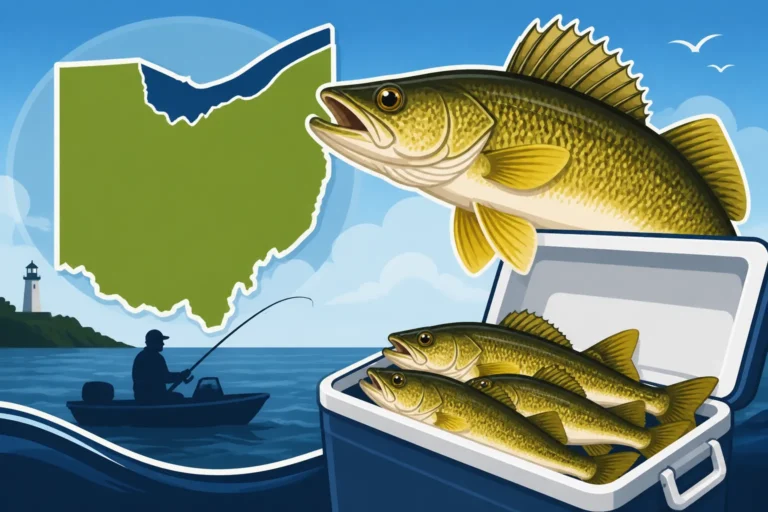
Every daily limit and every minimum length that applies during the regular season applies on the free days too. If a lake has a minimum length for walleye or saugeye, a short fish goes back in the water. If Lake Erie has a daily walleye limit or a zone-based yellow perch limit, that limit still counts. Black bass, muskie, catfish, crappie, and trout all keep their usual rules.
The trouble for beginners is that these rules vary by species and by water body. A bass you can keep on one reservoir may need to go back on another lake with a special regulation. Before you go, skim Ohio Statewide Bag and Size Limits for the baseline rules, then check whether the specific lake you are visiting has its own exceptions.
Here is a scenario I have watched play out more than once. A family catches a stringer of small crappie from a dock at a state park lake. They are thrilled, and rightly so. But the lake has a minimum length on crappie, and half of those fish are short. A wildlife officer walking the shoreline stops to chat, and what should have been a perfect day ends with an awkward conversation. A free measuring board or a cheap ruler taped to the cooler lid would have prevented the whole thing.
Line Limits and Gear Rules
Ohio limits how many lines an angler can fish at one time, and that limit does not relax on the free weekend. Many first-timers bring three or four rods and set them all out along a bank, which can put them over the limit. If you are not sure how many rods you can legally run, read Two-Pole and Line Limit Rules in Ohio before you pack.
Gear restrictions still apply as well. Snagging rules, restrictions on certain bait-collecting methods, and any special rules on stocked trout waters stay in effect. If you are fishing a stream or a tailwater with a special regulation, those signs at the access point are not suggestions.
Lake Erie and Border Waters
Lake Erie is open on the free weekend, and for many Ohio families it is the main attraction. Shore anglers on piers in Port Clinton, Sandusky, Huron, Vermilion, and Cleveland can fish for yellow perch, white bass, freshwater drum, and the occasional walleye without a license on those two days. Charter boats also see a busy weekend, although passengers on a licensed charter should still ask the captain how the free days affect their trip.
The Ohio River is a little more complicated because it forms a boundary with other states, and fishing rules there depend on where you are and which shore you fish from. Kentucky and West Virginia run their own free fishing events on their own schedules. If you plan to fish the Ohio River, read Special Fishing Rules on the Ohio River so you know which state’s rules apply where you are standing.
| Rule or requirement | Regular season | Free Fishing Days |
|---|---|---|
| Fishing license for residents 16 and older | Required | Not required |
| Fishing license for nonresidents | Required | Still required |
| Fishing license for anglers under 16 | Not required | Not required |
| Daily bag limits | Apply | Apply |
| Minimum length limits | Apply | Apply |
| Line and rod limits | Apply | Apply |
| Special lake and stream regulations | Apply | Apply |
| State park parking and facility rules | Apply | Apply |
| Private pond permission from the owner | Required | Required |
Where to Fish During Ohio’s Free Fishing Days
The free weekend is only as good as the spot you choose. Because so many beginners are out, I recommend picking places with easy access, decent restroom options, and a realistic chance of catching something within the first hour. Nothing kills a new angler’s enthusiasm faster than three hours without a bite.
Family-Friendly Lakes and State Parks
Ohio’s state park lakes are ideal for the free weekend. Many have fishing piers, paved shoreline paths, and bluegill and crappie populations that bite readily in June. Lakes such as Caesar Creek, Deer Creek, Delaware, Buckeye, and Indian Lake all offer easy shoreline access and a chance at a variety of species. Smaller wildlife area ponds are also worth a look because they are often quieter.
If you are fishing in or near a state park, remember that park rules about parking areas, hours, and where you can fish remain in force. For a quick rundown on park-specific restrictions, see Ohio State Park Fishing Rules.
For families looking for the easiest possible day, I suggest finding a pier or a stretch of riprap near a parking lot, setting up with simple bobber rigs and worms, and letting the kids reel in bluegill. You can find more ideas in Best Ohio Fishing Spots for Families, which covers locations with good facilities and reliable action.
Lake Erie Piers and Shoreline
For anglers in northern Ohio, the free weekend is a perfect excuse to try Lake Erie from shore. In June, yellow perch, white bass, and freshwater drum are commonly caught from piers and breakwalls, and smallmouth bass can show up along rocky shorelines. Walleye are more often caught by boat at that time of year, but shore anglers do land them, especially early and late in the day.
Pier fishing is also a social affair. You will likely be shoulder to shoulder with experienced locals, and most of them are happy to share what is working. I have learned more about perch rigs from an hour on a Lake Erie pier than from any book. Just be courteous, give people room to cast, and do not set up directly in someone else’s lane.
If you want to plan a Lake Erie outing around the free days, look for a pier with nearby parking and restrooms, and arrive early, because the best railings fill up fast.
Rivers, Streams and Metroparks
Ohio’s rivers offer a different kind of experience. The Great Miami, Scioto, Muskingum, and Maumee rivers all hold smallmouth bass, catfish, and a mix of other species. Wading a shallow riffle for smallmouth on a June morning is one of my favorite ways to spend a free fishing day, and it costs nothing except gas and a few lures.
City and county parks deserve a special mention. Many metropark systems around Columbus, Cleveland, Cincinnati, Dayton, and Toledo maintain ponds and lakes with good access. Some metropark districts have their own rules, including occasional permit requirements on specific waters, and the free weekend does not override a park district’s own policies. Check the posted rules at the park before you cast.
Private ponds are another frequent question. The free weekend covers public waters only in the sense that the license requirement is lifted. It does not give anyone permission to fish private property. If you want to fish a neighbor’s pond, you still need the landowner’s permission, every time.
How to Plan a Successful Free Fishing Weekend
A little planning goes a long way, especially if you are bringing children or friends who have never fished before. The goal is to make the day simple, comfortable, and productive.
Gear for Beginners
You do not need much. A basic spinning rod and reel combination, a small selection of hooks, some split shot sinkers, a few bobbers, and live bait like nightcrawlers or wax worms will catch fish on almost any Ohio lake in June. If you do not own any gear, a shopping trip to a local tackle shop or a sporting goods store will get you outfitted for a reasonable sum. Many families also order starter kits from Amazon a week or two before the free weekend, which saves time and lets you practice tying knots in the backyard before the big day.
If you want to go a step further, consider a few small extras that make the day easier: a pair of needle-nose pliers for removing hooks, a small cooler with ice for any fish you plan to keep, a bucket for bait, a towel, and a measuring tape. A small tackle box with preset rigs can be found on Amazon for less than the cost of a family lunch, and it keeps kids from tangling everything in the first ten minutes.
| Item | Why it helps | Budget tip |
|---|---|---|
| Spinning rod and reel combo | Easy for beginners to cast and reel | A basic combo is plenty for panfish and bass |
| Small hooks and split shot | Matches bluegill and crappie mouths | Buy an assortment pack |
| Bobbers | Shows bites clearly to new anglers | Bright colors are easier for kids to watch |
| Live bait | Catches nearly everything in June | Nightcrawlers and wax worms work well |
| Needle-nose pliers | Safe hook removal | A cheap pair is fine |
| Measuring tape or board | Keeps you legal on size limits | Tape one to your cooler lid |
| Sunscreen, hat, water | Keeps the day comfortable | Bring more water than you think you need |
Planning the Day Step by Step
Here is the routine I follow when taking first-timers out on a free fishing weekend:
- Confirm the free fishing dates for the year and check the weather forecast a few days ahead.
- Choose a lake, pond, or pier with easy access, restrooms, and parking close to the water.
- Look up the size and bag limits for the specific water you plan to fish.
- Pack simple tackle, bait, a measuring device, pliers, and a small cooler.
- Arrive early in the morning, before the heat and the crowds.
- Start with bobber rigs and live bait for bluegill and crappie to get early action.
- Switch to lures or bigger baits for bass or catfish once the kids have caught a few fish.
- Keep only what you plan to eat, and release the rest gently.
- Clean up your spot and take all trash and line home with you.
Handling Crowds and Etiquette
Free fishing weekends attract big crowds, and good manners make a huge difference. Give other anglers room to cast. Avoid walking behind someone who is casting. Do not crowd a spot where someone is already catching fish. Keep music low or off. And above all, never leave fishing line or hooks on the shore. Discarded line tangles birds and wildlife, and it is one of the most common complaints park staff report after busy weekends.
If you plan to keep fish, a sharp fillet knife and a sturdy cooler make the cleanup easier at home. Many anglers buy fish cleaning supplies from Amazon or a local outdoor store before the season so they are ready when the free weekend arrives. If you are not sure how to clean your catch, ask an experienced angler at the dock. Most are happy to show you.
After the Free Weekend: Making Fishing a Habit
The free weekend is meant to be a gateway. If you or your family enjoyed it, the next step is usually buying a regular license so you can keep fishing for the rest of the season.
Choosing the Right License
Ohio offers several license types for residents, including annual licenses, short-term options, multi-year options, and lifetime licenses. Seniors and some veterans may qualify for discounted options. If you are unsure which license fits your plans, start with Ohio Fishing License Types and Options, which compares the choices side by side.
For many people, the decision comes down to how often they plan to fish. If you only go out a few times a year, a one-day or annual license may make the most sense. If you know you will fish regularly for years to come, a multi-year or lifetime license can save money and hassle. The price differences and break-even points are covered in Ohio Resident Fishing License Cost.
Buying and Carrying Your License
You can buy an Ohio fishing license online, through the state’s licensing system, or in person at many sporting goods stores, bait shops, and other retailers. Buying online is quick and lets you print your license or keep a digital copy on your phone. For a step-by-step walkthrough, see How to Buy an Ohio Fishing License Online.
Once you have a license, keep it with you whenever you fish. If a wildlife officer asks to see it, you will need to show it. Many anglers keep a digital copy on their phone and a printed copy in their tackle box, just in case. Note the expiration date when you buy, and set a reminder on your phone so you can renew before it runs out.
Keeping the Momentum Going
If the free weekend sparked an interest, keep it going with small goals. Try a new lake each month. Learn to target a new species. Take a child or a friend who has never fished before. Join a local fishing club or follow your county’s fishing reports. The more you fish, the more you will learn, and the more fun it becomes.
For families especially, fishing can become a tradition. Many of my favorite memories are of early summer mornings on a quiet Ohio lake, watching a bobber and waiting for the next bite. The free weekend is a chance to start that tradition at no cost, and it is one of the best things Ohio does for anglers every year.
Disclaimer
This article is for general informational purposes only and does not constitute professional advice. Laws, prices and regulations vary by location and change over time. Consult a qualified professional for guidance on your specific situation.