Two-Pole and Line Limit Rules in Ohio
It's a question that trips up countless anglers, whether you're a seasoned veteran or just dipping your toes into Ohio's rich waters: "How many fishing poles can I actually use at once?" The rules aren't always crystal clear, and the last thing anyone wants is to unknowingly break a regulation and spoil a perfectly good day on the water. This comprehensive guide is here to untangle the confusion, walk you through Ohio's pole and line limits, and help you understand the nuances so you can fish confidently and legally.
Understanding Ohio's General Line Limit
Ohio's fishing regulations, while designed for conservation and fair angling, can sometimes feel like a maze. When it comes to the number of lines you can have in the water, there's a foundational rule that most anglers need to know.
The Statewide Standard: Two Poles, One Line Each
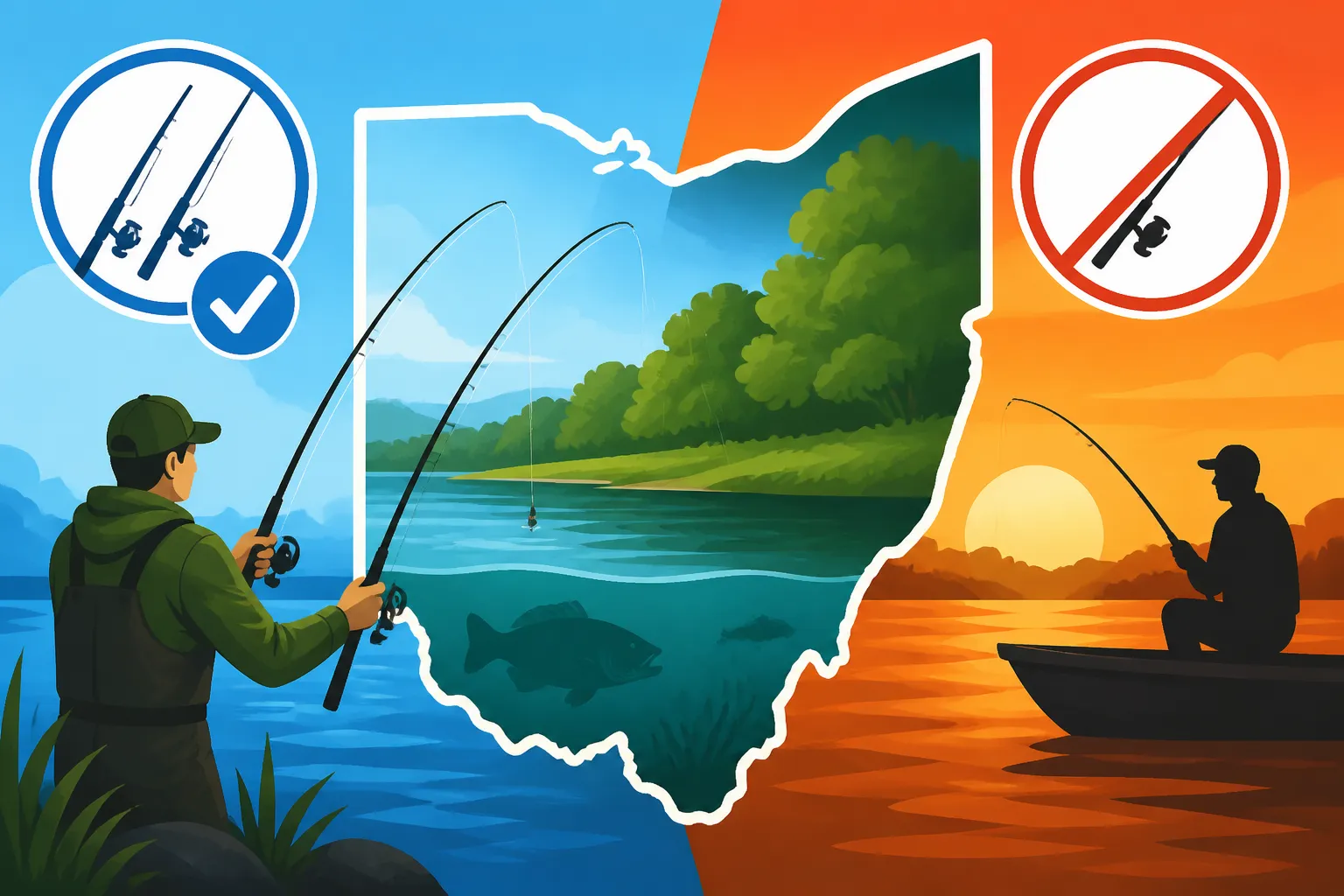
Across the vast majority of Ohio's inland lakes, reservoirs, and streams, the rule is pretty straightforward: you are allowed to fish with no more than two fishing poles. And here's the kicker – each of those poles can only have one single line attached. This means you can't, for example, have one rod with two separate lines running off it, even if you’re trying to cover more water. It's about the number of lines being actively deployed from a "pole," which is usually interpreted as a rod and reel setup or a simple cane pole.
Imagine you're out on Alum Creek Lake, enjoying a beautiful Saturday morning. You've got your favorite bass rod rigged up with a topwater lure, and you're actively casting and retrieving. If you then decide to set up a second rod with a bobber and live minnow, targeting some crappie, that's perfectly fine. You're using two poles, each with one line. However, if you then pulled out a third rod, even if it was just sitting in a rod holder while you sipped your coffee, you'd be over the limit. It’s a common pitfall, especially for those who might be used to different regulations in other states or even from their childhood fishing experiences. The Ohio Department of Natural Resources (ODNR) wants to ensure fair access and prevent anglers from monopolizing fishing spots with an excessive number of lines.
This rule applies whether you're fishing from the bank, a boat, or even a kayak. It's the standard default that applies almost everywhere you go in Ohio, and it's crucial for every angler to have a solid grasp of this basic principle to avoid any issues. For a deeper dive into the overall rules, check out our guide on Ohio Fishing Regulations Every Angler Should Know.
What Constitutes a "Line" or "Pole"?
It might seem like a silly question, but understanding what the ODNR considers a "line" or a "pole" is actually quite important. When the regulations talk about a "pole," they generally mean a device used to fish that has a line attached to it. This can be your fancy spinning rod and reel, a baitcasting setup, a simple cane pole, or even an ice fishing tip-up. Each of these counts as one "pole" that can deploy one "line."
Now, what about the "line" itself? A single line means just that: one continuous fishing line extending from your pole into the water. This line can have multiple hooks attached to it, as long as it's still considered a single line. For example, a crappie rig with two or three hooks on one main line is typically considered one "line" in the water, not multiple lines. The regulations focus on the number of distinct lines entering the water from separate fishing devices. However, it's vital to remember that while the number of hooks per line isn't usually restricted in Ohio's general two-pole rule, there might be specific situations or waters where hook limits do apply, so always cross-reference with the Ohio Statewide Bag and Size Limits if you're ever unsure. The primary concern with the two-pole rule is managing the overall footprint an angler has in the water, rather than the specific terminal tackle they're using on each individual line.
This distinction is important because some people might mistakenly think that if they put a sabiki rig with seven hooks on one rod, it counts as seven lines. That's not how it works in Ohio. It's one pole, one line, even if that line is adorned with multiple baits or lures designed to catch more than one fish at a time. This helps keep the enforcement simple and fair, focusing on the number of active fishing setups rather than the intricacies of each rig.
Special Exceptions to the Two-Pole Rule
While the two-pole, one-line-per-pole rule is the standard, Ohio, like many states, recognizes that different fishing scenarios might warrant different approaches. There are a couple of significant exceptions that every angler should be aware of, especially if you plan on participating in certain types of fishing.
Ice Fishing: A Different Ballgame
Ah, ice fishing! There’s something uniquely serene and yet exciting about huddling over a hole in the ice, waiting for that tell-tale tap. And here's where Ohio's line limits get a bit more generous. When you're out on the hard water, the regulations typically allow you to use up to six fishing devices simultaneously. That’s right, six! This is a stark contrast to the open-water two-pole rule and is a huge benefit for ice anglers who want to cover more ground and present various baits at different depths.
Why the difference? Well, ice fishing is inherently a more stationary pursuit. You're typically confined to a relatively small area, sitting or standing near your holes. The six-device limit acknowledges this and allows anglers to increase their chances of success without creating the same kind of spatial conflict that multiple lines would cause in open water. You could have two traditional ice fishing rods, three tip-ups spread out to detect bites from different angles, and maybe even a jigging spoon on another rod, all working for you. However, there's a critical caveat: you must be in immediate control of all your fishing devices. This means you can't just set up six tip-ups and wander off to the shanty down the lake for an hour. You need to be close enough to quickly respond to a bite on any of your lines.
This exception makes ice fishing incredibly productive and fun. Imagine you’re on Mosquito Creek Lake during the winter, hoping for some walleye. With six lines, you can spread out your offerings, perhaps using different baits like minnows on tip-ups and jigging spoons or small plastics on rods. It significantly increases your odds. Just be mindful of your proximity to other anglers; even with a six-line limit, courtesy and safety are paramount. If you're planning an ice fishing adventure, you'll definitely want to check out our detailed guide on Ice Fishing Rules on Ohio Lakes.
The Ohio River's Unique Regulations
The Ohio River is a beast of its own, a sprawling waterway that forms a significant portion of Ohio's southern border. And because it's a border water, shared with Kentucky and West Virginia, its fishing regulations often operate under different rules, sometimes through reciprocal agreements. When fishing the Ohio River, anglers are generally permitted to use up to three fishing poles or lines at one time.
This increase from the standard two lines to three is a nod to the unique challenges and opportunities presented by a large river system. The vastness of the river, its currents, and the diverse species it holds often make it beneficial to deploy an additional line. Anglers often target catfish, sauger, and hybrid striped bass in the Ohio River, and having an extra line can really boost your chances, especially when dealing with the strong currents that might carry your bait downstream. For instance, an angler might be using one rod with a heavy bottom rig for catfish, another with a lighter setup for sauger, and a third with a crankbait targeting a different depth or current seam.
The reciprocal agreements mean that if you possess a valid Ohio fishing license, you can generally fish the entire main stem of the Ohio River, including waters adjacent to Kentucky or West Virginia, provided you adhere to the most restrictive of the regulations between the states. However, for pole limits, Ohio often defers to a three-pole standard for its resident anglers on the river. It's always a good practice to verify the most current rules, as border water regulations can sometimes have intricate details. Knowing these special allowances is crucial for anyone planning a trip to this magnificent waterway. Our guide on Special Fishing Rules on the Ohio River provides even more in-depth information.
Practical Implications and Common Misconceptions
Understanding the letter of the law is one thing, but knowing how it plays out in real-world fishing scenarios and clearing up common misunderstandings can save you a lot of grief. Let's talk about some of the practical aspects of Ohio's pole and line limits.
Active vs. Passive Fishing: What's Allowed?
The regulations often imply a level of engagement from the angler, even when multiple lines are in use. While the rule specifically states the number of lines allowed, there's an unspoken expectation that those lines are being actively managed or at least closely monitored. This isn't usually codified as "active fishing" in the regulations, but the concept of "immediate control" for ice fishing, for example, points to this general philosophy. You can't just throw out two rods from the bank of Lake Erie and then wander off to make a phone call or take a nap. If a wildlife officer observes your lines unattended for an extended period, even if you are within the two-pole limit, it could potentially be seen as abandonment or an attempt to fish beyond reasonable control.
Think about it from a conservation and ethical standpoint. An unattended line can snag on debris, injure wildlife, or result in a lost fish if it gets hooked and is left to struggle. So, while you might be allowed two rods, it's generally good practice to keep them within sight and earshot, ready to respond to a bite or any issue that arises. This means setting up your rods in a way that allows you to easily grab them, perhaps using rod holders if you're fishing from a dock or bank, or keeping them close by in your boat. This isn’t just about avoiding a potential citation; it’s about responsible angling and showing respect for the environment and the fish you’re targeting.
Sharing Poles and Group Dynamics
This is a common question, especially for families or groups of friends heading out for a day of fishing: "If my buddy isn't using his second pole, can I use it?" Or, "My child is struggling with their rod, can I hold it for them while also using my two?" The answer is pretty clear: the pole limit applies per licensed angler. Each individual with a valid Ohio fishing license (or who is exempt from needing one, like very young children under specific conditions) is entitled to use their allotted number of lines.
So, if you and your friend both have valid licenses, you can each use two poles, for a total of four poles between you. However, you cannot legally use your friend's unused second pole to fish with a third line yourself. If your child, who might be exempt from needing a license, is fishing with one rod, that rod counts towards their permissible limit (which for kids is generally consistent with the adult limits for enforcement purposes, even if they don't hold a license themselves). If you are assisting a child, ensure that your total number of active lines, plus any lines the child is actively using, doesn't exceed the combined legal limit for the licensed anglers present. It can get a bit confusing, but the principle is individual responsibility. If you're fishing with minors, our guide on Ohio Youth Fishing License Rules might shed more light on who needs a license.
This rule emphasizes that the privilege of fishing with multiple lines is tied to the individual angler, not to the collective gear available on the boat or shore. It’s about ensuring that each person adheres to their own set of allowances, promoting fairness and preventing a single individual from effectively deploying a disproportionate number of lines under the guise of group fishing.
The "Tackle Box Full" Fallacy
Let's be honest, most of us anglers have more rods and reels than we really need. We collect them for different techniques, different species, or simply because a new model caught our eye (and maybe we found a great deal on Amazon!). It's easy to look at a tackle box brimming with gear and assume that because you own it, you can use it. But that's a classic "tackle box full" fallacy. Just because you possess multiple rods does not mean you are legally allowed to deploy them all simultaneously in the water.
This is a point of frustration for many, especially if they’ve invested in specialized gear. You might have a dedicated muskie rod, a lightweight panfish setup, a heavy catfish rig, and a finesse bass rod. It's great to have options, but you still have to pick and choose which two (or three, or six, depending on the scenario) you'll actually have in the water at any given moment. It’s a common scenario for anglers who are used to having every tool at their disposal. The temptation to rig up "just one more" can be strong, but it's important to resist and stick to the legal limit.
Remember, the regulations are there for a reason, primarily to manage the resource and ensure a fair and enjoyable experience for everyone. So, while that new rod you just got delivered from Amazon might be screaming to be put to use, remember the two-pole limit before you cast out. It's better to have two productive lines in the water than to risk a fine for having an illegal third. Knowing your Ohio Fishing Season Calendar can help you plan which two rods are best for the time of year and target species.
Why These Regulations Exist
Regulations, especially those that limit how we can enjoy our hobbies, can sometimes feel restrictive. But when it comes to fishing, there are very good reasons behind rules like the two-pole limit. They aren't just arbitrary lines in the sand; they're carefully considered measures aimed at maintaining healthy ecosystems and ensuring the longevity of our beloved sport.
Conservation and Resource Management
At its core, the two-pole and line limit in Ohio is a crucial tool for conservation and resource management. Imagine a scenario where every angler could deploy an unlimited number of lines. The sheer volume of hooks in the water would dramatically increase the pressure on fish populations. This could lead to overfishing, depletion of specific species, and ultimately, a decline in the overall health of Ohio's aquatic ecosystems.
By limiting the number of lines, the ODNR helps to control the total catch potential, allowing fish populations to sustain themselves and reproduce effectively. It's a balance: providing ample opportunity for anglers to enjoy their sport while simultaneously safeguarding the future of the fish. This is particularly important for species that are highly sought after or have slower reproductive rates. The regulations also contribute to ensuring that there's enough fish for everyone, not just those who can afford or manage the most gear. This helps distribute the resource more equitably among all license holders. Without these limits, the vibrant fisheries we enjoy today, from the walleye of Lake Erie to the bass in our inland reservoirs, could quickly become a distant memory. It's a small trade-off for the greater good of Ohio's natural heritage.
Safety and Fair Play Among Anglers
Beyond conservation, the line limits also play a significant role in promoting safety and fair play among anglers. Picture a crowded fishing pier on a busy summer day. If everyone had five or six lines out, imagine the chaos: tangled lines, arguments over fishing spots, and potentially dangerous situations with hooks flying everywhere. The two-pole limit (or three on the Ohio River, or six for ice fishing, acknowledging different spatial needs) minimizes these conflicts.
It helps to ensure that no single angler can dominate a prime fishing spot with an excessive spread of lines, effectively boxing out other enthusiasts. This is particularly important in popular areas like public docks, riverbanks, or smaller lake coves where space can be at a premium. By standardizing the number of lines, everyone has a more equal chance to access the fish and enjoy their time without constantly worrying about their lines getting crossed with a neighbor's. It fosters a more respectful and cooperative environment on the water, reducing frustration and making fishing a more pleasant experience for all. Ultimately, these rules are about creating a shared recreational space where everyone can safely and fairly pursue their passion for fishing. They are a foundational element of what makes our public waters accessible and enjoyable for the entire angling community.
How to Stay Compliant and Avoid Fines
Nobody wants their fishing trip ruined by a run-in with a wildlife officer, especially when it's over a misunderstanding of the rules. Staying compliant with Ohio's two-pole and line limit (or its exceptions) is crucial for a stress-free day on the water.
Always Consult the Latest Regulations
The single most important piece of advice for staying compliant is this: always consult the latest Ohio fishing regulations digest. Rules can and do change. What was permissible last year might have been updated for the current season, especially regarding specific waters or methods. The Ohio Department of Natural Resources (ODNR) publishes a new fishing regulations booklet annually, usually available online as a PDF and in print at bait shops, sporting goods stores, and ODNR offices. This booklet is your ultimate authority.
Don't rely solely on what you think you remember, or what a friend told you, or even what you read on a forum. Take a few minutes before each fishing season, or before visiting a new body of water, to quickly review the relevant sections. This will ensure you're up-to-date on not just line limits, but also bag limits, size restrictions, and any special regulations for particular lakes or rivers. It’s your responsibility as a licensed angler to know and follow these rules. Ignoring them can lead to significant penalties. For comprehensive information on acquiring your license, refer to our Ohio Fishing License Guide for Residents and Nonresidents. You can also find out Where to Find the Ohio Fishing Regulations Booklet online.
Monitoring Your Lines Effectively
Even when you're within the legal limit for lines, effective monitoring is key to responsible angling and avoiding potential issues. As discussed, there’s an implied expectation that you are in control of your gear. If you’re fishing with two poles, keep them close enough that you can see both of them and react quickly if a fish bites or if a line gets tangled.
For bank anglers, this might mean positioning your rods in rod holders right next to your chair. For boaters, it means keeping your extra rod within arm’s reach or in a mounted holder where it's easily visible. Don't set a rod in one spot and then wander a hundred yards down the bank. Not only is this discourteous to other anglers, but it also creates a situation where you can’t properly manage your line. Imagine trying to land a fish from that distance or untangle a snag! Many anglers use bells on their rod tips or electronic bite alarms to help monitor a second pole, which is a great strategy. These simple tools, often found affordably on Amazon, allow you to be alerted instantly to activity on your unattended line, allowing you to quickly grab it and engage. This approach demonstrates responsible angling and shows respect for the fish, the environment, and fellow anglers. It’s also crucial for practicing proper catch-and-release techniques if that’s your intention, as a fish left on the line for too long can become exhausted or injured. Remember, a good angler is always a mindful one. If you're new to fishing, learning some Best Ohio Fishing Techniques for Beginners can help you manage your lines more effectively.
Here's a quick reference table for Ohio's pole and line limits:
| Fishing Scenario | Number of Poles/Lines Allowed | Key Considerations |
|---|---|---|
| General Inland Waters | 2 | Each pole must have only one line. |
| Ice Fishing | 6 | Must be in immediate control of all devices. |
| Ohio River | 3 | Applies to the main stem, typically via reciprocity. |
| Private Ponds (Non-Com.) | 2 (Generally)* | *Unless owner-operated, state rules apply if public has access. Check with landowner. |
Note: Fishing a private pond where you are the owner and it is not open to the public often has exemptions from state licensing rules, but generally adheres to conservation principles if stocked by the state or connected to public waters. It's always best to clarify with the landowner if you're not the owner. Our article on Do You Need a License to Fish a Private Pond in Ohio? goes into more detail.
Disclaimer
The information provided in this guide is for general informational purposes only and is subject to change. While we strive to offer accurate and up-to-date content, fishing regulations can be complex and are regularly updated by the Ohio Department of Natural Resources (ODNR). It is the sole responsibility of each angler to consult the official, current Ohio Fishing Regulations published by the ODNR before engaging in any fishing activity. Reliance on any information provided here is at your own risk.