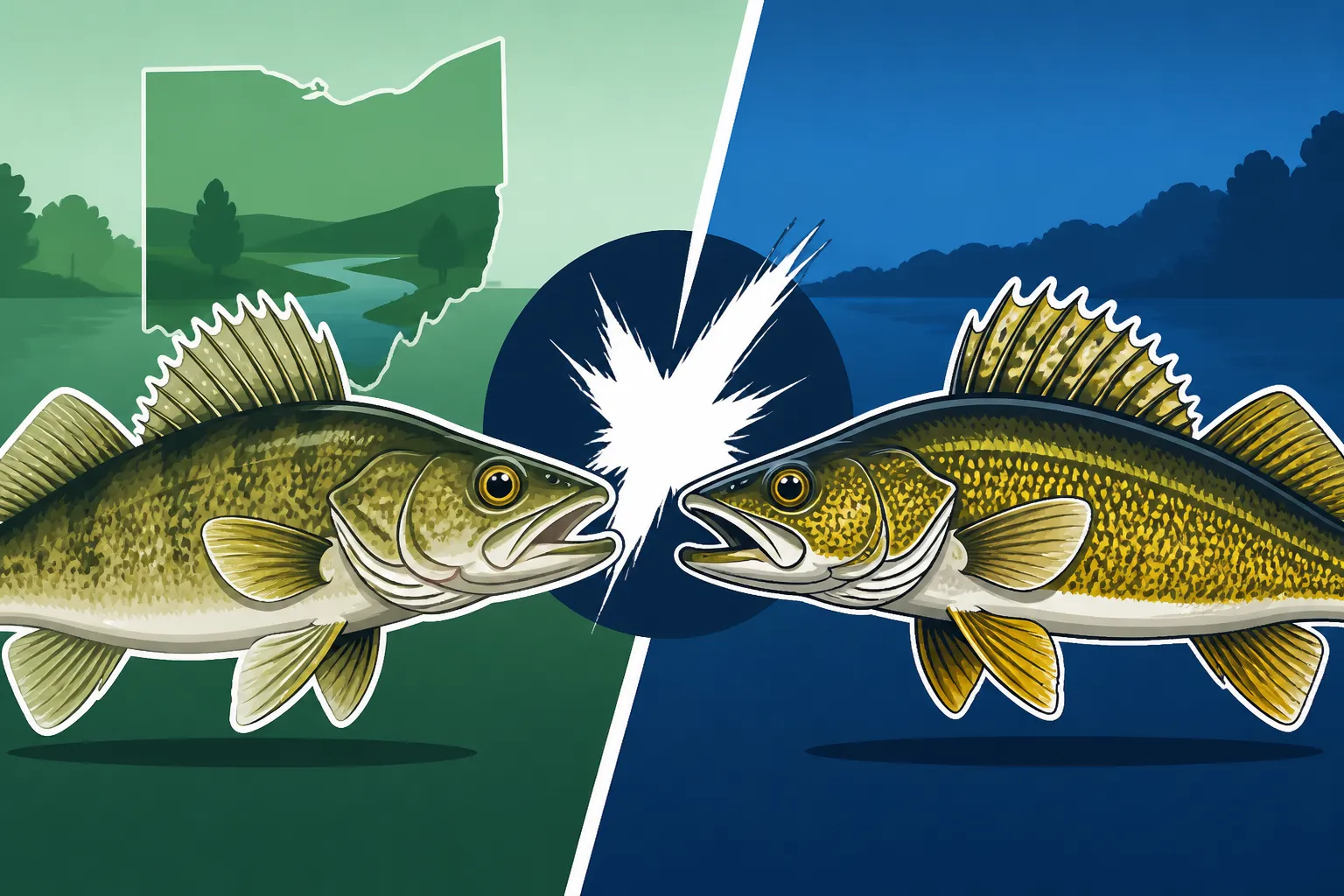
Saugeye vs Walleye Identification
If you've spent any time fishing Ohio's bountiful waters, especially our incredible inland reservoirs or the mighty Lake Erie, you've likely come across fish that make you pause and scratch your head. Is it a walleye, or is it a saugeye? This common confusion can really trip up even experienced anglers, not just because they look so similar, but because knowing the difference can be crucial for staying compliant with regulations. This guide is here to untangle that mystery, giving you the clear, practical identification tips you need to confidently tell these two fantastic game fish apart.
The Genetic Blueprint: What Makes Them Different?
Before we dive into the nitty-gritty of visual cues, it’s helpful to understand why these two fish are so similar in the first place. It all comes down to genetics and a little bit of human intervention aimed at enhancing our fishing opportunities. They’re both part of the Stizostedion genus, but their exact parentage is where the story really unfolds.
Walleye: The Purebred Northwoods Icon
Ah, the walleye! For many Ohio anglers, especially those drawn to the legendary waters of Lake Erie, the walleye is the ultimate prize. These fish are true icons of cooler, clearer waters, though they adapt well to various environments. Genetically, walleye (Sander vitreus) are a pure species. They’ve evolved naturally, developing distinct characteristics over millennia. In Ohio, you’ll find them thriving in Lake Erie, obviously, but also in many of our larger river systems that feed into the lake, and even in some inland lakes where conditions are favorable.
Their genetic purity means their appearance tends to be quite consistent across different populations, with some natural variation based on diet and habitat. They are known for their iridescent, golden-olive hue, large, reflective eyes adapted for low light conditions, and a generally streamlined body built for chasing down baitfish. When you catch a walleye, you're holding a fish whose lineage goes back through countless generations of natural selection, a true predator of the depths.
Saugeye: A Man-Made Hybrid Marvel
Now, let's talk about the saugeye (Sander vitreus x Sander canadensis). The "x" in that scientific name is your first big clue – it signifies a hybrid. A saugeye is a cross between a female walleye and a male sauger. That's right, these fish don't occur naturally in the wild; they are specifically bred in hatcheries and then stocked into public waters. Why create such a fish? Well, saugeye offer the best of both worlds, inheriting desirable traits from each parent. From the walleye, they get their faster growth rate and larger size potential. From the sauger, they gain a greater tolerance for warmer, more turbid waters, and a tendency to survive better in lakes and reservoirs that might not be ideal for pure walleye.
Ohio has an incredibly active saugeye stocking program, particularly in our inland reservoirs. Places like Alum Creek Lake, Hoover Reservoir, and Caesar Creek Lake are well-known for their fantastic saugeye fishing. This means if you're fishing away from Lake Erie, especially in a man-made impoundment, there's a very good chance your catch could be a saugeye. They're designed to thrive where walleye might struggle, providing exciting fishing opportunities closer to home for many Ohioans. You can learn more about these great fish in our Ohio Saugeye Fishing Guide.
Key Visual Cues for Identification
Alright, let's get down to brass tacks. When you pull a fish out of the water, and you're wondering if it's a walleye or a saugeye, these are the visual features you absolutely need to inspect. It's often a combination of these clues that will give you the definitive answer.
Dorsal Fin Distinctions
This is arguably the most reliable and often the easiest characteristic to spot. Both walleye and saugeye have two dorsal fins – a spiny front one and a soft-rayed back one. The front, spiny dorsal fin is where you need to focus your attention.
On a true walleye, you will almost always find a very distinct, dark, dusky spot near the rear base of the spiny dorsal fin. It's usually a pronounced black or dark brown mark, sometimes a little diffuse, but definitely there. Think of it as a signature thumbprint. This spot is a hallmark of the species and is rarely absent or ambiguous. When you're trying to ID, turn the fish so you can clearly see this fin. If that dark spot jumps out at you, you're very likely looking at a walleye.
With a saugeye, this prominent dark spot is typically absent. Instead, the spiny dorsal fin on a saugeye will usually have distinct, dark bars or blotches that run vertically across the membrane and rays. These markings are more like stripes or mottling, giving the fin a somewhat speckled or banded appearance, rather than a single, concentrated dark spot. This is a direct inheritance from their sauger parent, as saugers are known for these very distinct dorsal fin markings. Sometimes, the markings on a saugeye might be subtle, but they are usually present as bars or mottles, never that clean, singular walleye spot. It might be helpful to grab a fishing identification book from Amazon to quickly reference these features on the water.
Body Markings and Coloration
While less definitive than the dorsal fin, the overall body coloration and markings can offer strong supporting evidence. These can vary based on water clarity, diet, and even the time of year, but general patterns hold true.
Walleye tend to have a more uniform, often golden to olive-brown color on their backs and sides, fading to a creamy white belly. They might have some subtle darker mottling or bars, but these are usually not sharply defined. Their flanks often have a beautiful, almost metallic sheen. In clear Lake Erie waters, their colors can be quite vibrant, while in darker, stained waters, they might appear a bit duller. The key here is the general lack of bold, distinct patterns along their main body.
Saugeye, on the other hand, often display more pronounced, irregular dark blotches or saddle-like markings along their sides. These patterns are typically more distinct than those on a walleye and are another trait inherited from their sauger ancestry. Their overall body color can also be a bit more mottled or "muddy" looking, reflecting the darker, turbid water environments they often inhabit. If you see clear, irregular blotches along the side of the fish, rather than just subtle shading, it's a strong indicator you might have a saugeye. This can be especially noticeable on fish from our inland reservoirs where water clarity varies more.
Tail Fin and Pectoral Fin Features
Don't overlook the fins beyond the dorsal! The caudal (tail) fin and the pectoral fins also offer helpful clues, though they require a closer look.
The walleye's caudal fin has a very characteristic white tip on its lower lobe. This white tip is usually quite distinct and contrasting, almost like it's been dipped in white paint. It's another excellent identifier, and for many anglers, it’s the second thing they check after the dorsal fin spot. This feature is very consistent among walleye.
For a saugeye, this white tip on the lower caudal fin lobe is often either completely absent or much less distinct. If it's there, it might be a faint, dusky white, or broken up by other markings, rather than the clean, bright white you see on a walleye. Additionally, saugeye often show rows of small, distinct spots on their other fins, including the soft dorsal, caudal, and sometimes pectoral fins. These spots are also a sauger trait. While walleye fins can have some spotting, it's generally less organized and prominent than what you'd see on a saugeye.
It can be a game of subtle differences, so take your time examining all the fins. Sometimes, if I'm really unsure, I'll even gently spread the fins to get a better look at the patterns.
Other Important but Less Obvious Clues
Beyond the primary visual identifiers, there are a couple of other, more subtle anatomical features that can help cement your identification. These might require a closer inspection or a bit more experience, but they contribute to the overall picture.
Cheek Scales and Eye Shape
This one is a classic for distinguishing sauger from walleye, and since saugeye are half-sauger, it's a great clue for them too. Pay attention to the scales on the fish’s cheek, which is the area behind and below its eye.
A pure walleye typically has fully scaled cheeks. If you run your finger lightly over the cheek area, it will feel rough and covered in scales all the way down to the preopercle (the bone forming the back and bottom margin of the cheek). This is a pretty consistent feature across walleye populations.
Saugeye (and sauger) often have cheeks that are partially scaled or even mostly scaleless. This means if you feel their cheek, you might find a patch of smooth, unscaled skin, or scales only on the upper portion, leaving the lower part bare. This is a very reliable indicator when it's present. It's a small detail, but a consistent one, and if you can master identifying this, you're well on your way to being an expert. Sometimes a quick photo with your phone and zooming in can help, or a close-up picture from a good fishing camera that you can find on Amazon later.
Both species are known for their large, reflective "walleyes" (the tapetum lucidum), which helps them see in low light. So, while impressive, the eye shape or size itself isn't usually a differentiator between a walleye and a saugeye; it just tells you they’re part of that nocturnal hunting family.
Mouth and Tooth Structure
When it comes to their mouths and teeth, walleye and saugeye are quite similar, which makes sense given they are so closely related and share similar predatory diets. Both possess an impressive set of sharp, needle-like teeth, especially on their roof and along their jaws, perfectly designed for grasping slippery baitfish.
The overall head shape and mouth size are generally comparable between the two. You’ll notice that both have a fairly prominent, somewhat pointed snout. Because of these similarities, examining the mouth structure isn't usually the primary way to differentiate between a walleye and a saugeye. It's more useful for confirming you have a member of the perch family (Percidae) and ruling out other species that might superficially look similar but have very different mouthparts, like some of the suckers or carp.
Instead of focusing on the mouth, it’s better to circle back to those more distinctive markers like the dorsal fin and the tail fin. The consistency of these other features makes them far more reliable for telling your walleye from your saugeye when you're out on the water.
Why Accurate Identification Matters
You might be thinking, "What's the big deal if I mix them up? They're both great eating fish!" And you'd be right, they are both fantastic table fare. However, accurate identification goes beyond just curiosity; it has real implications for both conservation and legality in Ohio.
Following Ohio Regulations
The absolute biggest reason to know the difference between a walleye and a saugeye is to stay within Ohio's fishing regulations. It’s a common frustration to catch a beautiful fish, only to find out later you might have accidentally violated a rule. In many of Ohio’s inland waters, especially our stocked reservoirs, walleye and saugeye often have different minimum length limits and daily bag limits. For instance, a reservoir might have a higher minimum length for walleye, or a more restrictive bag limit for saugeye, or vice-versa.
Imagine you're out on a popular central Ohio reservoir, enjoying a fantastic day of fishing. You catch a few fish you think are walleye, and you carefully measure them, ensuring they meet the walleye length limit. You head home, proud of your catch, only to later show photos to a friend who points out that they were clearly saugeye, and you might have kept fish that were under the saugeye length limit for that specific body of water. This kind of mistake can unfortunately lead to fines and penalties if a wildlife officer checks your catch. Understanding Ohio Fishing Regulations Every Angler Should Know and Ohio Statewide Bag and Size Limits is paramount, and it starts with knowing what fish you've actually caught. Always double-check the current regulations for the specific lake or river you are fishing, as rules can vary significantly. You can find convenient, portable measuring tapes and rulers on Amazon that easily attach to your tackle box or boat.
Understanding Fish Behavior and Habitat
Beyond the legal aspect, correctly identifying your catch can significantly enhance your understanding of fish behavior and habitat. While walleye and saugeye share many characteristics, their preferred environments and subtle behavioral differences can influence how and where you fish for them.
Walleye, particularly those in Lake Erie, often prefer cooler, deeper, and sometimes clearer water, and are frequently targeted with different trolling or jigging techniques in open water or specific structures. They might school differently and respond to different forage in their native environments. Learning more about their habits can be found in our Ohio Walleye Fishing Guide.
Saugeye, due to their sauger parentage, are generally more tolerant of warmer, murkier waters, and are often found thriving in many of Ohio's man-made reservoirs and larger river systems. This means if you're consistently catching what you've now identified as saugeye in a particular spot, you'll start to learn that they prefer those specific conditions. This knowledge helps you refine your techniques, choose the right baits, and target areas where saugeye are most likely to be active. You might find that vertical jigging in reservoir channels works wonders for saugeye, while slower trolling with planer boards is the ticket for walleye in Lake Erie's open basins. Being able to discern between the two allows you to tailor your approach and become a more effective and knowledgeable angler. Check out Best Ohio Reservoirs for Walleye and Saugeye for ideas on where these hybrids thrive.
Saugeye vs. Walleye: Quick Comparison Table
To make things even clearer, here's a quick reference table summarizing the key identification points we've covered.
| Feature | Walleye | Saugeye (Walleye x Sauger Hybrid) |
|---|---|---|
| Spiny Dorsal Fin | Distinct dark spot at the rear base. | Distinct dark bars or blotches; no single spot. |
| Caudal (Tail) Fin | Prominent white tip on the lower lobe. | White tip usually absent or faint/indistinct. |
| Body Markings | Generally uniform golden-olive; subtle mottling. | More pronounced, irregular dark blotches/saddles. |
| Cheeks | Fully scaled. | Partially scaled or mostly scaleless. |
| Other Fins | Generally clear or minimal spotting. | Often has distinct rows of spots on other fins. |
| Preferred Habitat | Cooler, clearer waters (Lake Erie, large rivers). | Warmer, more turbid waters (inland reservoirs). |
| Origin | Pure, naturally occurring species. | Man-made hybrid, extensively stocked. |
Disclaimer
This article is for general informational purposes only and does not constitute professional advice. Laws, prices and regulations vary by location and change over time. Consult a qualified professional for guidance on your specific situation.