Difference Between a Carp and a Buffalo Fish
It’s a common scenario out on the water in Ohio: you reel in a big, powerful fish, and your buddy yells, “Is that a carp or a buffalo?!” You might find yourself scratching your head, because let’s be honest, these two species, while distinctly different, can look quite similar at first glance, especially to an untrained eye. This guide is here to clear up that confusion once and for all, helping you confidently identify your catch and understand why those differences matter to us Ohio anglers.
Visual and Physical Distinctions: Knowing What to Look For
The easiest way to tell a carp from a buffalo fish is often by looking closely at their mouths and body shapes. These are bottom-feeding fish, and their anatomy reflects how they find their food. While both can grow to impressive sizes and put up a fantastic fight, their physical features tell a very different story about their species.
Common Carp Features
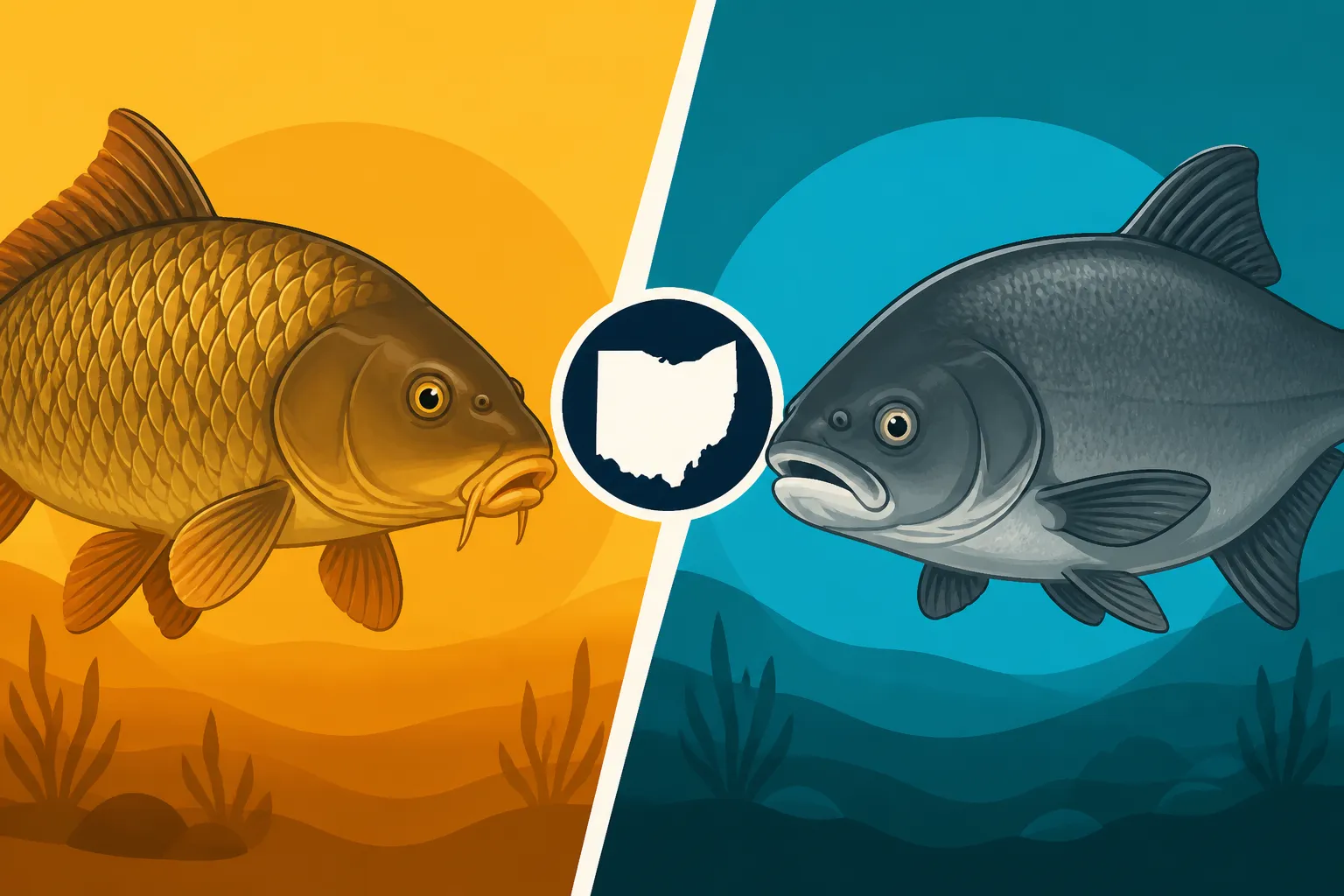
The common carp (often just called "carp" in Ohio) is an introduced species, and it’s become incredibly widespread across our state’s lakes, rivers, and even smaller ponds. When you look at a carp, one of the most striking features is its mouth. Common carp have a distinctive, protrusible mouth that points downwards, perfectly adapted for rooting around in the muck and silt at the bottom. But here's the kicker: they have barbels. These are whisker-like sensory organs, usually two pairs, found around their mouth. Think of them as little feelers that help them find food in murky water. Their scales are typically large and distinct, often appearing in rows, and their body shape is robust and football-like, sometimes a bit more elongated depending on the individual and its environment. You'll also notice a single, long dorsal fin that runs almost the entire length of their back, often with a serrated, spiny ray at the front. The coloration can vary from olive green to brownish-gold, sometimes with a yellowish belly. Ohio Carp Fishing and Identification provides a deeper dive into these fascinating fish.
Buffalo Fish Features
Now, when we talk about buffalo fish, we’re typically referring to three main species found in Ohio: the bigmouth buffalo, smallmouth buffalo, and occasionally the black buffalo. These are native North American species, and they are part of the sucker family, not the carp family. The most crucial difference is right there on their face: buffalo fish do not have barbels. Their mouths are also very different. A bigmouth buffalo, as the name suggests, has a large, wide mouth that opens forward and slightly upward, perfect for filter-feeding on plankton in the water column. The smallmouth buffalo has a smaller, subterminal (downward-pointing) mouth, but it’s still distinctly different from a carp’s, lacking those tell-tale whiskers. The black buffalo's mouth is similar to the smallmouth. All buffalo species have larger eyes relative to their head size compared to carp, and their bodies tend to be deeper and more compressed laterally (taller from back to belly, but flatter side-to-side) than the typically rounder common carp. Their scales are also large but can appear smoother and more uniform. Their dorsal fin is high and sickle-shaped, not long and flowing like a carp's, and it lacks the strong, serrated spine.
Here's a quick reference table to help visualize the key differences:
| Feature | Common Carp | Bigmouth Buffalo | Smallmouth Buffalo | Black Buffalo |
|---|---|---|---|---|
| Barbels | Present (2 pairs, whisker-like) | Absent | Absent | Absent |
| Mouth Position | Downward-pointing, protrusible, terminal | Forward-pointing, large, slightly upward | Downward-pointing, small, subterminal | Downward-pointing, large, subterminal |
| Body Shape | Robust, stout, somewhat rounded, football-like | Deep-bodied, compressed, often silvery | Deep-bodied, compressed, bronze/olive | Deep-bodied, compressed, dark/blackish |
| Dorsal Fin | Long, single fin, often with serrated spine | High, sickle-shaped, no spine | High, sickle-shaped, no spine | High, sickle-shaped, no spine |
| Scales | Large, distinct, often in rows | Large, uniform | Large, uniform | Large, uniform |
| Eyes | Smaller relative to head | Larger relative to head | Larger relative to head | Larger relative to head |
Habitat, Diet, and Behavior Differences
Beyond their looks, carp and buffalo fish occupy different niches in Ohio’s aquatic ecosystems, which influences where you might find them and what they’re eating. Understanding these ecological roles can also help you predict their behavior when you're out fishing.
Carp's Preferred Environments and Feeding Habits
Common carp are incredibly adaptable. They can thrive in a wide range of water conditions, from clear lakes to muddy rivers and even stagnant ponds. This adaptability is part of why they've spread so successfully throughout Ohio. They prefer warmer, slower-moving waters, often found in the shallower, muddier areas of reservoirs and streams. Their diet is incredibly varied, making them opportunistic omnivores. They primarily bottom-feed, using those barbels to detect food items like aquatic insects, larvae, crustaceans, and plant matter buried in the sediment. They'll also eat small fish and fish eggs. This rooting behavior can actually stir up sediments, which can sometimes impact water clarity and disrupt native aquatic vegetation. When you're fishing for carp, you'll often find them near weed beds or structures in calmer waters, actively searching for a meal. You can find detailed information on their biology and how to catch them in Ohio Carp Fishing and Identification.
Buffalo Fish's Ecological Role and Behavior
Buffalo fish, especially the bigmouth buffalo, are often called "freshwater filters." The bigmouth buffalo is a planktivore, meaning it primarily feeds on microscopic organisms (plankton) by filtering water through its gill rakers. This makes them beneficial to the ecosystem, as they help control plankton blooms and improve water quality. They tend to prefer open water environments in larger lakes and reservoirs, though they can also be found in slower river sections. Smallmouth and black buffalo are more benthic feeders, meaning they feed on invertebrates and plant matter found on or just below the bottom, similar to suckers, but without the carp's rooting intensity. They typically inhabit deeper pools and slower runs in rivers, and the open waters of large reservoirs. Unlike carp, which can be quite solitary or found in loose groups, buffalo fish often travel in large schools, especially the bigmouths as they filter feed. When you encounter a school of buffalo, it can be an exciting experience, as they can sometimes create large boils on the surface as they feed.
Fishing Implications and Ohio Angler Considerations
Knowing the difference isn’t just for bragging rights; it can impact your fishing strategy, what gear you choose, and how you approach regulations. Plus, some anglers prefer one species over the other for table fare or the fight.
Angling for Carp vs. Buffalo Fish
The distinct feeding habits of carp and buffalo fish lead to very different angling approaches. Common carp are notorious bait stealers, and they are often targeted by anglers using bottom rigs with dough balls, corn, or boilies. They have a powerful, sustained fight that makes them a favorite among many Ohio anglers. When you feel a strong, steady pull on your line and see those distinctive whiskers as it comes to the net, you’ll know you’ve got a carp. For gear, a sturdy rod and reel are a must, and many anglers enjoy the challenge of targeting them with specialized carp fishing equipment. You might even find some advanced carp fishing gear on platforms like Amazon.
Buffalo fish, on the other hand, are a bit more challenging to target intentionally, especially the bigmouth buffalo due to their plankton-filtering diet. They are most often caught incidentally by anglers targeting other bottom-feeding fish like catfish or by those using fine-tuned tactics like tiny jigs under a bobber or small pieces of bait on light line. Because smallmouth and black buffalo feed closer to the bottom, methods used for suckers or even channel catfish can sometimes entice them. Many anglers mistake them for catfish or even giant panfish when they reel them in. They can also put up a significant fight, especially big ones, often making powerful runs. If you're looking for Ohio Catfish Fishing Techniques or Best Baits for Ohio Catfish, you might find yourself hooking a buffalo by surprise!
Ohio Regulations and Management
Understanding which fish you’ve caught is also crucial for adhering to Ohio’s fishing regulations. While carp are generally considered an invasive species and have no size or bag limits in Ohio (meaning you can keep as many as you want, and any size), buffalo fish are native. Although they generally don't have strict statewide limits like game fish such as walleye or bass, it's always smart to double-check the current Ohio Fishing Regulations Every Angler Should Know or the Ohio Statewide Bag and Size Limits booklet, as regulations can change or be specific to certain bodies of water. For instance, while most "rough fish" don't have tight rules, responsible harvest is always encouraged. The distinction also plays a role in how fisheries managers view these species – carp management often focuses on control, while buffalo fish are considered part of the natural ecosystem. If you're unsure about the latest rules, a quick search on the Ohio Department of Natural Resources (ODNR) website is always a good idea before heading out. Don’t forget to make sure your Ohio Fishing License Guide for Residents and Nonresidents is up to date!
Practical Identification Tips for Anglers
When you're out on the boat or bank, you don't always have a field guide handy. Having a few quick checkpoints can make identification much faster and easier.
Quick Checkpoints on the Water
Imagine you've just landed a decent-sized, bronze-colored fish that's been pulling hard. First thing to look for: barbels. Can you see any whisker-like protrusions around its mouth? If yes, it's a carp. If no, it's a buffalo or perhaps a large sucker. Next, examine the mouth itself. Does it look like a round, sucking vacuum cleaner tube that extends downward, or is it more of a wide, forward-facing opening, or a smaller, subterminal mouth without the prominent "sucker" lips? Carp will have that distinct downward-pointing, protrusible mouth with barbels. Buffalo will lack barbels, and their mouth shape will either be large and terminal (bigmouth) or smaller and subterminal (smallmouth/black buffalo). Finally, glance at the dorsal fin. Is it long and flowing like a regal banner, often with a serrated ray? That's a carp. Is it high and sickle-shaped, like a shark's fin, without a spine? That points to a buffalo. These three quick checks—barbels, mouth, dorsal fin—will solve most of your carp vs. buffalo dilemmas right on the spot.
Gear for Identifying and Handling
While you might not need specialized gear just for identification, having a few key items on hand can make the process smoother and safer for both you and the fish. A good fish gripper can help you handle a strong, slippery fish without getting a barb or a fin spine in your hand. A wide-mouth landing net is also invaluable for safely bringing larger fish aboard, whether it's a carp or a buffalo. If you're serious about identifying fish and want to confirm your catches, a compact, waterproof fish identification guide that covers Ohio's freshwater species can be a great addition to your tackle box. You can often find excellent options for these on Amazon, from laminated cards to small, durable books. Also, consider a measuring tape and a portable scale if you enjoy recording your catches, as these can help you track your personal bests, no matter the species. After all, every catch is a story, and knowing exactly what kind of fish you've tangled with just adds to the narrative!
Disclaimer
This article is for general informational purposes only and does not constitute professional advice. Laws, prices and regulations vary by location and change over time. Consult a qualified professional for guidance on your specific situation.