Best Rod and Reel Setup for Ohio Muskie
Trying to land an Ohio muskie with an underpowered rod or a flimsy reel is a recipe for heartbreak and frustration. These apex predators are legendary for their brute strength, aggressive strikes, and explosive fights, often leaving anglers with snapped lines, bent hooks, and a story about "the one that got away." This comprehensive guide will walk you through everything you need to know to assemble the perfect rod and reel setup specifically designed to tackle Ohio's mighty muskie.
Understanding the Muskie Challenge in Ohio
Muskie, often called the "fish of 10,000 casts," aren't your average panfish. They are powerful, cunning, and have mouths full of razor-sharp teeth. Ohio's waters, from the vast expanses of Lake Erie to the serene depths of its inland reservoirs, hold some truly remarkable specimens, and being prepared for their ferocity is key to success.
Why Muskie Demand Specialized Gear
Imagine trying to wrangle a small alligator with a crappie rod. Sounds ridiculous, right? That's essentially what you're doing if you don't equip yourself properly for muskie. Their sheer size and power mean standard bass or walleye gear just won't cut it. A muskie can easily spool a smaller reel, snap a lighter rod, or chew through inadequate line. These fish require heavy-duty equipment built to withstand extreme stress. From the moment they strike your bait to the thrilling boat-side battle, every component of your tackle needs to be robust and reliable. This isn't just about landing the fish; it's about doing so efficiently and safely for both the angler and the muskie, especially when you consider the importance of proper handling and release.
The Thrill and Frustration of Muskie Fishing
Muskie fishing is an addiction for many, a pursuit defined by long hours of relentless casting, the anticipation of that explosive strike, and the sheer adrenaline rush when a true giant decides to play. It's not uncommon to fish for an entire day, or even several days, without a single bite. This can be incredibly frustrating, testing an angler's patience and resolve. However, the moment a muskie charges your lure, the rod buckles, and the drag screams, all those hours of toil instantly fade away. The fight is intense, often involving powerful head shakes, deep dives, and acrobatic jumps. This thrill is amplified when you know your gear is up to the task, giving you the confidence to battle these freshwater titans. Without the right setup, that hard-earned strike can quickly turn into a heartbreaking memory of a lost fish and damaged equipment. You'll find a lot of passionate advice in any good Ohio Muskie Fishing Guide about how to stay persistent.
Choosing the Right Muskie Rod for Ohio Waters
The muskie rod is your primary tool, the extension of your arm, and it needs to be powerful enough to cast large lures and strong enough to absorb the shock of a muskie's strike and fight. Choosing the right rod involves a careful balance of length, power, action, and handle design.
Rod Length Considerations
Muskie lures are often large and heavy, ranging from big bucktails and crankbaits to hefty jerkbaits and soft plastics. To effectively cast these baits long distances and generate the necessary leverage during a fight, you'll want a longer rod. Most dedicated muskie rods fall into the 7'6" to 9'6" range.
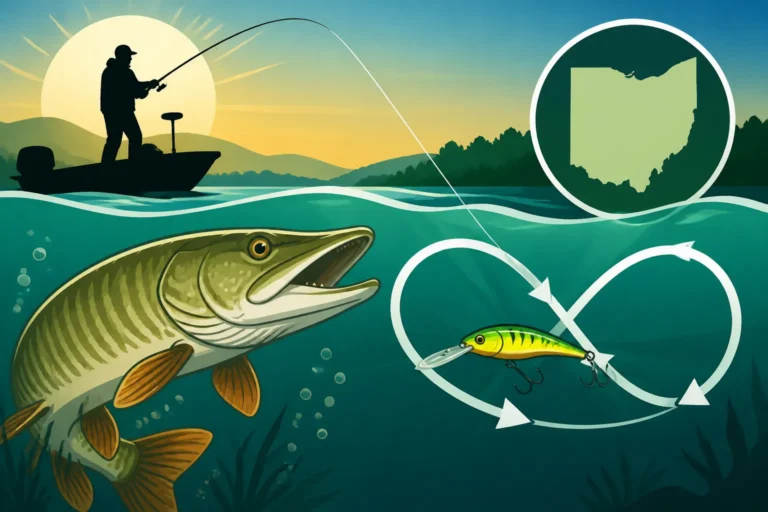
A longer rod, say 8'6" to 9'6", excels at casting big baits a country mile, which is crucial for covering vast areas on waters like Lake Erie or the larger Ohio reservoirs. This added length also provides a greater sweep for the all-important figure-eight retrieve at the boat, a maneuver often necessary to coax a following muskie into striking. However, longer rods can be more cumbersome in tight casting situations or smaller boats. Shorter muskie rods, typically 7'6" to 8'0", offer more accuracy and manageability, making them ideal for pinpoint casting around structure, overhanging trees, or in situations where space is limited. They still provide ample power but require a bit more effort to cast truly massive baits or execute wide figure-eights. Consider the typical waters you'll fish; if it's mostly smaller lakes or rivers, a shorter rod might be more practical, but for expansive waters like Alum Creek Lake or Lake Piedmont, a longer rod is often preferred.
Rod Power and Action Explained
Understanding rod power and action is fundamental to selecting the right muskie rod. "Power" refers to a rod's stiffness or lifting strength, while "action" describes where the rod bends when pressure is applied.
For muskie, you'll almost exclusively be looking at heavy (H) or extra-heavy (XH) power ratings. Anything less simply won't have the backbone to handle muskie lures, penetrate their bony mouths with a hook, or turn their head during a fight. An extra-heavy rod is a workhorse, ideal for throwing the biggest bucktails, magnum crankbaits, or heavy soft plastics. It provides maximum lifting power and control. A heavy-power rod is a great all-around choice for a wider range of muskie baits, offering a bit more sensitivity without sacrificing too much backbone. As for action, "fast" or "extra-fast" is generally what you want. A fast-action rod bends mostly in the top third, allowing for quick, powerful hooksets and excellent sensitivity to feel what your lure is doing. An extra-fast action bends even less, concentrating the flex at the very tip, which is fantastic for pinpoint casting accuracy and maximum leverage for strong hooksets, especially when using single-hook baits or big topwaters. A slower action, like moderate, would be too soft and won't give you the control or hooksetting power needed for muskie. Brands like St. Croix and Shimano offer excellent options that fit these criteria, often found readily available through retailers like Amazon.
Handle Design and Comfort for All-Day Casting
Muskie fishing is a marathon, not a sprint. You'll be making hundreds, if not thousands, of casts over a full day, often with heavy lures that fatigue your arms and shoulders. A comfortable and functional rod handle is absolutely critical.
Look for a rod with a long handle, usually 15-20 inches from the reel seat to the butt end. This extended length allows you to tuck the butt of the rod under your arm or against your body, providing leverage and reducing strain during casting and fighting a fish. A long handle also aids in two-handed casting, which is essential for launching those heavier muskie baits. The material of the handle is also important; cork and EVA foam are common choices. Cork offers a classic feel and good grip, while EVA foam tends to be more durable and can provide better grip when wet. Choose what feels best in your hands for extended periods. Beyond length and material, consider the overall ergonomics. Some rods have split grips, while others have full-length handles. While largely a personal preference, a full-length handle often provides more contact points for leverage during a tough fight. Investing in a rod with a well-designed, comfortable handle will significantly reduce fatigue and allow you to stay on the water, casting effectively, for longer periods, which is often the key to getting that one bite.
Selecting the Perfect Muskie Reel
Your reel is the engine of your muskie setup, responsible for line management, delivering smooth casts, and providing the necessary drag power to subdue a powerful fish. Just like the rod, it needs to be robust and purpose-built.
Baitcasting vs. Spinning Reels for Muskie
For muskie fishing, baitcasting reels are overwhelmingly the preferred and recommended choice. They are built for strength, efficiency, and handling heavy lines and large lures, perfectly suiting the demands of muskie angling.
Traditional spinning reels, while versatile for lighter applications, simply don't have the necessary gearing strength, drag power, or line capacity for muskie. They are prone to twisting heavy line and their bail systems are not designed for the constant, powerful casts required. Baitcasting reels, on the other hand, feature robust construction, powerful gears, and a direct drive system that translates into superior cranking power and drag performance. They are designed to sit atop the rod, balancing the heavy lure and providing a more natural casting motion for larger baits. There are some specialized heavy-duty spinning reels on the market, but for muskie, especially in Ohio's waters, a high-quality baitcaster is the gold standard. When selecting one, look for models designed specifically for heavy freshwater or saltwater applications, often referred to as "low-profile" or "round" baitcasters. Brands like Shimano, Daiwa, and Abu Garcia offer dedicated muskie baitcasting reels that will stand up to the challenge.
Gear Ratios and Their Importance
A reel's gear ratio tells you how many times the spool rotates with one full turn of the handle. This number significantly impacts how quickly you retrieve line and, consequently, how you can work your lures.
For muskie fishing, a fast gear ratio is generally preferred. You'll typically be looking at ratios in the 6.1:1 up to 7.3:1 or even higher. A faster retrieve ratio (e.g., 7.1:1 or 7.3:1) is excellent for working bucktails quickly, burning spinnerbaits, or covering water efficiently with crankbaits. It also helps you pick up slack line rapidly after a long cast or a muskie surge, ensuring you maintain tension and can set the hook promptly. This speed can be crucial for the Figure-Eight Retrieve for Muskie Fishing right at the boat. While slower gear ratios (e.g., 5.1:1) offer more cranking power, they often aren't fast enough for the retrieve speeds often needed for muskie lures, especially when trying to trigger a reaction strike. However, if you primarily throw large, high-resistance crankbaits or deep-diving lures that require a lot of torque to reel in, a slightly lower gear ratio might be beneficial, around 5.4:1 to 6.2:1. Many muskie anglers will carry multiple setups with different gear ratios to match specific lure types and retrieve speeds, but if you're starting with one, aim for the faster side to maximize versatility.
Line Capacity and Drag Systems
These two features are non-negotiable for a muskie reel. Without adequate line capacity and a powerful, smooth drag system, you're severely handicapping your chances.
Line capacity needs to be substantial. You'll be using heavy braided line, typically 65 to 100-pound test (we'll dive into line more in the next section), and you need enough of it to make long casts and still have plenty left on the spool for a surging muskie. A reel that can comfortably hold at least 150-200 yards of 80-pound braid is a good starting point. Some larger models can hold even more. Running out of line when a muskie makes a powerful run is a common nightmare for ill-equipped anglers. Just as crucial is a robust and smooth drag system. Muskie apply immense pressure, and a jerky or inconsistent drag can lead to line breaks or pulled hooks. Look for reels with a high maximum drag rating, often 20 pounds or more. More importantly, the drag needs to operate smoothly under pressure, without sticking or slipping. Carbon fiber drag washers are a common feature in high-quality muskie reels, providing consistent performance. Test the drag before you hit the water, ensuring it pulls out smoothly at various settings. A reliable drag system is your best friend in controlling a hard-fighting muskie and preventing sudden shock loads on your line and rod.
The All-Important Muskie Fishing Line and Leader
Your line and leader are the direct connection to the fish. Failures here are often the most heartbreaking, turning a potential trophy into just another story. For muskie, strength, abrasion resistance, and invisibility are paramount.
Braided Line: The Muskie Angler's Choice
When it comes to muskie fishing in Ohio, there's really only one choice for your main line: braided line. Monofilament and fluorocarbon, while useful for other species, simply don't possess the necessary characteristics to stand up to muskie.
Braided line offers incredible strength-to-diameter ratio, meaning you can use heavy test weights (typically 65 to 100-pound test) without it being excessively thick. This heavy test is crucial not only for fighting powerful fish but also for casting heavy lures without fear of snapping your line mid-cast. The lack of stretch in braided line provides unparalleled sensitivity, allowing you to feel every bump, tick, and subtle take, even with big baits. This also translates into powerful, immediate hooksets that can drive a large hook into a muskie's bony mouth. Furthermore, braided line is highly abrasion-resistant, a necessity when fishing around submerged timber, rock piles, or encountering the muskie's rough scales and sharp fins. Popular brands like PowerPro and Berkley X9 offer excellent braided lines for muskie, available in various strengths. Always err on the side of heavier line for muskie; 80-pound test is a good all-around choice for most Ohio muskie scenarios, offering a balance of castability and raw power.
Leader Materials and Essential Knots
Directly tying your lure to braided line is a recipe for disaster. A muskie's teeth will instantly sever braided line, and even thick fluorocarbon can be quickly compromised. This is where a robust leader comes in.
For muskie, you'll need a wire or heavy fluorocarbon leader to protect your main line from those formidable teeth. Steel leaders (often multi-strand wire) are incredibly strong and tooth-proof. They come in various lengths (typically 9-18 inches) and breaking strengths (80-150 lbs). While highly effective, they can sometimes have a bit more memory or be visible to fish in clearer water. Heavy fluorocarbon leaders, ranging from 100 to 150-pound test, offer a more stealthy presentation. Fluorocarbon is highly abrasion-resistant and nearly invisible underwater, making it a favorite for many anglers. While it can withstand some toothy encounters, it's not entirely impervious; always check your fluorocarbon leader for nicks and abrasions after every muskie encounter or snag. For connecting your braided line to your leader, a strong knot like the Palomar knot or Improved Clinch knot is essential, ensuring you have a secure connection. When connecting your leader to your lure, you'll typically use a heavy-duty snap or snap swivel. Ensure all components of your leader system – snaps, swivels, and wire/fluoro – are rated for muskie. Don't cheap out here; your leader is the last line of defense.
Matching Your Setup to Ohio's Muskie Hotspots
Ohio offers diverse muskie fishing environments, and while a general-purpose muskie setup is a good start, tailoring your gear to specific hotspots and techniques can significantly boost your success. Knowing when to use a specific type of rod or reel can make all the difference.
Heavy Cover Fishing: Leesville and West Branch
Lakes like Leesville Reservoir and West Branch Reservoir are renowned for their muskie populations, often holding these giants in and around heavy cover – submerged timber, weed beds, and dense brush. Fishing these areas demands specific gear choices.
For these environments, you'll want a rod with maximum power and a faster action. An extra-heavy power, fast to extra-fast action rod in the 7'6" to 8'6" range is ideal. This powerful setup gives you the backbone to pull a muskie out of thick cover before it can wrap you up and break off. You need to be able to dictate the fight, not the fish. A faster gear ratio baitcasting reel (7.1:1 or higher) is excellent here for quickly retrieving slack and getting the fish moving away from snags the moment it strikes. Heavy braided line, 80 to 100-pound test, is a must for cutting through vegetation and providing shock absorption against potential snags. Your leader should be stout wire (100+ lb test) or heavy fluorocarbon, again, 100-130 lb test, to withstand the abrasion of cover and the fish's teeth. Lures like heavy jig-and-trailer combinations, large weedless soft plastics, or bulky spinnerbaits are often productive here, and your setup needs to be able to cast and work them effectively. Remember, in these heavy cover situations, you're not just fighting a fish; you're fighting the environment, and your gear needs to be up to the challenge. Consider checking out the Leesville Lake Muskie Fishing Guide for specific tactics.
Open Water Trolling: Piedmont and Alum Creek
When targeting muskie in more open water areas or covering vast expanses on lakes like Piedmont Lake or Alum Creek Lake, trolling becomes a highly effective technique. This method requires a slightly different rod and reel approach.
For trolling, you'll want rods that are a bit more forgiving but still incredibly strong. A heavy power, moderate-fast to fast action rod in the 8'0" to 9'0" range is excellent. The slightly more moderate action helps absorb the shock of a strike while trolling at speed and handles the continuous pressure of large diving crankbaits without constant rod tip bouncing. While trolling, you're less concerned with casting distance and more with lure presentation and fight absorption. The reel choice will still be a baitcaster, but a round baitcaster is often preferred by trollers for its larger line capacity and typically beefier internal components. A moderate gear ratio (5.1:1 to 6.1:1) is perfectly acceptable for trolling, as you're not actively retrieving; the boat is doing the work. However, ensure it has a robust drag system to handle the sudden impact of a muskie hitting a trolled lure. Line capacity is paramount here, as muskie can make incredibly long runs when hooked offshore. Spool up with 80-100 pound braided line, ensuring you have at least 200 yards. Wire leaders are standard for trolling muskie, as they offer maximum tooth protection and durability against prolonged lure vibrations. Look for options on Amazon specifically designed for trolling.
Essential Accessories to Complete Your Muskie Kit
Having the right rod, reel, line, and leader is only part of the equation. Muskie fishing also requires a few critical accessories, especially when it comes to safe handling and care of these magnificent fish.
Tools for Muskie Safety and Release
Catching a muskie is a thrilling accomplishment, but releasing it healthy and unharmed is paramount for conservation, especially given the Ohio Muskie Minimum Length Limit on Inland Lakes and the Muskie Growth Rate in Ohio Lakes. Muskie are delicate despite their fierce appearance, and improper handling can lead to delayed mortality.
The first and most critical tool is a large, rubberized landing net. Standard bass nets are far too small and can damage a muskie's fins or remove their protective slime layer. A net with a hoop size of at least 30×36 inches and a deep, knotless, rubber-coated mesh is ideal. This type of net cradles the fish, minimizes scale and slime loss, and prevents hooks from getting tangled. Another essential item is a long-nosed pliers or jaw spreaders. Trying to remove hooks from a muskie's mouth with your fingers is incredibly dangerous for you and stressful for the fish. A jaw spreader helps keep their mouth open safely, while long pliers allow you to reach deep-set hooks. Many anglers also carry bolt cutters as a last resort to quickly cut hooks when they are deeply swallowed or impossible to remove, ensuring a faster release. Finally, a good release glove can protect your hands from teeth while handling the fish for a quick photo or final release. Always prioritize the fish's well-being; these tools are just as important as your rod and reel. For more details on safe handling, consult guides like How to Revive a Muskie Before Release and Best Landing Net for Ohio Muskie Fishing.
Rod and Reel Maintenance for Longevity
Given the investment you'll make in quality muskie gear, proper maintenance is crucial to ensure longevity and reliable performance season after season. Neglecting your equipment can lead to premature failure and costly repairs.
After every outing, especially if fishing in rain or on Lake Erie with its brackish water, take the time to wipe down your rod and reel. Use a damp cloth to remove any grime, fish slime, or salt residue. Pay particular attention to the reel, cleaning any visible dirt from the exterior. Periodically, your reel will benefit from a more thorough cleaning and lubrication. Consult your reel's manual for specific instructions, but generally, this involves disassembling accessible parts, cleaning them with a reel cleaner, and applying a light coat of high-quality reel oil to bearings and a small amount of reel grease to gears. Don't over-lubricate, as this can attract dirt. Inspect your rod guides for any chips or cracks that could fray your line. Check your reel's drag system to ensure it's still smooth and adjust it if necessary. Store your rods horizontally or in a rod rack to prevent warping, and keep reels covered to protect them from dust and dings. Many local tackle shops offer professional reel cleaning and maintenance services, which can be a wise investment once a year. Regular care, as with any precision equipment, will keep your muskie setup performing at its peak, ready for that next legendary strike.
Here's a quick summary of muskie rod and reel recommendations:
| Component | Recommendation (General Muskie) | Considerations for Heavy Cover (e.g., Leesville) | Considerations for Open Water Trolling (e.g., Piedmont) |
|---|---|---|---|
| Rod Length | 7'6" – 9'6" (longer for casting, shorter for accuracy) | 7'6" – 8'6" (for leverage and control) | 8'0" – 9'0" (for lure presentation and shock absorption) |
| Rod Power | Heavy (H) to Extra-Heavy (XH) | Extra-Heavy (XH) (maximum backbone to pull fish from snags) | Heavy (H) (sufficient power with more forgiveness for trolling) |
| Rod Action | Fast to Extra-Fast | Fast to Extra-Fast (quick hooksets, maximum leverage) | Moderate-Fast to Fast (absorbs strike shock, handles lure resistance) |
| Reel Type | Baitcasting (Round or Low-Profile) | Baitcasting (robust, powerful, fast line retrieval) | Baitcasting (often Round, for large line capacity and durability) |
| Gear Ratio | 6.1:1 to 7.3:1 (faster preferred for lure work) | 7.1:1 or higher (rapid line pickup, quick fish control) | 5.1:1 to 6.1:1 (sufficient for trolling, good cranking power) |
| Line Capacity | 150-200+ yards of 80lb+ braid | 150-200+ yards of 80-100lb braid | 200+ yards of 80-100lb braid (for long runs) |
| Drag System | Smooth, powerful (20+ lbs max drag) | Smooth, powerful (20+ lbs max drag, critical for stopping runs) | Smooth, powerful (20+ lbs max drag, crucial for sudden strikes) |
| Main Line | 65-100 lb Braided Line | 80-100 lb Braided Line (for cutting through cover, abrasion) | 80-100 lb Braided Line (strength for trolling and runs) |
| Leader | 80-150 lb Wire or Heavy Fluorocarbon | 100-150 lb Wire or Heavy Fluorocarbon (abrasion and tooth proof) | 100-150 lb Wire (standard for trolling, maximum protection) |
| Key Accessory | Large Rubberized Landing Net | Long-nosed Pliers/Jaw Spreaders | Bolt Cutters (for quick hook removal) |
Disclaimer
The information provided in this guide is for general informational purposes only and does not constitute professional advice. Fishing regulations and conditions can change rapidly. Always consult the latest Ohio Department of Natural Resources fishing regulations before heading out on the water. Exercise caution and practice safe fishing techniques.