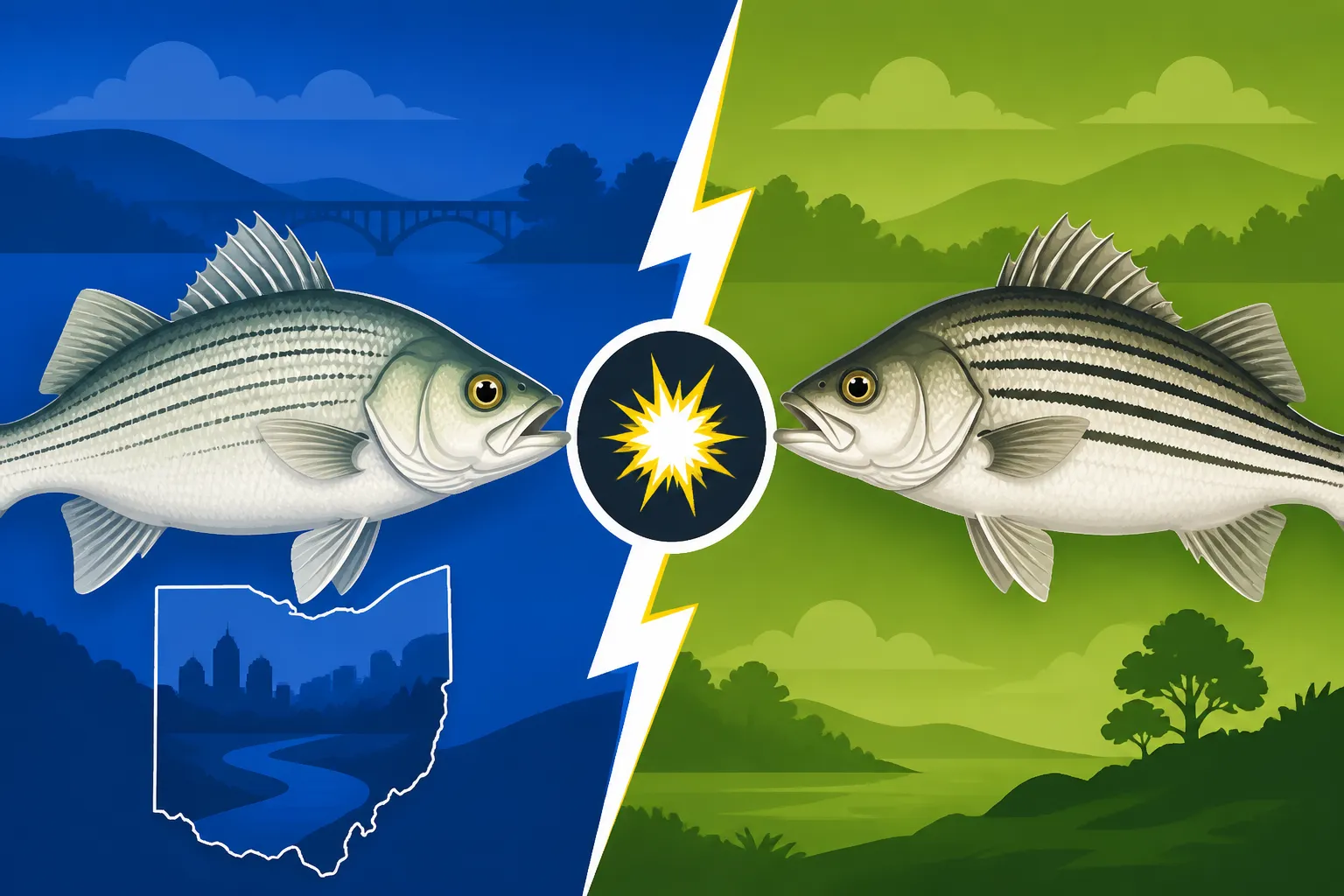
Difference Between White Bass and Hybrid Striper
It's incredibly common for anglers, even seasoned ones, to get a little stumped when reeling in a fish that looks like a white bass but fights like a freight train. That's because Ohio waters are home to both the native white bass and the hard-fighting hybrid striper, often called "wipers," and distinguishing between the two can be a real head-scratcher. This guide is here to clear up that confusion, giving you the definitive characteristics, habitats, and behaviors that set these two fantastic game fish apart.
The White Bass: Ohio's Energetic Schooler
The white bass is a beloved species across Ohio, known for its strong schooling behavior and aggressive strikes, especially during its famous spring spawning runs. Many anglers cut their teeth on white bass, and they remain a go-to target for sheer numbers and consistent action. They're native to our waters and play a vital role in many freshwater ecosystems.
Distinctive Features and Appearance
When you look at a white bass, you'll generally notice a silver body with a slightly greenish tint on the back, fading to white on the belly. The most prominent features are the horizontal, dusky stripes running along their sides. Here's the key: on a true white bass, these stripes are typically continuous and unbroken, though sometimes a lower stripe might be faintly broken near the tail. They have a relatively deep body for their length, giving them a somewhat stocky appearance. The head tapers nicely to a fairly small mouth, and their eyes tend to be on the larger side. If you're comparing it to a hybrid, a white bass will generally feel a bit more streamlined, almost delicate in comparison, especially when they aren't fully grown.
Size is another important indicator, though not always foolproof. While white bass can certainly reach impressive sizes, especially in prolific waters like Lake Erie or the Ohio River, they usually max out at around 1 to 2 pounds, with true trophies hitting 3 or 4 pounds. Anything significantly larger might make you wonder if you've got something else on the line. Their dorsal fins are distinct, with a spiny anterior section and a soft-rayed posterior section, typical of the temperate bass family. Pay attention to the tongue; a white bass will have a single patch of teeth on its tongue.
Natural Habitats and Spawning Runs
White bass are highly adaptable and thrive in a variety of Ohio's freshwater environments. You'll find them in large rivers like the Ohio River and its tributaries, as well as expansive reservoirs and lakes such as Lake Erie, Grand Lake St. Marys, and Mosquito Creek Lake. They prefer open water and tend to congregate in schools, especially around submerged structures, points, and humps. During the summer, they might chase baitfish near the surface, creating exciting feeding frenzies that are visible from a distance.
Their most celebrated behavior, and a prime time for anglers, is the annual spring spawning run. As water temperatures rise, large schools of white bass migrate upstream into rivers and creeks that feed into larger lakes and reservoirs. These runs, particularly on Lake Erie tributaries, can be absolutely epic, with anglers lining the banks, catching fish after fish. When the White Bass Run Happens on Lake Erie Tributaries is a widely anticipated event. They typically spawn over gravel or rocky bottoms in moving water, making these river sections hotspots for a few weeks each spring.
Feeding Habits and How They Impact Anglers
White bass are opportunistic predators with a voracious appetite. Their primary diet consists of small baitfish like shad, shiners, and emerald shiners, but they'll also readily consume insect larvae, crustaceans, and even smaller invertebrates. They are visual hunters, often ambushing schools of baitfish from below. This aggressive feeding behavior makes them a blast to catch, as they'll strike a variety of lures with enthusiasm.
Because they feed heavily on baitfish, understanding baitfish movements and presence is key to locating white bass. If you see birds diving or baitfish scattering on the surface, chances are there's a school of white bass (or something larger!) underneath. This also informs the best tackle choice; small, shiny lures that mimic baitfish are often incredibly effective. We're talking about small inline spinners, Kastmasters, Road Runners, and jigs tipped with soft plastics. You can find a huge selection of these kinds of lures on platforms like Amazon, making it easy to stock up for your next outing.
The Hybrid Striper (Wiper): Ohio's Powerhouse Crossbreed
Now, let's talk about the hybrid striper. This fish is a true powerhouse, a product of human ingenuity in fisheries management, and it provides an absolutely thrilling fight that often surprises anglers expecting a typical white bass. It's important to know that while white bass are native, hybrid stripers are stocked in Ohio waters to provide exciting angling opportunities, especially in larger reservoirs.
Understanding the Hybrid Origin
The hybrid striper, often affectionately called a "wiper" (from White Bass x Striper), is exactly what it sounds like: a cross between a female striped bass (often from saltwater populations, but also freshwater landlocked populations) and a male white bass. This crossbreeding results in a fish that often exhibits hybrid vigor, meaning it grows faster, gets significantly larger, and fights harder than either of its parent species individually. They combine the schooling behavior of the white bass with the raw power and size potential of the striped bass. If you want to learn more about the species itself, check out What a Hybrid Striped Bass Is.
In Ohio, these fish are sterile, meaning they cannot reproduce naturally. This is an important distinction because it means their populations are entirely dependent on stocking efforts by the Ohio Department of Natural Resources (ODNR). This allows fisheries managers to control their numbers and prevent any negative impacts on native fish populations while still providing a fantastic game fish. Knowing Does Ohio Stock Hybrid Striped Bass? can help you understand where to find them.
Key Visual Identifiers of the Wiper
Identifying a hybrid striper often comes down to looking closely at those stripes. Unlike the white bass's mostly continuous lines, the hybrid striper typically has broken, interrupted, or uneven horizontal stripes along its sides. These breaks might be subtle, or they might be quite pronounced, especially on the lower body. Sometimes the stripes can appear wavy or fragmented. The body shape is also generally more elongated and torpedo-like compared to the deeper, stockier white bass, reflecting its striped bass parentage.
Hybrids also tend to have a larger, more powerful mouth than a white bass, capable of engulfing bigger baits. Their size is often the most immediate giveaway; wipers can easily exceed 5 pounds, with many reaching 10-15 pounds, and even larger specimens are caught in Ohio's top wiper fisheries. A 20-pound wiper is certainly not out of the question, making them a formidable opponent on light tackle. Like the white bass, they also have two distinct dorsal fins, but their overall musculature and robustness are usually much more pronounced. Look for two distinct tooth patches on the tongue, unlike the single patch on a white bass.
Where to Find These Strong Fighters
Hybrid stripers thrive in large, open-water reservoirs where they can chase schools of baitfish, primarily shad. Lakes such as Lake Erie, Hoover Reservoir, and some sections of the Ohio River are well-known for their thriving wiper populations. They prefer deeper water during the heat of summer but will move shallower to chase bait, especially during dawn and dusk. Their aggressive nature means they are constantly on the hunt.
Unlike white bass, which often make distinct spawning runs into smaller tributaries, wipers, being sterile, don't engage in the same type of reproductive migration. However, they will follow baitfish into shallower creek arms and coves, especially in spring and fall, offering excellent shore-fishing opportunities. Anglers often find them around dam spillways, current breaks, and large underwater structures where baitfish congregate. They love moving water and current, which helps them ambush their prey.
Unraveling the Confusion: A Side-by-Side Comparison
It’s easy to see why these two species can be confusing. They share common ancestry and often occupy similar niches in the same bodies of water. However, a keen eye and understanding of a few key differences will help you correctly identify your catch every time. This is crucial not just for bragging rights, but sometimes for adhering to specific fishing regulations. Anglers often face similar dilemmas with species like Saugeye vs Walleye Identification or White Crappie vs Black Crappie Identification.
The Stripe Story: Broken vs. Unbroken Lines
This is, by far, the most reliable visual indicator for telling white bass and hybrid stripers apart.
- White Bass: Think of them as having "neat" stripes. Most of their lateral lines will be solid, unbroken, and relatively uniform. There might be one or two fainter, lower lines that could be slightly broken towards the tail, but the dominant pattern is continuous.
- Hybrid Striper (Wiper): These fish have "messy" stripes. Their lateral lines will almost always be broken, interrupted, or irregular, especially on the lower half of their body. These breaks can look like dashes, squiggles, or distinct gaps. The lines may not even run perfectly parallel.
It's helpful to remember that individual fish can vary, but this rule of thumb holds true for the vast majority. It's always best to examine multiple stripes if you're unsure.
Body Shape, Mouth, and Fin Differences
Beyond the stripes, other physical traits can offer strong clues:
- Body Shape: White bass tend to be deeper-bodied and more compressed, almost disk-like when compared to the hybrid. Hybrids are more torpedo-shaped, elongated, and stout, built for powerful runs and open-water pursuit. Imagine the difference between a frisbee (white bass) and a football (wiper).
- Mouth: While both are predators, wipers generally possess a larger, more powerful mouth suitable for swallowing bigger prey. A good tip is to see if the upper jaw extends past the eye; often, on a hybrid, it will be more pronounced than on a white bass.
- Tongue Tooth Patches: This is a definitive anatomical difference. Gently open the fish's mouth and look at its tongue. A white bass will have a single, distinct patch of teeth in the middle of its tongue. A hybrid striper will have two separate, distinct patches of teeth on its tongue. This is a scientific marker that doesn't lie!
- Fins: Both have two dorsal fins. The first (spiny) dorsal fin on a hybrid striper is often taller and more robust, consistent with its larger, more powerful frame.
Beyond Appearance: Behavioral Clues
While not as definitive as visual identification, understanding the typical behavior of each fish can also give you a hint:
- Fight: If you hook something that feels like a small car has taken your bait, tearing off line with incredible power and making multiple long runs, you’re almost certainly battling a hybrid striper. White bass put up a respectable fight for their size, but it rarely compares to the brute strength of a wiper.
- Location within a Water Body: While there's overlap, if you're consistently catching larger, stronger fish in the main lake basin or around deep current breaks of a large reservoir, especially near a dam, the odds lean towards hybrids. If you're in a smaller river during a spring run, catching many fish in shallower, flowing water, it's more likely to be white bass. Ohio River Fishing Guide might lead you to both!
- Size of Prey Taken: Hybrids can and will hit larger baits and lures than white bass. While white bass typically prefer smaller baits (1/8 to 1/4 ounce jigs, small spinners), wipers won't hesitate to smash larger crankbaits, swimbaits, or even substantial live shad. Many Best Lures for Ohio Fishing will work for both, but the size might differ.
Here's a quick comparison table to help you keep things straight:
| Feature | White Bass | Hybrid Striper (Wiper) |
|---|---|---|
| Stripes | Generally continuous and unbroken | Almost always broken, interrupted, or wavy |
| Body Shape | Deeper, more compressed, "stocky" | More elongated, torpedo-like, "muscular" |
| Maximum Size | Typically 1-4 lbs (rarely larger) | Often 5-15+ lbs (can be much larger) |
| Tongue Teeth | Single patch of teeth | Two distinct patches of teeth |
| Fight | Good fight for size, strong pulls | Extremely powerful, long, hard runs |
| Mouth Size | Relatively smaller | Larger, more pronounced |
| Origin | Native to Ohio, naturally reproducing | Stocked hybrid (sterile), non-reproducing |
| Habitat Focus | Rivers, tributaries, open lakes (schools) | Large reservoirs, deep open water, strong current |
Why Correct Identification Matters for Ohio Anglers
You might think, "A fish is a fish, why does it matter?" But knowing what you've caught goes beyond just identifying it for fun. It impacts how you fish, where you fish, and even how you comply with local regulations. Being able to correctly identify fish is a hallmark of a knowledgeable angler. For more detailed information, consider checking out Ohio White Bass and Hybrid Striper Identification.
Navigating Ohio's Fishing Regulations
One of the most critical reasons for distinguishing between these two species is fishing regulations. While often similar, bag limits and size restrictions can sometimes differ. Fishery managers may impose different rules to protect native white bass populations or to manage the stocked hybrid populations effectively. Accidentally keeping an undersized hybrid when you thought it was a legal white bass could lead to a citation. Always check the current Ohio Fishing Regulations Every Angler Should Know before you head out, and refer to your physical ODNR fishing guide if you have any doubts.
Understanding the regulations helps ensure the sustainability of both native and stocked fisheries. It's our responsibility as anglers to be informed and abide by these rules, contributing to healthy fish populations for everyone to enjoy for years to come.
Tailoring Your Fishing Approach
Knowing whether you're targeting white bass or hybrid stripers can significantly influence your strategy. White bass, particularly during spring runs, respond well to smaller, fast-moving baits in current. They're often found shallower and in larger, tighter schools. Hybrid stripers, on the other hand, frequently demand heavier tackle, larger lures, and often require searching deeper, more expansive water bodies. Their sheer power calls for robust rods and reels.
If you're out specifically for big hybrid stripers, you'll gear up differently than if you're hoping to fill a cooler with white bass during a river run. This includes your choice of line weight, leader material, hook size, and even the retrieve speed you use. Platforms like Amazon offer a vast array of fishing gear, from light spinning rods perfect for white bass to heavy-duty baitcasting setups designed to handle the brutal force of a wiper.
The Joy of Knowing Your Catch
Finally, there's the pure satisfaction of knowing exactly what you've reeled in. Angling is a journey of learning, and becoming proficient at fish identification deepens your connection to the sport and the aquatic environment. It allows you to understand the biology, behavior, and management of the fish you pursue. Plus, when you share your fishing stories with friends, you can confidently explain the difference between that feisty white bass and the monster hybrid striper that almost spooled you! Fish Species Anglers Confuse Most Often in Ohio is a topic many of us can relate to.
Disclaimer
This article is for general informational purposes only and does not constitute professional advice. Laws, prices and regulations vary by location and change over time. Consult a qualified professional for guidance on your specific situation.