Does an Ohio Fishing License Work in Other States?
It’s a common scenario: you’ve got your Ohio fishing license in your wallet, you’re packed and ready for an exciting trip, and then a friend mentions a sweet spot just over the state line. Suddenly, a question pops into your head that can cause a real headache: "Does my Ohio fishing license actually work in other states?" This guide is here to clear up that very confusion, ensuring you're always on the right side of the law and ready to cast your line, no matter where your angling adventures take you.
The Fundamentals of State Fishing Licenses
Fishing licenses, much like driver's licenses or hunting permits, are fundamentally tied to the sovereign laws and regulations of individual states. It's a system designed to manage and conserve natural resources within specific geographical boundaries, and understanding this foundational principle is key to navigating the rules.
Why Licenses Are State-Specific
Think about it this way: each state has its own unique ecosystem, its own challenges with fish populations, and its own funding needs for conservation efforts. Ohio, with its incredible diversity from Lake Erie to the Ohio River and countless inland lakes and streams, has specific programs for stocking, habitat restoration, and enforcement. The fees you pay for your Ohio Fishing License Guide for Residents and Nonresidents directly support these efforts within Ohio's borders.
If an Ohio license were valid everywhere, it would quickly become a logistical and financial nightmare for other states. Who would fund the management of Kentucky's rivers or Pennsylvania's streams if everyone was fishing on an Ohio permit? Each state’s Department of Natural Resources, like the Ohio Department of Natural Resources (ODNR), operates independently, relying on its own licensing structure to maintain the health and sustainability of its aquatic environments. This ensures that every angler contributes to the waters they fish, fostering a sense of shared responsibility for our precious natural resources. It also allows states to tailor regulations, like specific Ohio Statewide Bag and Size Limits or seasonal restrictions, to their local conditions.
The Doctrine of State Sovereignty in Wildlife Management
At the heart of why fishing licenses are state-specific lies the doctrine of state sovereignty. In the United States, each state largely retains the authority to manage its own natural resources, including fish and wildlife, within its borders. This isn't just about collecting fees; it’s about control over conservation strategies, ecological studies, and law enforcement. The ODNR, for instance, employs wildlife officers whose jurisdiction is primarily limited to Ohio.
These officers are responsible for enforcing Ohio Fishing Regulations Every Angler Should Know, protecting against poaching, and ensuring compliance with all the rules that keep our fisheries healthy. When you cross into Michigan or Indiana, you enter a different legal jurisdiction, with different officers, different laws, and different conservation priorities. It’s a bit like needing a different parking permit when you visit a different city; the local rules apply, and it's up to you to know them. This framework, while sometimes inconvenient for traveling anglers, is vital for the effective, localized management of fish populations, preventing overfishing in one area while another struggles to fund its own programs.
Ohio Fishing License Validity Beyond State Borders
This is where the rubber meets the road for many traveling anglers. The straightforward answer is usually "no," your Ohio fishing license generally doesn't grant you the right to fish in another state. However, like most rules, there are some important exceptions and nuances, especially concerning shared waterways.
The General Rule: No, an Ohio License Doesn't Transfer
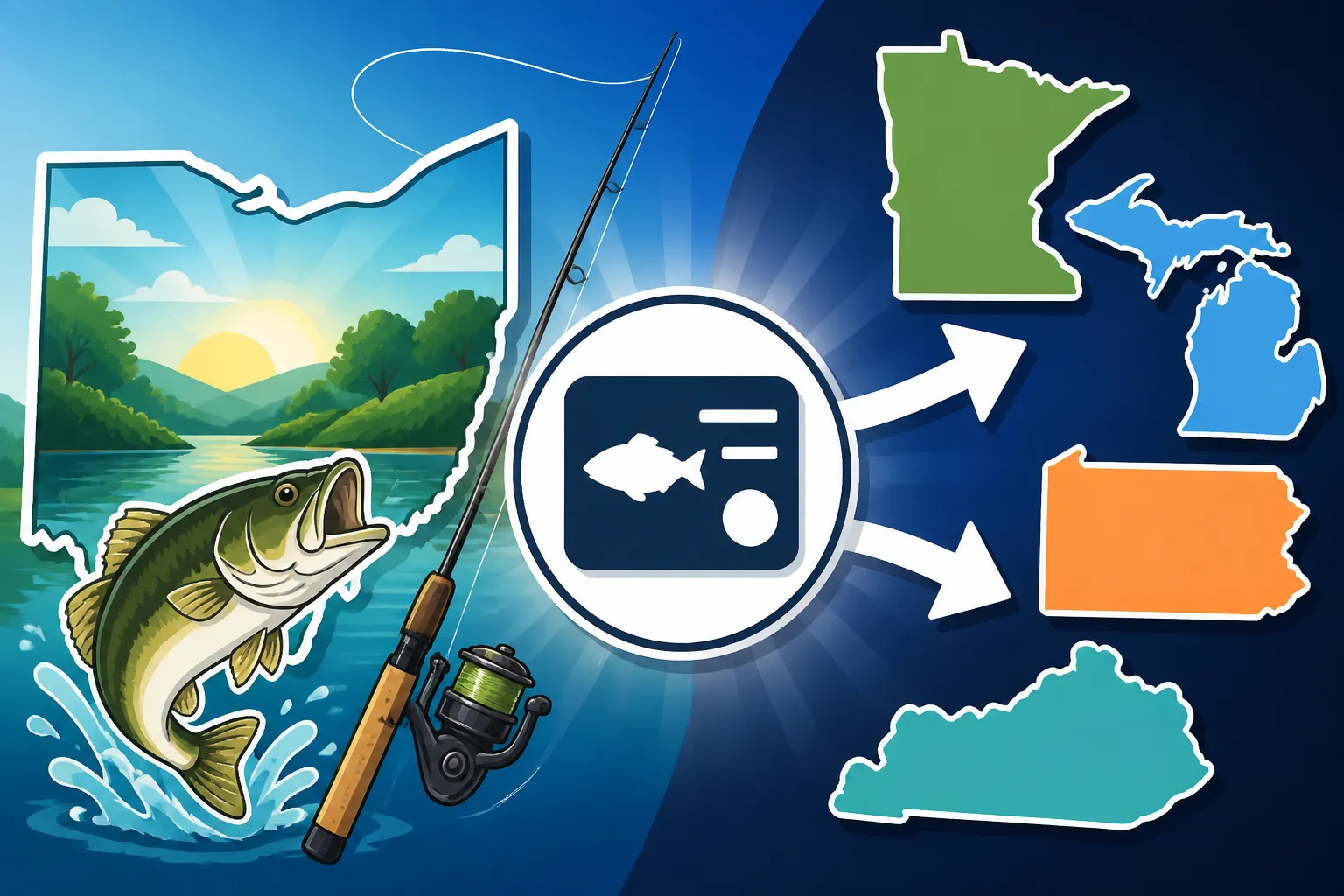
Let's get this out of the way upfront: if you buy an annual Ohio fishing license, it’s valid only for fishing in the waters within Ohio’s state lines. This means if you're planning a weekend trip to a beautiful lake in Pennsylvania, or you're heading south for some fantastic bass fishing in Kentucky, your Ohio license is, unfortunately, just a souvenir from your home state.
It's a common misconception, especially for those new to traveling for fishing. You might think, "I paid for a license, surely it's good in the neighboring state!" But alas, it’s not. Each state requires you to purchase its specific non-resident fishing license. These licenses are typically more expensive than resident licenses, reflecting the fact that non-residents are not contributing to the state’s tax base that often supplements conservation efforts. You can usually purchase these non-resident licenses online, often through the respective state's DNR website, or at local bait shops and sporting goods stores once you arrive. Just imagine showing up to fish the Allegheny River in Pennsylvania with only your Ohio license – you’d be out of luck, and potentially facing a fine, which can be a real damper on a fishing trip. Always double-check before you leave!
Exceptions and Interstate Agreements: The Ohio River and Lake Erie
While the general rule is no reciprocity, there are some critical exceptions, particularly for shared border waters. The most notable example for Ohio anglers is the magnificent Ohio River. Due to a unique reciprocal agreement, a valid fishing license from Ohio, Kentucky, Indiana, West Virginia, or Pennsylvania allows you to fish the main stem of the Ohio River. This means if you have your Ohio license, you can fish from either the Ohio or Kentucky bank, or from a boat anywhere on the river, without needing a separate Kentucky license. This is a huge convenience for anglers who frequent the river.
However, a crucial caveat exists: this reciprocity typically only applies to the main stem of the river itself, up to the mouths of its tributaries. If you decide to venture into a creek or river that flows into the Ohio River, even just a few feet upstream, you are likely entering the jurisdiction of the adjacent state and would need that state's license. So, while you can fish the mouth of the Licking River in Kentucky from your boat with an Ohio license if you stay on the Ohio River, if you go up the Licking River itself, you'd need a Kentucky license. It’s a fine line, but one worth knowing to avoid trouble. You can find more details on these specific rules in guides like "Special Fishing Rules on the Ohio River."
Another area where similar considerations come into play, albeit with slightly different nuances, is Lake Erie. While Lake Erie is bordered by Ohio, Michigan, Pennsylvania, New York, and even Canada, specific reciprocal agreements exist primarily with neighboring states on shared waters. For example, Ohio and Michigan have an agreement for the shared waters of Lake Erie that allows a resident from either state to fish the Michigan or Ohio waters of Lake Erie with their respective state's fishing license. However, if you head further east into Pennsylvania or New York waters, you would still need their non-resident license. This often means that while an Ohio license covers you across the expanse of Lake Erie's Ohio and often Michigan waters, you’d need a Pennsylvania non-resident license to fish near Erie, PA.
Here’s a simplified table for common scenarios:
| Fishing Location | Ohio License Valid? | Notes |
|---|---|---|
| Inland Ohio Lakes/Rivers | Yes | Absolutely! This is what your license is for. |
| Ohio River (main stem) | Yes | Due to reciprocity agreements with bordering states (KY, IN, WV, PA). |
| Ohio River Tributaries | No | Once you enter a tributary (creek, river) in another state, you need that state's license. |
| Lake Erie (Ohio Waters) | Yes | Covered by your Ohio license. |
| Lake Erie (Michigan Waters) | Yes | Reciprocity exists between OH and MI for Lake Erie. |
| Lake Erie (Pennsylvania Waters) | No | You would need a Pennsylvania non-resident fishing license. |
| Any inland lake/river in PA/KY/MI/IN etc. | No | You need a non-resident license from the state you are fishing in. |
Always, always consult the current regulations of the state you intend to visit. These agreements can change, and it's your responsibility as an angler to be informed.
How to Prepare for Out-of-State Fishing Adventures
Planning an out-of-state fishing trip doesn't have to be complicated, but a little preparation goes a long way in ensuring a smooth and legal experience. You don’t want to drive hours, get to your destination, and realize you can’t even wet a line!
Researching Other State's Regulations
This is step one, and arguably the most crucial. Before you even pack your bags, head to the internet. Every state’s wildlife or natural resources department has an official website. For example, if you’re heading to Michigan, you’d visit the Michigan Department of Natural Resources (MDNR) website. On these sites, you can typically find detailed information on:
- License Requirements: What kind of license do non-residents need? Are there one-day, three-day, or annual options? What are the Ohio Nonresident Fishing License Cost equivalents in that state?
- Season Dates: Just like Ohio has specific Ohio Fishing Season Dates and Effective Periods, other states do too. A species might be open year-round in Ohio but have a closed season during certain months in another state.
- Bag and Size Limits: These can vary dramatically. What’s legal to keep in Ohio might be too small or too large, or you might be allowed to keep more or fewer fish in another state. Knowing these limits beforehand is critical to avoid fines.
- Gear Restrictions: Some states have specific rules about what kind of bait you can use, the number of rods you can fish with (remember How Many Fishing Lines You Can Use in Ohio is limited), or whether treble hooks are allowed in certain waters.
- Special Regulations: Are there any catch-and-release only sections? Are certain lures prohibited? Are there specific rules for ice fishing or certain bodies of water?
It might seem like a lot to dig through, but most state DNR websites are designed to be user-friendly. Many even offer downloadable regulation booklets in PDF format, which you can save to your phone or print out. Don't rely on word-of-mouth or old information; always check the official source for the current year.
Purchasing Non-Resident Licenses
Once you’ve done your homework and understand what you need, it's time to actually acquire the license. The good news is that just like Buying an Ohio Fishing License Online, most states offer online purchasing options through their respective wildlife agency websites. This is often the most convenient method. You can typically print a temporary license immediately, or have a digital copy on your phone, which is usually sufficient for proof.
Alternatively, if you prefer to buy in person or need to pick up some local bait, tackle, or advice, you can generally purchase non-resident licenses at bait and tackle shops, sporting goods stores (like larger retailers), or even some convenience stores in the state you’re visiting. Places like Walmart or Dick's Sporting Goods often sell licenses as well. Just be sure to bring your identification, as you'll need to provide proof of residency from your home state. It's never a bad idea to grab a physical copy if available, even if you have a digital one, as phone batteries die and cell service can be spotty in remote fishing spots. Some anglers even buy specific accessories on Amazon, like waterproof license holders, to keep their licenses safe and accessible.
Digital vs. Physical Licenses Across State Lines
The world is increasingly digital, and fishing licenses are no exception. Most states now allow you to carry your fishing license digitally on your smartphone, whether it's an image of your license, a PDF, or through a dedicated state app. This is generally accepted by wildlife officers.
However, when you're crossing state lines, it's always wise to err on the side of caution. While Ohio's digital license might be perfectly acceptable here, the enforcement officer in West Virginia or Indiana might have different preferences or local regulations regarding digital proof. Before relying solely on your phone, check the specific state's rules regarding digital licenses. Some might still prefer a physical copy, or at least require you to have access to a downloaded PDF rather than relying on internet access to pull it up. I’ve heard stories of anglers in remote areas with no signal who couldn’t prove they had a license, leading to an unnecessary hassle. Printing a physical backup, or even picking up a cheap laminator on Amazon to protect it, is a small effort for peace of mind. For a full rundown on your options, check out "Ohio Fishing License Types and Options" to see how comprehensive our state is in providing access.
Common Misconceptions and Cost Considerations
It’s easy to get tangled up in the details of fishing regulations, and some common misunderstandings persist, especially when it comes to fishing across state lines. Let’s unravel some of these myths and look at the financial side of things.
The "One License Fits All" Myth
This is perhaps the biggest and most persistent myth out there. The idea that a fishing license from one state, especially your home state, should grant you universal fishing rights across the country is simply not true. As we’ve discussed, each state manages its own resources and has its own distinct regulations and conservation funding mechanisms.
This myth often stems from a misunderstanding of how wildlife management is structured in the U.S. There isn't a single federal fishing license that applies to all freshwater fishing, much to the chagrin of many traveling anglers. While federal duck stamps exist for migratory waterfowl hunting, a similar concept doesn't apply to state-managed fisheries. The closest thing might be specialized federal permits for fishing in national parks or certain federal waters, but even those usually require an underlying state license. So, if you hear someone at the bait shop confidently declaring their Ohio license is good in Tennessee, politely inform them they might be headed for a ticket, because What Happens If You Fish Without a License in Ohio applies in other states too if you don't have their license! It’s really about ensuring the waters you enjoy are supported by your contribution to that specific state's efforts.
Understanding Non-Resident License Costs
One of the less enjoyable realities of fishing out-of-state is the cost. Non-resident licenses are almost universally more expensive than resident licenses. This makes sense when you consider that residents contribute to the state’s economy and tax base year-round, which indirectly supports conservation. Non-residents, while welcome visitors, typically don't.
The cost can vary significantly from state to state and depend on the duration of the license. For example, a one-year non-resident fishing license in a neighboring state like Pennsylvania might run you around $50-$60, while a shorter-duration license (like a 3-day or 7-day) might be $25-$40. Compare this to the relatively affordable Ohio Fishing License Costs Explained for residents, and you can see why planning multiple out-of-state trips can add up.
It’s always a good idea to factor these costs into your trip budget. Don’t let a few extra dollars deter you from experiencing new fisheries, but be prepared. Sometimes, buying a combination hunting and fishing license, if available and if you participate in both, might offer a slight saving compared to buying them separately, but this varies by state. You can often find the specific costs on the state's DNR website. Just pop over to the website of the state you're planning to visit and look for their non-resident license fees. Sometimes, even buying a small item like a new fishing hat or sunscreen on Amazon for your trip feels less painful than an unexpected license fine! Make sure you know what options are available, whether it's a one-day, multi-day, or annual permit, as states offer various Ohio Fishing License Types and Options for non-residents as well.
Disclaimer
The information provided in this guide is for general informational purposes only and does not constitute legal advice. Fishing regulations and laws can change frequently and vary by specific location, body of water, and time of year. Always consult the official website or publications of the relevant state's Department of Natural Resources or equivalent agency for the most current and accurate regulations before engaging in any fishing activities. Compliance with all applicable laws and regulations is the sole responsibility of the angler.