How to Read Water for Trout in Small Ohio Streams
One of the biggest hurdles for anglers venturing into Ohio's smaller streams for trout is the sheer mystery of it all. Unlike a lake where you might rely on a fish finder or known structure, small streams can look like a continuous ribbon of water, leaving you wondering where on earth a fish would even hold. But trust me, once you learn to decipher the subtle clues the water presents, you’ll unlock a whole new level of fishing success and enjoyment. This guide will walk you through the art of reading water, helping you pinpoint those elusive trout hiding spots in Ohio’s intimate waterways.
The Secret Language of Small Streams: Understanding Trout Needs
When you're standing on the bank of a small Ohio trout stream, trying to figure out where the fish are, it's easy to feel overwhelmed by the moving water, the brush, and the rocks. But remember, trout aren't just randomly distributed. They are creatures of efficiency, always seeking the best balance of food, cover, and comfortable water conditions without expending too much energy. Learning to read water is essentially learning to think like a trout and identify locations that fulfill these fundamental needs.
Small streams, unlike their larger river counterparts, often have more condensed features. This means that a prime holding spot might be quite small, perhaps only a few feet long, but it will offer everything a trout desires. The water isn't just moving; it's revealing its secrets if you know what to look for. Consider the flow, the depth, and the surrounding environment—each piece of the puzzle contributes to forming a fishy lie.
Why Small Streams Demand a Different Approach
Fishing small streams for trout is a distinctly different experience from, say, chasing walleye on Lake Erie or even targeting steelhead in our larger tributaries. In a small stream, trout are often more skittish due to their confined environment and the lack of vast, deep hiding places. They are acutely aware of anything moving on the bank or shadows passing overhead. This means your approach needs to be stealthier, and your ability to spot a holding lie from a distance becomes paramount.
Furthermore, small streams can be incredibly dynamic. A heavy rain can quickly turn a crystal-clear trickle into a muddy torrent, completely altering where trout will hold. Conversely, during dry spells, sections of the stream might become too low or warm, pushing trout into deeper, cooler pockets. Understanding these environmental shifts is just as important as knowing the structural elements, influencing not only where you find fish but also how you approach them. It's a constant recalibration, but that's part of the charm and challenge of it. You can learn more about how different weather patterns affect fish by exploring our guide on Reading Weather Patterns for Ohio Fishing.
Trout's Basic Needs: The Foundation of Fish Location
Every decision a trout makes about where to position itself comes back to a few core needs: food, cover, oxygen, and optimal temperature. If you can identify a spot that offers a good combination of these, you're likely looking at a trout's home.
- Food: Trout are opportunistic feeders, and they'll situate themselves where food is naturally funneled to them with minimal effort. This often means areas where current delivers insects, small baitfish, or even terrestrial bugs that fall into the water.
- Cover: Security is huge for trout. This can be anything from deep water, undercut banks, submerged logs, boulders, or even just the broken surface of a riffle. They need a place to hide from predators (like birds or otters, and even us anglers!) and to feel secure.
- Oxygen: Cold, well-oxygenated water is essential for trout. Fast-moving water, like riffles and cascades, introduces oxygen, making these areas attractive, especially when water temperatures are on the warmer side.
- Temperature: Trout are cold-water species. They thrive in specific temperature ranges, and any deviation will send them searching for more comfortable water. Springs, shaded areas, and deeper pools can offer thermal refuge during warmer months. Understanding the Ohio Inland Trout Stocking Months can also give clues as to when trout are most active and where they might be seeking specific water temperatures.
Deciphering Key Water Features and What They Offer
Now that we understand what trout are looking for, let's break down the specific water features you'll encounter in small Ohio streams and what each might tell you about where fish are holding. This isn't just about spotting a rock; it's about interpreting how that rock interacts with the current, depth, and surrounding environment to create a potential trout haven.
Think of it like reading a map, but instead of contour lines, you're looking at the texture and movement of the water itself. A pair of good polarized sunglasses, easily found on Amazon, can make an enormous difference in helping you see beneath the surface glare and identify these crucial features.
Pools and Eddies: Deep, Slow, and Inviting
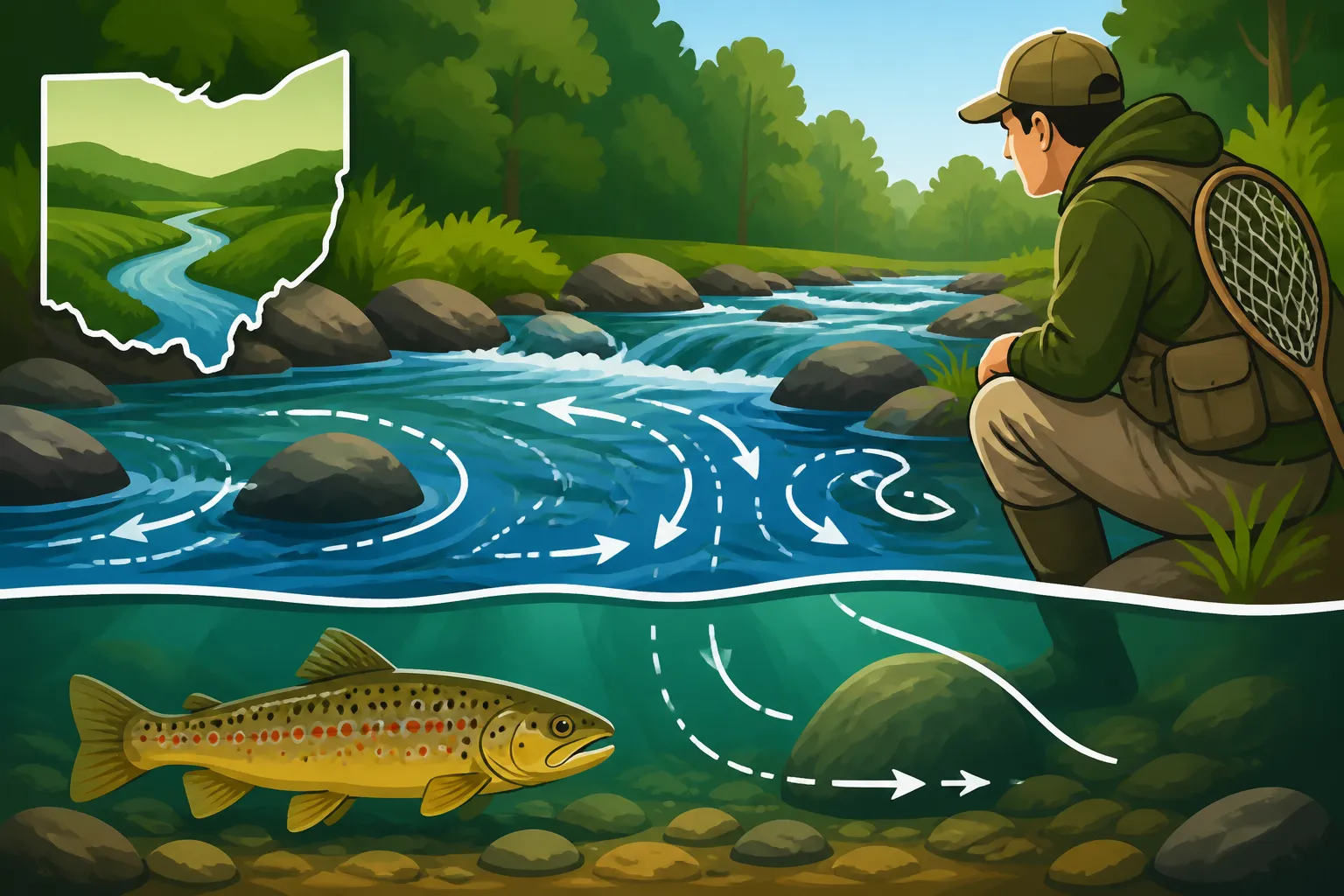
Pools are arguably the most obvious features in a small trout stream. They are simply deeper sections of water where the current slows down, often found below a riffle or a cascade. Eddies are pockets of calm or swirling water, often forming behind obstructions like large rocks or logs, where the main current flows past. Both are absolutely critical trout habitat.
Trout love pools because they offer depth, which provides cover and a sense of security. The slower current allows them to rest without fighting the flow, conserving precious energy. Yet, they are often positioned near the head or tail of a pool, where food from the faster water above or alongside is still accessible. An eddy is a fantastic ambush point, providing a perfect lie for a trout to dart out, grab a meal, and then retreat back to the relative calm. These areas are prime spots for finding larger, more territorial trout, so approach them stealthily.
Riffles and Runs: The Stream's Food Conveyor Belt
Riffles are those shallower, turbulent sections of a stream where the water tumbles over rocks, creating frothy white water. Runs are deeper, smoother sections of faster-moving water, often found between riffles and pools. While they might seem less inviting than a calm pool, they are incredibly important for trout.
Riffles are the stream's oxygenation and food delivery systems. The tumbling water introduces high levels of oxygen, which is vital for trout, especially in warmer conditions. More importantly, this turbulence dislodges insects and other invertebrates from the streambed, sending them downstream as an easy meal. Trout won't usually hold directly in the fastest, shallowest part of a riffle, but they will position themselves in the deeper slots, the edges of the fastest current, or immediately downstream where the current begins to slow, ready to intercept food. Runs, with their consistent flow, also act as excellent food conveyors, and trout will hold along their edges or behind any current breaks within them.
Undercut Banks and Overhanging Vegetation: Natural Shelters
These features are the natural hiding spots that every stream angler dreams of finding. An undercut bank is exactly what it sounds like: a section of the bank that has been eroded away by the current, creating a hollowed-out space beneath the surface. Overhanging vegetation includes bushes, trees, or grass that extend out over the water, often creating shade and offering additional cover.
Undercut banks provide incredible overhead and lateral cover, making trout feel completely secure. They can hide here from predators, resting in the slower currents found within the undercut, while still being able to dart out into the main current to feed. Overhanging vegetation offers similar benefits, casting crucial shade on hot days, providing terrestrial insects that fall into the water, and breaking up the visual line for predators. Always approach these spots carefully, casting into the darkest, most secluded areas first, as trout here are often holding tight and are easily spooked.
Reading the Current and Submerged Structures
It's not enough to just see a pool or a riffle; you need to understand how the water moves within these features and what hidden elements might be beneath the surface. The current is constantly dictating where trout will position themselves to conserve energy while maximizing feeding opportunities.
Think about how a strong wind might affect you walking down the street – you’d naturally seek shelter or a path of least resistance. Trout do the same. They leverage every subtle change in current or structure to their advantage. This is where the real "reading" comes in, and it's a skill that develops with observation and practice.
Current Seams and Transition Zones: Where Opportunities Lie
Current seams are invisible lines in the water where two different currents meet. This might be where a fast current brushes against a slower eddy, or where the main flow passes the slack water behind a large boulder. Transition zones are broader areas where one type of water feature gives way to another, such as the head of a pool transitioning from a riffle, or the tail of a pool where the water begins to speed up again.
These are absolute gold mines for trout. Current seams act like natural food conveyer belts, concentrating drifting insects and other forage along their edges. Trout will often sit just out of the fastest current, in the slightly slower water of the seam, waiting for food to be delivered to them. Transition zones, particularly the heads and tails of pools, are also prime areas because they offer a combination of faster feeding lanes and nearby resting or cover areas. A skilled angler knows that targeting these subtle boundaries often leads to success.
Submerged Structure: The Hidden Homes
Beneath the surface of a small stream lies a complex world of rocks, logs, root balls, and gravel beds. These submerged structures are far more than just obstacles; they are vital components of trout habitat, providing current breaks, cover, and insect-producing surfaces.
- Boulders and Rocks: Even a seemingly small boulder can create a significant current break downstream (a "cushion" of slower water) where a trout can hold comfortably. Larger rocks can create eddies on their sides or provide overhead cover.
- Logs and Root Balls: These are prime cover. Trout will often lie directly upstream, downstream, or to the side of submerged logs or fallen trees, using them to break the current and hide. Root balls from streamside trees can create complex underwater tunnels and pockets that are fantastic holding lies.
- Gravel and Cobble Beds: These aren't just pretty stream bottoms; they are crucial spawning habitat for trout (though many stocked Ohio trout don't reproduce naturally). More importantly, they harbor countless aquatic insects, making them productive feeding areas, especially when adjacent to current.
When you spot a dark spot in the water or a subtle change in the current's flow, it often indicates submerged structure. A good pair of polarized glasses helps immensely here, allowing you to peer through the glare and identify these hidden elements.
Depth Changes and Drop-offs: The Security Blanket
Even in small streams, changes in depth are critical. A drop-off, where the streambed suddenly plunges to a deeper level, can create significant holding water. These depth changes might be subtle, just a foot or two, but they make all the difference to a trout.
Deeper water provides security. Trout feel safer from aerial predators and less exposed to currents. During warmer months, deeper pools often hold cooler water, offering a vital thermal refuge. A trout positioned at the edge of a drop-off can quickly dart into the main current to grab food and then retreat to the safety of the deeper water. Always pay attention to how the stream bottom contours, as these underwater shelves and trenches are often prime real estate. If you're looking for more general guidance on Ohio fishing, our Ohio Fishing Regulations Every Angler Should Know covers a lot of the basics, including where you can fish.
Seasonal and Environmental Factors Affecting Trout Location
Trout aren't static residents; their preferred lies can change dramatically based on the time of year, water conditions, and even the time of day. Learning to adapt your water reading skills to these dynamic factors is key to consistent success. The stream is a living, breathing system, and its inhabitants respond to its rhythms.
Understanding how environmental changes influence trout behavior will make your water reading far more effective. It’s about thinking beyond just the immediate structure and considering the broader context of the stream at that moment.
Water Temperature: The Guiding Hand
Water temperature is perhaps the most critical environmental factor dictating trout behavior and location. Trout are cold-water fish, generally preferring temperatures between 45-65°F (7-18°C). Outside this range, they become stressed and inactive.
- Cold Water (Early Spring/Late Fall/Winter): In colder water, trout become sluggish and will seek out the deepest, slowest pools where they can conserve energy. They're less likely to be actively feeding in fast currents. Your presentation needs to be slow and deliberate.
- Optimal Water (Spring/Fall): During ideal temperature windows, trout are active and can be found throughout the stream, using all types of lies – riffles, runs, and pools – wherever food is abundant.
- Warm Water (Summer): This is when water reading becomes crucial for trout survival. Trout will actively seek out cold water refuges: spring-fed pockets, deep pools with groundwater seepage, or heavily shaded areas with turbulent, oxygenated water. Avoiding fishing during extreme summer heat is often recommended to minimize stress on these sensitive fish. You might find our Ohio Fishing Season Calendar helpful for understanding general seasonal shifts.
Water Clarity and Flow: Post-Rainfall Realities
Recent rainfall can dramatically alter a small stream, changing its clarity and flow rate. This directly impacts where trout will hold and how they feed.
- High, Muddy Water: After a heavy rain, the stream will often be high and discolored. Trout will move to the edges of the main current, seeking slower, clearer water along the banks or in eddies behind large obstructions. They rely more on scent and feel than sight in these conditions. This is a tough time for fly fishing, but worms or scented baits might be effective. You can find out more about this specific challenge in our guide on How to Tell If a River Is Too Muddy for Steelhead, which, while focused on steelhead, applies to trout in general.
- Normal Flow, Clear Water: In stable conditions, with normal flow and good clarity, trout are typically more spread out and actively feeding. All the features we discussed – riffles, runs, pools – are fair game. This is often the best time for sight fishing and presenting delicate flies or small lures.
- Low, Clear Water: During dry spells, water levels drop, and the stream becomes extremely clear. Trout become incredibly spooky. They will consolidate into the deepest, most shaded pools and under the thickest cover. Stealth becomes paramount, and longer, lighter leaders are essential. Fishing becomes challenging, but rewarding for those who can execute a perfect, subtle presentation.
Time of Day and Light: Shifting Priorities
Just like us, trout respond to the sun's position and the amount of light penetrating the water. Their activity and preferred lies can shift throughout the day.
- Low Light (Dawn/Dusk): These are often the prime feeding times for trout. They feel more secure in the dim light and will move out of the deepest cover into shallower feeding lanes, riffles, and the heads of pools. Terrestrial insects are also more active, making them a common food source.
- Bright Sun (Midday): As the sun climbs high, trout will typically retreat to deeper water, heavy cover (like undercut banks or logjams), or shaded areas. They become more cautious and harder to tempt. When the sun is high, consider targeting the deepest parts of pools or areas with significant overhead cover. This is when those polarized sunglasses are worth their weight in gold, allowing you to peer into the shadows. You can purchase effective models from retailers like Amazon that specialize in outdoor gear.
By combining your knowledge of water features with these dynamic environmental factors, you'll start to develop a true intuition for where trout are holding in Ohio's small streams. It's a journey of observation, experimentation, and a deep appreciation for the natural world.
A Quick Reference for Reading Water
To help you put all this information together, here's a quick table summarizing key water features and what they generally tell you about trout presence and behavior in small streams. Remember, these are guidelines, not hard-and-fast rules, as every stream and every day is different!
| Water Feature | Characteristics | What it Offers Trout | Trout Behavior/Location |
|---|---|---|---|
| Pools | Deep, slow-moving water, often below riffles. | Resting, security from predators, thermal refuge. | Often hold in the deepest sections, near head/tail for food. |
| Eddies | Swirling or calm water behind obstructions. | Resting, ambush point for food, current break. | Holding in slack water, facing upstream towards current. |
| Riffles | Shallow, turbulent water over rocks, noisy. | High oxygenation, dislodged insects, food delivery. | Along edges of fast current, deeper slots within the riffle. |
| Runs | Deeper, smoother fast-moving water. | Consistent food delivery, moderate oxygen. | Along current seams, behind submerged structures. |
| Undercut Banks | Eroded bank creating overhang/cavity. | Excellent overhead cover, security, slower current. | Deep inside the undercut, near the opening for feeding. |
| Overhanging Vegetation | Bushes/trees extending over water. | Shade, cover from predators, terrestrial insect drop. | Beneath the cover, especially in shaded areas; waiting for food. |
| Current Seams | Lines where fast & slow currents meet. | Food concentration, reduced current effort. | Just out of the fastest current, facing into the seam. |
| Submerged Rocks/Logs | Boulders, fallen trees, root balls underwater. | Current breaks, ambush points, hiding spots. | Immediately upstream, downstream, or to the side of the structure. |
| Depth Changes/Drop-offs | Sudden increase in water depth. | Security, cooler water, resting areas. | On the lip of the drop-off, in the deeper water. |
Developing Your Stream Sense: Practice and Observation
Reading water for trout in small Ohio streams isn't a skill you master overnight. It's an ongoing process of observation, experimentation, and building a deep understanding of how water moves and how trout react to it. Every stream is unique, and even within the same stream, conditions change daily.
One of the best ways to hone your skills is simply to spend time on the water, even when you're not actively fishing. Watch how the current behaves, where leaves collect, and how shadows fall. If you spook a fish, observe where it flees to – that's a clue about where it feels safe. Consider picking up a good field guide on stream dynamics or trout habitat, readily available from online retailers like Amazon, to deepen your theoretical understanding.
Don't be afraid to experiment with your casts and presentations in different types of water. What works in a slow pool might be completely ignored in a fast riffle. Keep a mental note, or even a small journal, of what worked and where you found fish. Over time, you'll develop an intuitive "stream sense" that will guide you to those hidden trout lies. Remember, persistence pays off, and every cast is a learning opportunity.
The beauty of fishing small streams is that they teach you patience and a profound connection to nature. Each successful fish caught feels like solving a puzzle, a reward for truly understanding the language of the water. So grab your gear, find a quiet stream, and start reading the water – the trout are waiting. For more specific information, you can also check out our comprehensive Ohio Fishing License Guide for Residents and Nonresidents to ensure you're always fishing legally.
Disclaimer
This article is for general informational purposes only and does not constitute professional advice. Laws, prices and regulations vary by location and change over time. Consult a qualified professional for guidance on your specific situation.