How to Identify a Blue Catfish
It's incredibly frustrating when you're out on the water, you reel in a monster catfish, and then you're left scratching your head, trying to figure out if it's a blue cat, a channel cat, or even a flathead. These differences aren't just academic; they can impact bag limits and size restrictions, especially here in Ohio. This guide is designed to cut through that confusion, helping you confidently identify a blue catfish so you can fish legally and contribute to responsible angling practices.
Why Accurate Catfish Identification is Crucial for Ohio Anglers
You might think, "A cat's a cat, right?" But for us Ohio anglers, that couldn't be further from the truth. Knowing the difference between a blue catfish, a channel catfish, and a flathead catfish isn't just about showing off your fish ID skills; it's about adhering to fishing regulations, understanding fish behavior, and ultimately, protecting our precious fisheries. The Ohio Department of Natural Resources (ODNR) sets specific rules for each species, and misidentification could lead to unintentional violations.
Imagine reeling in what you think is a trophy channel cat, only to find out later it was actually a blue cat, and you've accidentally exceeded the legal limit or kept an undersized fish for that species. This kind of mistake, while often innocent, can carry consequences. Beyond regulations, knowing your species helps you better target them in the future, as their preferred habitats and feeding behaviors can differ significantly. Understanding the subtle distinctions empowers you to become a more effective and responsible angler.
Navigating Ohio's Catfish Regulations
Ohio's fishing regulations are designed to manage fish populations sustainably, ensuring healthy fishing for generations to come. This means that daily bag limits and minimum size requirements can vary wildly depending on the specific species of catfish you've hooked. For instance, a blue catfish might have a different size restriction than a channel catfish, particularly on larger bodies of water like the Ohio River where blue cats truly thrive.
Staying informed about these regulations is your responsibility as an angler. Always check the latest Ohio Fishing Regulations Every Angler Should Know before heading out. If you're unsure, it's always safer to measure and release, or better yet, take a clear photo and try to identify it with the help of a reputable guide or online resources like the ODNR's own identification charts once you're back on shore. This diligence prevents potential fines and helps maintain the integrity of our waterways.
Protecting Our Fisheries Through Proper Identification
Beyond the rules, accurate identification plays a vital role in conservation. Blue catfish, for example, are a relatively newer addition to some Ohio waterways, notably the Ohio River, where they've established robust populations. Understanding their presence and growth helps wildlife biologists monitor their impact on native species and ecosystem health. When anglers can accurately report their catches, it provides invaluable data for fishery management.
Consider the excitement of catching a truly massive fish. If you misidentify it, that valuable data point about a trophy-sized blue cat in a specific Ohio River pool might be lost or misattributed. Contributing to accurate catch data, even informally through fishing reports, helps biologists make informed decisions about stocking, habitat improvements, and regulation adjustments. It’s all part of being a good steward of our aquatic resources, ensuring that the thrill of hooking a big cat continues for everyone.
The Distinctive Features of an Ohio Blue Catfish
When you're trying to identify a blue catfish, it's all about paying close attention to a few key physical characteristics. They're often confused with channel catfish, so knowing these specific traits will be your best friend. Think of it like a checklist you go through mentally when that fish comes out of the water.
The blue catfish is a magnificent fish, known for its sheer size potential. While many catfish share some general traits, blue cats have several defining characteristics that set them apart. From their unique anal fin to their overall body shape and coloration, each detail tells a story. Taking a moment to observe these features will quickly help you confirm your catch.
The Tell-Tale Anal Fin
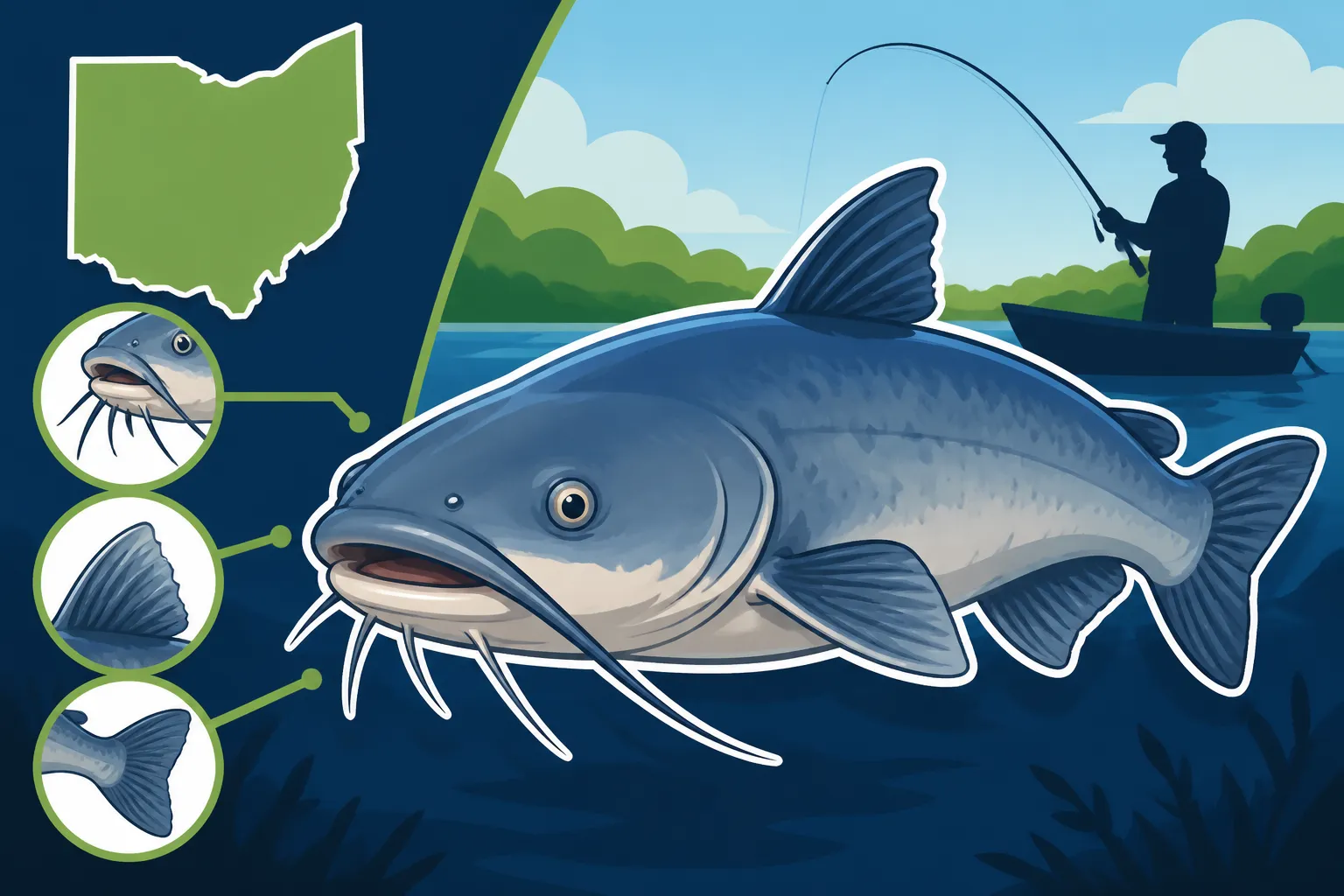
This is perhaps the most reliable characteristic for distinguishing a blue catfish from other species. The anal fin is the fin located on the underside of the fish, behind the anus and before the tail. For a blue catfish, this fin is long and has a straight outer margin, meaning it doesn't appear rounded or convex like some other catfish species.
Not only is the margin straight, but blue catfish also boast a significantly higher number of rays in their anal fin, typically ranging from 30 to 35 rays. This is a critical detail. You might need to gently spread the fin to count them, but it's a surefire way to tell. A quick count, even if it's an estimate, will often confirm your suspicion if you're looking at a true blue cat. This count is much higher than what you'd find on a channel catfish, which usually has fewer than 30 rays, and is shaped differently entirely.
Body Coloration and Shape
Blue catfish get their name for a reason! Their dorsal (back) side is typically a slaty blue to silvery-gray, often fading to a lighter, sometimes even white, belly. There are no spots on their body, which is a major distinguishing factor from channel catfish, especially smaller ones. The overall body shape is quite streamlined and robust, often appearing more "muscular" than a channel cat, particularly with larger specimens.
They often have a noticeable humped back just behind the head, especially in larger, mature individuals. This gives them a powerful, almost football-like appearance. While coloration can vary slightly based on water clarity and diet, the general absence of spots and the characteristic blue-gray hue are strong indicators. This sleek, unspotted, blue-grey body is a signature look that, once you learn it, is hard to mistake.
Head, Mouth, and Tail
Another set of important features can be found on the head and tail. Blue catfish have a relatively small head compared to their large, stout body. The head also appears somewhat flattened, but not to the extreme extent of a flathead catfish. Their mouth is usually subterminal, meaning the upper jaw slightly overhangs the lower jaw.
Perhaps the second most definitive characteristic after the anal fin is their deeply forked tail. This fork is much more pronounced and V-shaped than that of a channel catfish. Think of it as a sharper, more defined V. Their barbels (whiskers) are typically dark, matching their body coloration, and while long, they aren't unusually so. This combination of a relatively small head, robust body, and deeply forked tail paints a clear picture of a blue catfish.
Distinguishing Blue Catfish from Channel and Flathead Catfish
Here in Ohio, when you hook into a catfish, it's usually one of three main species: the blue catfish, the channel catfish, or the flathead catfish. While they are all "catfish," they have distinct features that anglers need to know. Misidentification is common, especially between smaller blue cats and larger channel cats. Let's break down the key differences so you can confidently tell them apart.
Often, the excitement of a bent rod and a splashing fish can make precise identification challenging, especially if you're new to catfish fishing. But with a little practice and a focus on specific anatomical markers, you'll become an expert. Remember, these distinctions aren't just for bragging rights; they're essential for complying with fishing regulations and ensuring the health of our fisheries.
Blue Catfish vs. Channel Catfish: The Anal Fin is Key
This is where most anglers get tripped up. Young blue catfish can sometimes be mistaken for channel catfish, especially if you're not looking closely. However, the anal fin is your absolute best friend here. As mentioned, the blue catfish has a long anal fin with a straight margin and 30-35 rays.
On the other hand, the channel catfish has an anal fin that is noticeably shorter, with a rounded or convex margin, and typically fewer rays, ranging from 24-29. This difference in shape and ray count is unmistakable once you know what to look for. Additionally, channel catfish often have distinct black spots on their body, particularly when they are smaller, though these spots can fade or disappear on very large or older fish. Blue catfish, remember, are never spotted. Both species have deeply forked tails, but the blue cat's fork is generally more pronounced and sharper than the channel cat's. If you're looking for gear to help you land these beauties, you can find a wide selection of robust catfish rods and reels on Amazon.
Blue Catfish vs. Flathead Catfish: Head Shape and Tail
Distinguishing a blue catfish from a flathead catfish is generally easier due to more dramatic physical differences. The flathead catfish truly lives up to its name, possessing a very broad, flat head that looks distinctly different from the blue cat's relatively smaller, slightly flattened head. Their lower jaw protrudes significantly, giving them a unique "bulldog" appearance.
Perhaps the most striking difference is the tail. While both blue and channel catfish have deeply forked tails, the flathead catfish has a rounded or squarish tail that may have a slight notch, but is never deeply forked. Their body coloration is also quite distinct, often appearing mottled brown, yellow, or olive, with darker blotches, allowing them to blend into their riverine habitat. They lack the silvery-blue to gray coloration of a blue cat. Their eyes are also notably smaller than those of blue or channel cats, usually positioned high on their flat head. You can find excellent waterproof fishing guides on Amazon that include detailed illustrations to help with these distinctions.
To help visualize these differences, here's a quick comparison table:
| Feature | Blue Catfish | Channel Catfish | Flathead Catfish |
|---|---|---|---|
| Anal Fin Margin | Straight, uniform length | Rounded or convex | Very short, somewhat rounded |
| Anal Fin Rays | 30-35 | 24-29 | 14-17 |
| Body Coloration | Silvery-blue to slate gray, no spots | Gray to olive, usually with dark spots (can fade) | Mottled brown/yellow/olive, dark blotches, no spots |
| Tail Shape | Deeply forked, V-shaped | Moderately forked | Rounded or slightly notched, not forked |
| Head Shape | Relatively small, slightly flattened | Moderate, somewhat rounded | Very broad, flat, shovel-like |
| Mouth Position | Upper jaw slightly protrudes | Terminal (jaws even) | Lower jaw protrudes significantly |
| Size Potential | Can grow very large (100+ lbs) | Medium to large (up to 50 lbs) | Large (up to 100+ lbs) |
| Ohio Habitat | Mainstem rivers (Ohio, Scioto), large reservoirs | Widespread in rivers, lakes, ponds | Mainstem rivers, large tributaries |
Habitat and Behavior as Identification Clues
Sometimes, where you catch a fish and how it acts can give you hints about its identity. Blue catfish are primarily found in large rivers and reservoirs with strong currents, deep channels, and plenty of open water. In Ohio, the Ohio River is famous for its thriving blue catfish population, and they are also establishing themselves in other major river systems like the Scioto River. They tend to school up, especially larger ones, and are often found in deeper pools, eddies, and channels. Fishing the Ohio River for Catfish will give you more insights into their prime locations.
Channel catfish, while also found in rivers, are much more widespread and adaptable, inhabiting nearly every type of water body in Ohio, from small farm ponds to large lakes and slow-moving streams. They tolerate a wider range of conditions and are often found in shallower areas, near cover, and along ledges. Flathead catfish, on the other hand, are ambush predators that prefer structure-rich areas in rivers and large creeks, often associating with logjams, undercut banks, and rocky bottoms where they can hide and wait for prey. While these are general trends, combining these habitat clues with physical identification is a powerful tool. Knowing the usual haunts for each species can certainly narrow down your options when you’re trying to figure out what you’ve just hauled in. For those deep-water blue cat adventures, a good fish finder is essential, and you can browse various models on Amazon.
Tips for Confirming Your Blue Catfish Identification on the Water
Even with all the knowledge in the world, identifying a fish quickly in a boat or on the bank can be a challenge. The fish is often moving, possibly slippery, and you might be excited or simply trying to get it back into the water efficiently. Having a few practical tips and tools on hand can make the process much smoother and more accurate.
Remember, the goal is not just to identify the fish correctly, but to do so safely for both you and the fish, especially if you plan on releasing it. A quick, confident ID means less handling time and a better chance for the fish's survival. Always prioritize the fish's well-being, especially for larger specimens that put up a good fight.
Keep a Field Guide Handy
One of the simplest yet most effective tools for on-the-water identification is a good field guide. Many comprehensive Ohio fishing guides include detailed illustrations and descriptions of common fish species, including the various catfish. You can keep a waterproof version in your tackle box or boat bag.
When you land a fish that puzzles you, a quick flip through the guide can often resolve the mystery. Look for pages dedicated to Ohio Channel Catfish Identification or Ohio Flathead Catfish Identification for direct comparisons. These guides often highlight the key features we've discussed, such as anal fin ray counts and tail shapes, making it easier to confirm your observations. This little resource can be a real lifesaver when you're uncertain, and many excellent ones are available on Amazon, often in compact, durable formats perfect for fishing trips.
Take Clear Photos for Later Reference
If you're still unsure, or if you practice catch and release, taking a few clear photos of your catch is an excellent strategy. Make sure to get shots that clearly show the key identification features:
- The entire fish: To show overall body shape and coloration.
- The anal fin: Spread out if possible, to show the margin and, if you can zoom in, even count the rays.
- The tail: To clearly show how deeply (or not deeply) it is forked.
- The head: From the top and side, to show its shape and jaw protrusion.
These photos can then be reviewed later, at home, using a larger screen and more time. You can compare them to online resources, your field guide, or even ask experienced anglers for their opinion. It’s a fantastic way to learn and become more proficient at identification over time, building your confidence for future trips.
The Importance of Safe Handling Practices
No matter what species you catch, always prioritize safe handling, especially with large catfish which can be powerful and have sharp pectoral and dorsal fins. If you’re going to measure or photograph the fish for identification, do it as quickly and gently as possible.
Consider using a large, rubberized landing net to safely secure the fish in the water before bringing it aboard. If you're targeting big cats, a sturdy pair of lip grippers can help you control the fish without harming its jaw, while also keeping your hands away from any sharp spines. Minimizing the time the fish is out of the water is crucial for its survival, so practice your identification steps to be as efficient as possible. Responsible handling ensures that even if you release your blue catfish, it has the best chance of thriving and growing even bigger for another angler to enjoy.
Disclaimer
This article is for general informational purposes only and does not constitute professional advice. Laws, prices and regulations vary by location and change over time. Consult a qualified professional for guidance on your specific situation.