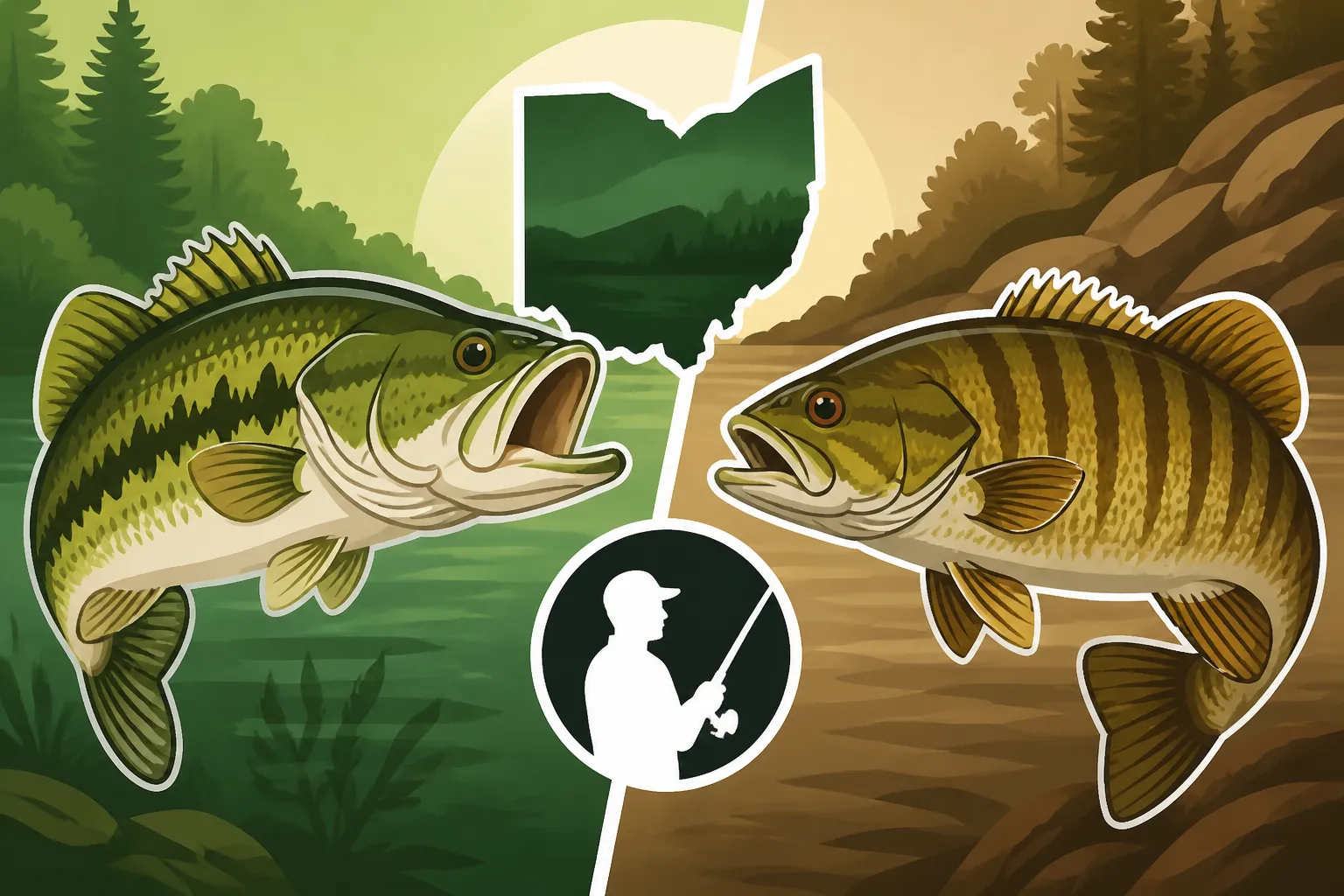
How to Tell a Largemouth From a Smallmouth Bass
Oh, the age-old dilemma! You're out on an Ohio lake, feeling that tell-tale tug, and as you reel in your catch, you squint. Is it a largemouth or a smallmouth? Many anglers, from seasoned veterans to excited newbies, struggle to quickly distinguish these two popular bass species. It’s not just about bragging rights; knowing the difference is crucial for adhering to specific regulations and understanding where to find them. This guide will help you confidently identify whether you've landed a largemouth or a smallmouth bass in Ohio waters.
The Jawline and Mouth Structure: Your First Clue
When you pull a bass out of the water, the very first thing you should look at—even before considering color—is its mouth. This is often the most definitive characteristic separating largemouth from smallmouth bass. It’s a reliable indicator that you can quickly spot, making it invaluable when you're on the water and need to make a fast identification.
How to Spot a Largemouth's Jaw
Think "big mouth," and you're already halfway there for a largemouth bass. Their jaw extends significantly further back than their eye. If you gently hold the fish and trace an imaginary line straight down from the back of its eye, you'll find that the corner of the largemouth's jaw, or maxilla, goes well beyond that line, often ending quite a bit past the back edge of the eye socket. It's a truly cavernous mouth, designed to engulf prey whole. This anatomical feature gives them a distinct advantage when ambushing unsuspecting baitfish or frogs.
Moreover, the largemouth's lower jaw tends to protrude noticeably past the upper jaw, giving it an almost perpetually "frowning" or aggressive appearance. This big, forward-facing mouth is a key adaptation for their preferred hunting style: lurking in dense cover and exploding out to ambush prey. When you see a bass with a mouth that looks like it could swallow a golf ball whole, you're almost certainly looking at a largemouth. This massive oral cavity also explains why they're so susceptible to larger, more aggressive lures, which you can easily find on Amazon for your next fishing trip.
Identifying a Smallmouth's More Modest Mouth
In stark contrast, the smallmouth bass lives up to its name. Its mouth is considerably smaller, and the jawline rarely extends past the middle of the eye, if it even reaches that far. If you perform the same imaginary line test from the back of the eye, the smallmouth's jaw will typically end before or directly underneath the pupil. It's a much more proportionate mouth relative to the size of its head, giving the fish a sleeker, more streamlined look.
Their jaws might still be quite strong, but they aren't designed for the same kind of gulp-and-swallow ambush tactics as their largemouth cousins. Instead, smallmouth are more adept at picking off smaller prey, like crayfish, insects, and tiny baitfish, often found in rocky environments. You'll notice their upper and lower jaws meet more evenly, without the pronounced overbite often seen in largemouth. This more compact mouth is perfectly suited for nabbing quick, agile snacks in clear, current-laden waters. It’s a subtle but critical difference that once you see, you'll never unsee.
Coloration and Pattern: More Than Just "Brown" or "Green"
While the mouth is your most reliable primary identifier, the color and markings of a bass can offer strong secondary clues. However, don't rely solely on color, as it can vary wildly depending on water clarity, diet, and even the fish's stress levels. A largemouth from muddy water might look drastically different from one caught in a clear, spring-fed lake, and the same goes for smallmouth.
Deciphering Largemouth Coloration and Lateral Line
Largemouth bass are typically known for their greenish hue, ranging from a vibrant olive green to a much darker, almost blackish green. This coloration often provides excellent camouflage in the weedy, often stained waters they prefer. The most distinctive pattern feature is a prominent, dark, horizontal lateral line running from the gills to the tail. This line can sometimes appear as a broken series of blotches rather than a solid stripe, but it’s always present and usually quite obvious. On some fish, especially those from very clear water, this line might be less distinct, but it's generally a reliable marker.
The belly of a largemouth is usually white or cream-colored, offering a sharp contrast to its darker back and sides. You might also notice irregular, dark blotches or spots scattered above the lateral line, breaking up their green scales. Remember that a largemouth can sometimes appear almost brown, especially if it's been living in tannic, boggy water or has a lot of dark substrate around it. But even then, the horizontal lateral line pattern usually remains discernable. If you're looking for Ohio Largemouth Bass Fishing Guide tips, understanding their typical coloration can help you spot them in their preferred habitats.
Recognizing Smallmouth's Mottled Markings and Vertical Bars
Smallmouth bass, as their name subtly suggests (they're often called "bronze-backs"), tend to exhibit a more brownish or bronze coloration. Their backs and sides are typically a rich, warm brown, sometimes with shades of gold, copper, or even yellowish-green, especially if they're caught from areas with significant algae growth. Unlike the distinct horizontal stripe of the largemouth, smallmouth bass often feature a series of dark, vertical bars or splotches along their sides. These bars can be very pronounced on some individuals, almost resembling tiger stripes, while on others, they might appear as more subtle, mottled patterns.
Their bellies are usually a lighter cream or yellowish-white, but the transition from the darker sides to the belly is often less abrupt than with a largemouth. Smallmouth from extremely clear water or those that have been stressed can sometimes appear very pale, almost silver, making identification a bit trickier. However, the presence of vertical barring, even if faded, remains a key characteristic. These vertical markings help them blend into rocky environments, mimicking shadows and crevices, which is exactly where these fish prefer to hunt. For more on where to find them, check out our Best Ohio Lakes for Smallmouth Bass article.
Dorsal Fin Separation: A Subtle, Yet Definitive Trait
Another often-overlooked but highly accurate way to differentiate between these two bass species is by examining their dorsal fins. The dorsal fin is the fin located on the fish's back. Both largemouth and smallmouth have two dorsal fins, but how they connect (or don't connect) is a critical diagnostic feature.
The Distinct Divide on a Largemouth
For a largemouth bass, the two dorsal fins are almost completely separated. There’s a noticeable, deep indentation or even a complete break between the spiny, anterior dorsal fin (the one closer to the head) and the softer-rayed, posterior dorsal fin (the one closer to the tail). It's as if they are two distinct fins positioned very close to each other, but not truly fused or continuous. You can often easily run your finger between the two sections without encountering any fin membrane.
This clear separation is a characteristic shared by many members of the sunfish family, to which bass belong. When you're handling a largemouth, you'll feel the rigid, sharp spines of the front dorsal fin, followed by a gap, and then the more flexible rays of the rear fin. This distinct division is a consistent anatomical trait that won't change based on water clarity or diet, making it a reliable identifier, regardless of where in Ohio you hook your fish. Keep this in mind, especially when you're examining a fish that might have unusual coloration.
The Connected Look of a Smallmouth's Dorsal Fins
Smallmouth bass, on the other hand, have dorsal fins that are more connected. While there is still a slight dip or notch between the spiny front section and the soft-rayed rear section, it’s not a deep, pronounced separation like you see in a largemouth. The membrane connecting the two dorsal fins is continuous, forming a single, albeit slightly notched, dorsal fin. You wouldn't be able to easily run your finger through a gap; instead, you'd feel a smooth, continuous membrane.
This subtle difference, though it might seem minor, is a strong indicator. It often gives the smallmouth a sleeker, more uninterrupted dorsal profile. If you run your hand gently along the back of a smallmouth from head to tail, you'll feel the spines transition into soft rays with only a minor interruption. This connected fin is part of their overall more streamlined body design, which is excellent for maneuvering in the currents and rocky structures they frequent. Understanding this can be particularly helpful if you're trying to distinguish between a very young largemouth and a smallmouth, where other features might be less developed.
Body Shape and Habitat Preferences: Where They Live, How They Look
Beyond the mouth, coloration, and fins, the overall body shape and the environments where you find these bass can give you further clues to their identity. Their physical forms are often adapted to their preferred habitats, making these aspects interconnected.
Largemouth's Stocky Build and Preferred Cover
A largemouth bass generally has a more robust, stocky, and somewhat "football-shaped" body. They are often deeper-bodied and have a more rounded profile, particularly as they mature. This body shape, combined with their large mouth, is perfect for their ambush predator lifestyle. They are kings of cover, preferring to hide in dense vegetation like lily pads, cattails, submerged grass beds, brush piles, fallen trees, and docks. They thrive in warmer, often murkier, and slower-moving waters, such as shallow lakes, ponds, sluggish rivers, and the quiet coves of larger reservoirs.
Their ability to live in such thick cover means they don't need to be as streamlined as their smallmouth cousins. Instead, their bulk gives them power and the ability to burst out from concealment to snatch prey. If you're fishing a weedy, shallow bay on a hot summer day and catch a green fish with a huge mouth, it's almost certainly a largemouth. This preference for heavy cover is why many anglers use weedless lures and heavy-duty rods, often purchased from retailers like Amazon, to pull these fish out of their hiding spots. For more detail on targeting these beauties, see our Best Ohio Lakes for Largemouth Bass article.
Smallmouth's Streamlined Form and Rocky Haunts
Smallmouth bass, by contrast, are typically more streamlined and slender. They have a torpedo-shaped body, built for speed and agility in moving water or open, rocky areas. Their body is generally less deep than a largemouth's and can appear more compressed side-to-side. This sleek physique allows them to navigate currents and rocky structures with ease, making them formidable fighters once hooked. They are often found in cooler, clearer waters with rocky bottoms, gravel shoals, current seams, and submerged timber. Think of the deeper, cleaner sections of Lake Erie, larger rivers, or rocky reservoirs like Alum Creek Lake.
Their habitat preference means they don't rely on dense vegetation for ambush points as much as largemouth do. Instead, they use rocks, ledges, and current breaks to hide and ambush crayfish and baitfish. If you're casting around boulders in a clear river or dropping a tube jig over a gravel bar on a big lake, and you hook a powerful, bronze-colored fish that fights like a demon, it's almost certainly a smallmouth. Understanding these habitat preferences not only aids in identification but also in locating these fantastic sportfish. Our guide on Smallmouth Bass Habitat Preferences delves deeper into where these fighters live.
Quick Reference Table: Largemouth vs. Smallmouth Bass in Ohio
To help you quickly distinguish between these two popular species, here's a handy table summarizing the key differences we've discussed. This can be a great cheat sheet to keep in your tackle box or on your phone for quick reference out on the water.
| Feature | Largemouth Bass | Smallmouth Bass |
|---|---|---|
| Mouth Size | Jaw extends past the back of the eye. | Jaw does not extend past the back of the eye (or only slightly). |
| Lateral Line | Prominent dark, horizontal stripe (often broken). | Series of dark, vertical bars or mottled patterns. |
| Coloration | Typically green (olive to dark), white belly. | Typically brown/bronze, sometimes yellowish-green. |
| Dorsal Fins | Deeply separated, almost two distinct fins. | Connected, with only a shallow notch. |
| Body Shape | Stocky, deeper body, more rounded profile. | Streamlined, more slender, torpedo-shaped. |
| Preferred Habitat | Dense vegetation, shallow, warmer, often murky water. | Rocky bottoms, clear, cooler water, current seams. |
| Lower Jaw | Often protrudes noticeably beyond the upper jaw. | Upper and lower jaws meet more evenly. |
Why Accurate Identification Matters Beyond Bragging Rights
You might think, "A bass is a bass, right?" But for serious anglers in Ohio, knowing how to tell a largemouth from a smallmouth bass is incredibly important for several practical reasons. First and foremost, fishing regulations, specifically Ohio Largemouth and Smallmouth Bass Minimum Length Limit and Ohio Bass Daily Limit on Inland Lakes, can vary between the two species, or sometimes for different bodies of water. You definitely don't want to get a citation because you misidentified your catch and kept an undersized fish! Always check the current Ohio fishing regulations before heading out.
Secondly, understanding the differences helps you become a more effective angler. If you know you're targeting smallmouth, you'll choose lures, techniques, and locations that cater to their preferences – perhaps a tube jig on rocky drop-offs, rather than a frog over lily pads. Conversely, if you're after largemouth, you'll focus on heavy cover with spinnerbaits or soft plastics. Knowing which species you've caught also contributes valuable data to fisheries management; accurate angler reports help the Ohio Division of Wildlife maintain healthy fish populations for everyone to enjoy. So, the next time you reel one in, take a moment to observe those key features. You'll not only be a more informed angler but also contribute to the conservation of these magnificent fish in Ohio.
Disclaimer
This article is for general informational purposes only and does not constitute professional advice. Laws, prices and regulations vary by location and change over time. Consult a qualified professional for guidance on your specific situation.