How to Locate Baitfish Schools on Lake Erie
Ever feel like you're just dragging your lines through empty water on Lake Erie, wondering where all the fish have gone? It's a common, utterly frustrating experience. Often, the reason you're not finding those trophy walleye or jumbo yellow perch is simply because you haven't found their food source. This guide is dedicated to demystifying the art and science of locating baitfish schools on Lake Erie, helping you understand their patterns, the tools to find them, and how to put yourself in the prime position for a productive day on the water.
Understanding Baitfish and Their Importance on Lake Erie
When you're out on the vast expanse of Lake Erie, it can feel like finding a needle in a haystack. But here's the secret: the "needle" often isn't the walleye or perch you're after, it's the schools of baitfish they're relentlessly pursuing. These smaller fish are the lifeblood of Lake Erie's ecosystem, forming the foundation of the food chain for virtually every predatory species we love to target. Ignoring them is like trying to find a hungry diner in a restaurant with no food – it just doesn't make sense!
Why Baitfish are Key to Successful Angling
Think of the relationship between baitfish and game fish like a perpetual game of hide-and-seek, where the stakes are life and death for the smaller fish, and a full belly for the predators. Walleye, yellow perch, smallmouth bass, and even the occasional steelhead or muskie aren't just swimming around aimlessly hoping to stumble upon a meal. They are actively hunting, patrolling areas where their prey congregates. If you can locate these dense schools of baitfish, you've essentially pinpointed the dinner table for the very fish you're trying to catch.
This predator-prey dynamic is incredibly powerful. A concentrated ball of baitfish acts like a magnet, drawing in game fish from a wide radius. When these schools are present, the predatory fish are often more active, more aggressive, and generally easier to entice with your lures or bait. Conversely, if you're fishing in an area devoid of baitfish, your chances of a successful catch plummet dramatically. It's a fundamental principle of fishing that savvy anglers always keep in mind: find the food, and you'll find the fish. This understanding is paramount for successful Ohio Walleye Fishing Guide or when you're specifically targeting perch.
Common Baitfish Species in Lake Erie
Lake Erie boasts a diverse array of baitfish, each with its own habits and preferences, but all serving as crucial food sources. Understanding which species are present and their typical behavior can give you a significant advantage.
Alewives and gizzard shad are two of the most common pelagic (open water) baitfish on Lake Erie. Alewives are slender, silver-sided fish that often form massive schools. They tend to prefer cooler water and are a primary food source for larger walleye, especially in the central and eastern basins. Gizzard shad, on the other hand, are rounder, with a distinct gizzard, and thrive in warmer, more turbid waters, often found closer to shore or in the shallower western basin. Both species are highly mobile, following plankton blooms and changes in water temperature, which means the game fish feeding on them will be on the move too.
Emerald shiners are another historically important baitfish, particularly favored by yellow perch and smaller walleye. These shimmering, delicate fish are often found closer to the bottom or in shallower areas, especially during certain times of the year. Finally, rainbow smelt, though less abundant than they once were, still provide forage, especially in deeper, colder waters. Each of these species forms dense schools, and identifying their typical habitat and behavior is critical. For instance, if you're looking for jumbo perch, you'll want to focus on areas where these baitfish are present, which ties directly into effective Ohio Yellow Perch Fishing Guide strategies.
Essential Tools for Locating Baitfish Schools
Trying to find baitfish schools on a body of water the size of Lake Erie without the right equipment is akin to searching for a needle in that proverbial haystack blindfolded. Modern technology and a bit of old-school research can significantly improve your odds. These tools aren't just gadgets; they're essential navigation and detection aids that empower you to read the underwater world.
Using Your Fish Finder Effectively
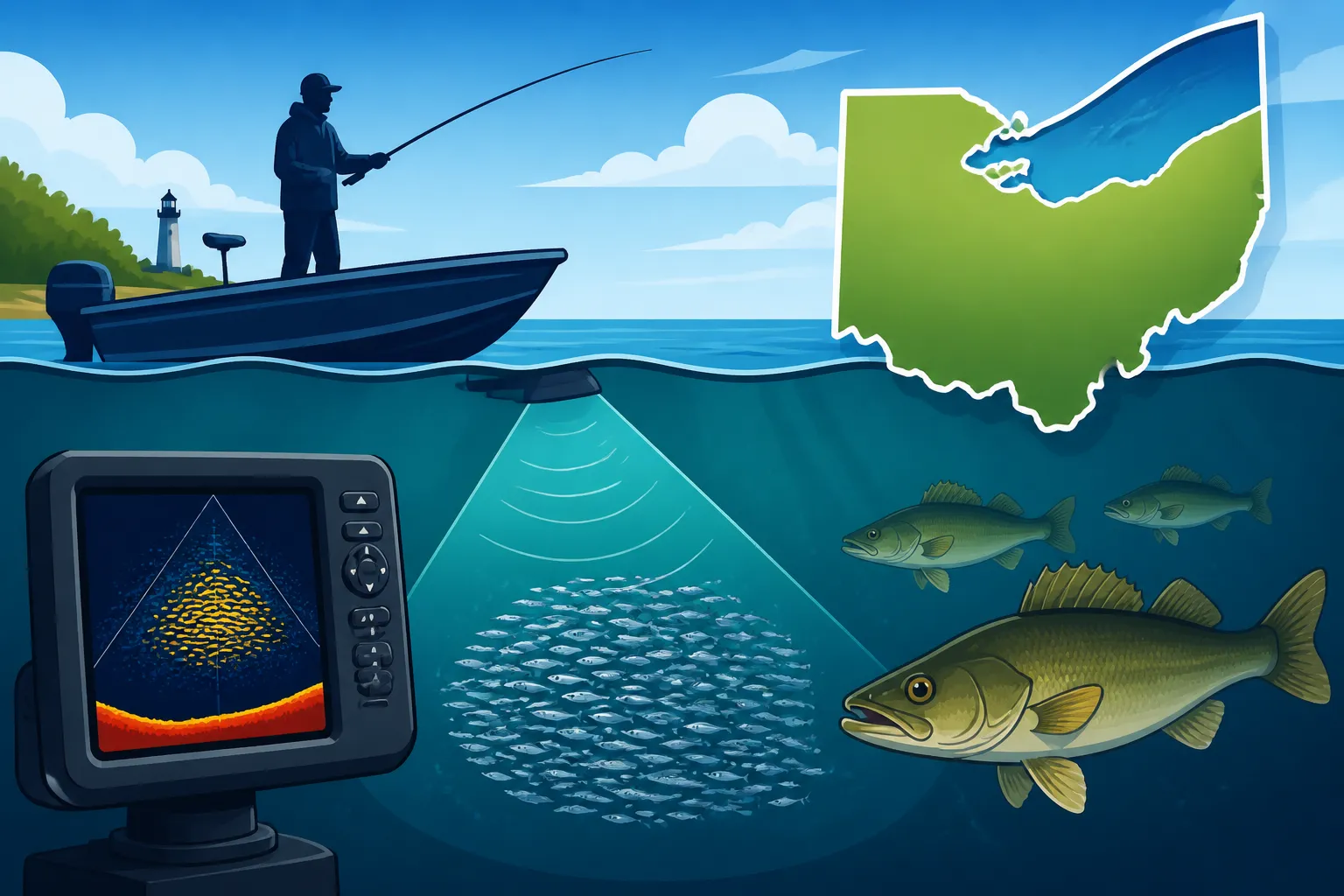
Your fish finder is arguably the most critical piece of equipment for locating baitfish. It's not just for seeing individual fish; it's a window into the entire underwater ecosystem. To effectively use it, you need to understand what you're seeing. Baitfish schools often appear as dense, amorphous clouds or "balls" on your sonar screen. They might look like a thick, inverted cone or a scattered mess of dots, depending on the species, how tightly schooled they are, and your transducer's cone angle.
A high-frequency transducer (200 kHz or higher) will give you better target separation, meaning you can distinguish individual fish within a tight school, but it penetrates less deeply. A lower frequency (50 kHz or 83 kHz) will give you broader coverage and deeper penetration, but less detail. Many modern units, including popular models you can find on Amazon, offer CHIRP sonar, which sends a range of frequencies for excellent detail and depth. Pay attention to the "gain" or "sensitivity" setting; too low and you'll miss the fainter returns of small baitfish, too high and you'll get excessive clutter. Look for arches or strong returns hovering around or within these bait balls – those are your target species. Learning How to Read a Fish Finder for Suspended Walleye is a game-changer, as walleye often suspend directly above, below, or within these bait schools.
When you spot a bait ball, observe its depth and movement. Are the baitfish tightly packed, indicating they're being pursued? Or are they more spread out, feeding leisurely? Are there larger arches nearby? These observations will tell you if you've found an active feeding zone. Adjust your boat speed to get a clear picture; sometimes slowing down or speeding up will help differentiate between structure and fish.
Topographic Maps and Lake Charts
Long before fish finders became ubiquitous, anglers relied on charts and maps, and they're still incredibly relevant today. Topographic maps, whether paper or digital on your chartplotter, reveal the contours of the lake bottom: reefs, drop-offs, humps, channels, and flats. Baitfish, and consequently the game fish that hunt them, don't just hang out randomly. They relate to structure.
For example, a deep drop-off might serve as a highway for baitfish moving between shallow feeding grounds and deeper safety. A hump or reef might create an upwelling of nutrients, attracting plankton, which in turn draws baitfish. Understanding these underwater features allows you to predict where baitfish might congregate, even before you turn on your sonar. Look for areas with sudden changes in depth, or points and ledges that create current breaks. Many dedicated Lake Erie Fishing Guide for Ohio Anglers maps highlight these key structural elements.
Cross-referencing your sonar readings with your charts is key. If your fish finder shows a bait ball at 30 feet, and your chart shows a deep channel running nearby, you're starting to build a complete picture of why the fish are there. Digital charts on devices, often purchased through retailers like Amazon, allow for overlays of depth, bottom composition, and even historical hot spots, making this analysis even more powerful.
Leveraging Online Resources and Fishing Reports
In today's connected world, you're not fishing in a vacuum. The collective knowledge of the angling community, coupled with official reports, can be an invaluable asset in locating baitfish. Online fishing forums, local bait shop websites, social media groups, and even official state wildlife division reports frequently share information about where baitfish schools are being observed.
These resources can provide real-time or near real-time intelligence. For example, a report might mention "huge schools of shiners at 25 feet off a certain buoy," or "gizzard shad pushing into the river mouths after the last rain." While conditions can change rapidly on Lake Erie, these reports give you a starting point and can save you hours of searching. Always verify information with your own eyes and electronics, but use these resources to narrow down your search area significantly. Think of it as getting a few clues before you start your own detective work. Many seasoned anglers on the forums will share their observations, giving you a valuable head start on identifying active zones for Ohio Walleye Fishing Guide or Ohio Yellow Perch Fishing Guide targets.
| Baitfish Species | Typical Depth/Habitat | Sonar Appearance | Predator Interest |
|---|---|---|---|
| Alewives | Pelagic, open water, cooler temps | Dense, suspended clouds/balls | Walleye, Lake Trout, Salmon |
| Gizzard Shad | Pelagic, warmer, often shallower/turbid | Scattered or dense clouds, near structure | Walleye, Bass, Catfish |
| Emerald Shiners | Near bottom or mid-water, shallower | Smaller, tighter schools, often near structure | Perch, Walleye, Smallmouth |
| Rainbow Smelt | Deeper, colder water, often nocturnal | Smaller, scattered groups or loose schools | Walleye, Lake Trout |
On-the-Water Strategies for Finding Baitfish
Once you've done your homework with charts and reports, it's time to hit the water. But simply idling around hoping to stumble upon baitfish isn't the most efficient approach. Successful anglers employ a combination of keen observation and calculated maneuvers to actively seek out these vital food sources. It's about being a detective, looking for clues both above and below the surface.
Observing Environmental Cues
Sometimes, the best fish finder isn't electronic; it's the natural world around you. Pay close attention to environmental cues that can indicate the presence of baitfish.
One of the most obvious indicators is bird activity. If you see flocks of gulls, terns, or other diving birds actively working an area, repeatedly diving into the water, it's almost certain they're feeding on baitfish pushed to the surface. These birds are essentially nature's fish finders, keying into the same baitfish concentrations that predatory game fish are. This is particularly common on Lake Erie when species like emerald shiners or young-of-the-year alewives are balled up near the surface.
Surface disturbances can also be a tell-tale sign. Look for subtle ripples, nervous splashes, or even schools of baitfish visibly dimpling the surface as they try to evade predators. This often happens early in the morning, late in the evening, or on overcast days when baitfish feel safer near the surface. While a flat, calm lake can make these observations easier, even in choppy conditions, a sudden change in surface texture or a flash of silver can indicate a feeding frenzy below.
Water temperature also plays a critical role. Baitfish, like all cold-blooded creatures, are highly sensitive to temperature changes. They'll often seek out their preferred temperature range, and game fish will follow. Use your fish finder's temperature gauge and look for thermoclines – distinct layers of water with different temperatures. Baitfish often congregate around these thermoclines, where food is abundant and oxygen levels are optimal. This is especially true during the summer months.
Targeting Specific Depths and Structures
Baitfish don't just roam aimlessly; they relate to specific depths and structures. Your strategy for finding them should incorporate this understanding.
As mentioned with charts, structural elements like reefs, humps, and drop-offs are prime locations. Baitfish will use these features for cover, or to ambush smaller prey, or simply because these areas concentrate plankton. A significant breakline – where the bottom contour changes dramatically – can act as a natural funnel for baitfish movement. Start by idling over and around these features, scanning with your sonar. You might find baitfish stacked up on the deep side of a hump, or hovering just off a rocky reef.
Beyond physical structure, "invisible" structures like the thermocline are equally important. The thermocline is a layer in the water column where the temperature changes rapidly. In Lake Erie, this typically sets up during the warmer months, providing cooler, oxygenated water below for some species, and warmer water above for others. Baitfish will often "stack" on or just above the thermocline, creating a visible band on your sonar. Predatory fish will patrol these edges, darting in and out to pick off unsuspecting baitfish. Adjusting your fishing depth to target this thermocline, especially for species like walleye, can be incredibly productive. This is a common strategy in Best Ohio Walleye Fishing Techniques.
Transition areas, where different bottom compositions meet (e.g., sand to rock, mud to gravel), can also be baitfish magnets. These areas often harbor a greater diversity of invertebrates, which are a food source for the baitfish themselves. Scan these zones carefully, as subtle changes can hold significant concentrations of forage.
Trolling and Drifting Patterns
Lake Erie is enormous, and covering water efficiently is crucial, especially when searching for mobile baitfish schools. Trolling and drifting are excellent strategies for this.
When you're actively searching, start by implementing a systematic trolling pattern. Don't just run in a straight line; use zig-zags, S-curves, or large circles to cover a wider area and vary the depth and speed of your presentation. This allows your fish finder to scan more of the water column and bottom. As you troll, constantly monitor your sonar. Once you mark a significant bait ball, you can then focus your efforts, perhaps by circling back through the area or deploying your fishing lines. Trolling for Lake Erie Walleye is a prime example of using this method to not only find fish but also present lures.
Varying your trolling speed is also important. Different baitfish species, and different presentations, respond to different speeds. Sometimes a slow crawl will give your sonar the best picture, while other times a faster pace is needed to trigger a predatory strike. Experiment and watch your electronics. If you mark fish in an area, you can also use this as an opportunity to check your Best Trolling Speed for Lake Erie Walleye.
Drifting is another effective search method, particularly when there's a good breeze. It allows you to present your baits or lures naturally while covering a wide swath of water. If you're drift fishing for yellow perch, for instance, you'd typically start upwind of a known structural element or a reported baitfish location and let the wind and current carry you. As you drift, keep an eye on your fish finder. If you start marking baitfish, drop a waypoint and consider another drift through that productive zone. You can also deploy a drift sock to control your speed and ensure your bait stays in the strike zone longer. This is a classic approach when learning How to Fish for Perch Near the Bottom.
Adapting to Baitfish Behavior and Seasonal Changes
Lake Erie's dynamic environment means that baitfish behavior is rarely static. Their movements and habits are heavily influenced by the seasons and daily weather patterns. Being able to adapt your search strategy to these changes is what separates consistently successful anglers from those who only catch fish occasionally. It's about understanding the rhythm of the lake.
Seasonal Movements of Baitfish
Just like the fish that prey on them, baitfish undergo significant seasonal movements. Knowing these general patterns will help you narrow down your search areas throughout the year.
In the spring, as water temperatures begin to rise after the ice melts, baitfish often move into shallower, warmer waters, particularly in the western basin. This is also when many species like emerald shiners and gizzard shad spawn in tributaries and nearshore areas. Predatory fish, especially walleye, will follow them into these shallower feeding grounds, often preceding their own spawning runs. This makes river mouths and shallow flats prime targets. Understanding When Ohio's Walleye Season Peaks on Lake Erie often involves understanding these early season baitfish movements.
As summer progresses and the lake warms up considerably, many baitfish, especially alewives, will move offshore and suspend in the cooler, deeper water, often concentrating around the thermocline in the central and eastern basins. This forces walleye and other predators to adapt, often suspending in the same water column, making them challenging to locate without precise depth control and good sonar interpretation. Other baitfish, like gizzard shad, might still be found in warmer, shallower areas, especially around weed beds or in turbid water, attracting bass and channel catfish.
Fall is a time of transition, and it can be one of the most productive seasons. As water temperatures cool, baitfish often begin to move back towards shallower areas or concentrate in specific deeper zones before winter. This can lead to massive feeding frenzies as predators gorge themselves in preparation for colder months. Baitfish might be found schooling tightly near drop-offs, humps, or in deeper channels. This is when large walleye and perch will put on their heaviest feed.
During winter, particularly if ice forms, baitfish activity slows considerably. They typically retreat to deeper, stable water where temperatures are more consistent. However, if conditions allow for ice fishing, finding these deeper baitfish schools under the ice, often near the bottom or subtle structure, is crucial for targeting inactive walleye and crappie.
Understanding Baitfish Response to Weather
Beyond the broad seasonal shifts, daily weather patterns can dramatically influence where baitfish are located and how they behave. Ignoring these factors is a missed opportunity.
Wind direction and strength are perhaps the most significant weather factors on Lake Erie. Consistent winds can create currents and push baitfish. A strong, sustained wind blowing into a bay or against a shore can stack baitfish against that shoreline, creating an easy buffet for predators. Conversely, a strong wind can scatter baitfish, making them harder to find. Understanding how wind-driven currents create "conveyor belts" for baitfish is a key to success.
Cloud cover and sunshine also play a role. On bright, sunny days, baitfish often retreat to deeper water or seek cover in shadows cast by structure to avoid predators. On cloudy or overcast days, they might feel more secure and venture into shallower water or suspend higher in the water column. This changes where you should be looking for them on your fish finder.
Barometric pressure changes associated with passing weather fronts can affect baitfish behavior. A rapidly falling barometer, often preceding a storm, can trigger a feeding frenzy as both baitfish and predators become more active. Conversely, a stable high-pressure system might lead to a more subdued bite, with fish hunkering down. While harder to observe directly with baitfish, these pressure changes will definitely impact where the game fish are holding relative to their food. Keep an eye on the weather forecast and try to anticipate these shifts. The more you pay attention to these subtle changes, the better equipped you'll be to employ the Best Fishing Gear and Tackle Guide to match your approach to the conditions.
Disclaimer
This article is for general informational purposes only and does not constitute professional advice. Laws, prices and regulations vary by location and change over time. Consult a qualified professional for guidance on your specific situation.