How to Set Up Planer Boards for Lake Erie Walleye
There’s nothing quite like chasing walleye on Lake Erie, but if you’ve ever tried to run more than a couple of lines off the back of your boat, you know the frustration. Lines tangle, baits get too close, and you just can't seem to cover enough water to find those elusive schools. This guide is all about solving that common dilemma by showing you exactly how to set up planer boards for Lake Erie walleye, allowing you to present a wide, irresistible spread and dramatically increase your chances of a banner day.
Understanding Planer Boards: Why They're a Game Changer for Lake Erie Walleye
When you're out on the vast expanse of Lake Erie, especially during the peak walleye seasons, it quickly becomes clear that traditional trolling methods, where all your lines stream directly behind the boat, have their limitations. You're trying to find scattered fish or cover a wide thermocline, and your baits are all clumped together in a narrow path. That's where planer boards come into their own, acting as brilliant, surface-level outriggers that extend your reach and effectiveness.
The Frustration of Limited Spreads and Crowded Waters
Picture this: you’ve got two, maybe three, rods out the back, each with a tempting crankbait or crawler harness. The boat moves along at a perfect walleye trolling speed, but you’re only covering a narrow strip of water. Meanwhile, your fish finder is showing marks off to the sides, just out of reach. It's a common scenario, and it can be incredibly frustrating. When you’re targeting walleye, especially during the summer months when they can be suspended or spread out, a narrow bait presentation simply doesn't cut it. The fish you're trying to catch often shy away from the boat's shadow and prop wash, meaning the baits directly behind you are often less productive.
This struggle is even more pronounced on a huge body of water like Lake Erie, where walleye might be spread across miles of similar-looking bottom or suspended at varying depths over vast flats. If you're confined to a small "strike zone" directly behind your boat, you're missing out on a huge percentage of potential bites. This limited spread directly impacts your ability to efficiently locate active fish and maximize your hookups. Many anglers spend years perfecting their Ohio Walleye Fishing Guide techniques, only to hit a plateau because they can't effectively present enough baits across a wide enough area.
The Core Concept: Spreading Your Baits Far and Wide
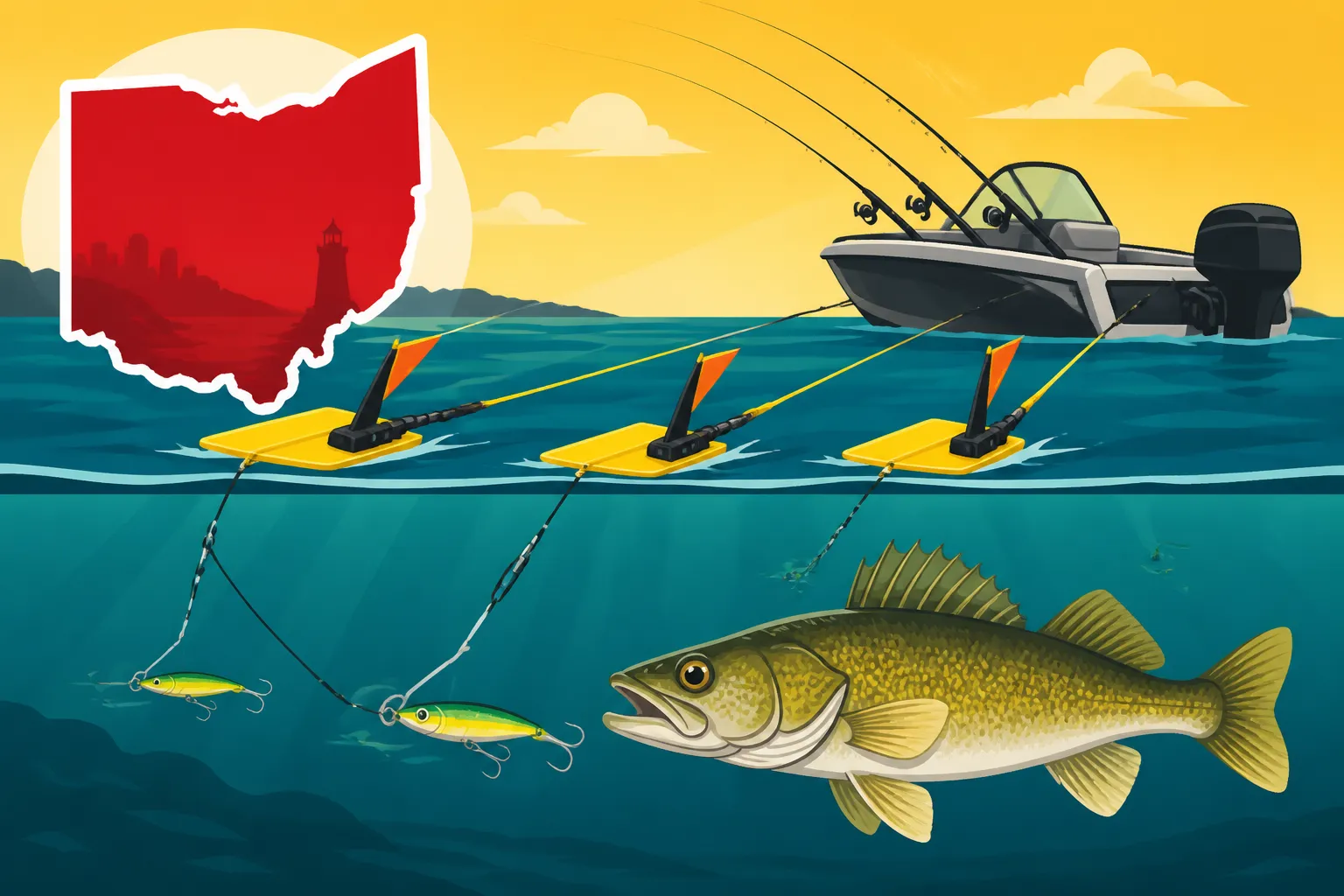
At its heart, a planer board system is designed to take your fishing lines and pull them out to the sides of your boat, effectively creating a much wider "path" that your baits cover. Think of planer boards like small, buoyant kites that "fly" out from your boat, carrying your fishing lines with them. Instead of having all your lures running in a narrow, disturbed lane directly behind your transom, you can now deploy baits dozens of feet, or even yards, to the port and starboard. This means your lures are presented in undisturbed water, away from the boat's engine noise and shadow, making them much more appealing to wary walleye.
This wide spread is crucial for several reasons. Firstly, it allows you to cover significantly more water, increasing your chances of running a bait directly into a walleye’s strike zone. Imagine covering a 100-foot-wide swath of water instead of a 20-foot one – your odds improve dramatically! Secondly, it enables you to run multiple lines without tangling, as each line is deployed at a different distance from the boat and often at a slightly different depth. This ability to run a diverse spread of baits – different colors, sizes, and diving depths – is key to figuring out what the walleye are keying in on that particular day. It transforms your approach from a hopeful poke to a systematic sweep, giving you a distinct advantage in the hunt for those delicious walleye.
Essential Gear for Your Planer Board Setup
Getting into planer board fishing doesn't require reinventing your entire tackle box, but it does necessitate a few specialized pieces of equipment to make the system work efficiently and effectively. Having the right tools for the job will save you headaches on the water and help you put more walleye in the cooler.
Choosing the Right Planer Boards and Masts
When it comes to the boards themselves, you generally have two main categories: in-line planer boards and mast-and-board systems. Each has its pros and cons, and the "best" choice often depends on your boat size, budget, and personal preference for Ohio Trolling Techniques for Lake Erie.
-
In-line Planer Boards: These are individual boards, usually made of foam or plastic, that attach directly to your fishing line via a release clip. Each rod has its own board. They're popular for smaller boats or for anglers who want a simpler setup, as they don't require a mast system. You simply attach the board, let out your desired amount of line and lure, and then deploy the board. They’re great for running 2-4 lines effectively. Brands like Off Shore Tackle's Side Planer are very popular for their reliability and ease of use. However, retrieving a fish often means fighting both the fish and the board, and managing many in-line boards can get a bit chaotic in rough water or when making sharp turns.
-
Mast-and-Board Systems: These systems consist of a tall mast mounted to the front of your boat, from which a main planer line extends out to a large "sea anchor" style board or a pair of larger, more powerful boards. Your individual fishing lines then attach to this main planer line via specialized release clips, allowing you to send multiple lines out from the mast. This setup is generally preferred by serious walleye anglers on larger boats because it allows for a massive spread – sometimes 8, 10, or even 12 lines – without a board on each individual fishing line. This makes fighting fish much simpler, as you only retrieve your fishing line, not the board. The main boards pull extremely hard, so they can handle heavy baits and rough Lake Erie chop. You can often find mast systems and boards designed for this purpose on retailers like Amazon.
When choosing boards, consider their size and buoyancy. Larger boards pull harder and can handle heavier lures or rougher conditions, but they can be more cumbersome to store. Look for durable construction that can withstand the elements, and ensure the release clips (whether integrated or separate) are robust enough to hold your line under trolling tension but release cleanly when a fish strikes.
The Critical Role of Release Clips and Trolling Line
You can have the best planer boards in the world, but without the right release clips, your system won't work. Release clips are the unsung heroes of planer board fishing, designed to hold your fishing line securely as the board pulls it out, yet release effortlessly when a walleye strikes.
-
Release Clips: There's a variety out there, from simple pinch-style clips to adjustable tension models. For Lake Erie walleye, you'll want clips that offer a good grip without damaging your line. Heavy-tension clips are ideal for magnum crankbaits or deep-diving lures where a lot of pressure is exerted. Lighter tension clips are better for subtle presentations or when using monofilament line, which has more stretch. Some clips have a small pin or spring that you can adjust to increase or decrease tension. Experiment to find what works best for your line and lure choices. Many clips now feature a small pin that "locks" the line in place but allows it to run through the clip after a fish hits, keeping the board on the main line (for mast systems) or allowing the in-line board to slide down to a swivel above your lure for easier netting.
-
Trolling Line: Your choice of fishing line is also paramount. Many anglers prefer braided line (like PowerPro or Berkley X5/X9) for their main trolling lines because of its minimal stretch and superior sensitivity, allowing them to detect even the slightest tap from a walleye far behind the boat. The thin diameter of braid also cuts through water better, reducing drag. However, braid can be tough on some release clips, and its lack of stretch means every head shake from a fish is transmitted directly to the rod, potentially tearing hooks. Some anglers prefer monofilament for its stretch, which acts as a shock absorber, especially when fighting fish that bite aggressively far back. A common compromise is to use braided mainline with a 10-20 foot fluorocarbon leader, which offers both sensitivity and invisibility. Ensure your line is strong enough to handle the stress of pulling a board and fighting a decent walleye – generally, 10-20 lb test is a good range for walleye.
Supporting Equipment: Rod Holders and Electronics
Don't underestimate the importance of your supporting cast of gear. They ensure your planer board system operates smoothly and safely.
-
Rod Holders: When you're pulling multiple lines, often with heavy boards, the strain on your rod holders can be substantial. Flimsy holders just won't cut it. Invest in heavy-duty, adjustable rod holders that can securely clamp to your boat and withstand the constant tension. Brands like Bert's Custom Tackle or Fish-On offer robust options that pivot and lock, allowing you to adjust the angle of your rods for optimal line separation and visibility. You'll typically want them angled slightly back and out to create maximum spread.
-
Electronics: While not strictly part of the planer board system, your boat's electronics are indispensable for effective planer board trolling. A reliable fish finder with a good transducer will help you identify baitfish, walleye schools, and underwater structure where fish might be holding. Modern units from Humminbird or Lowrance also offer GPS capabilities, which are crucial for maintaining a consistent trolling speed and track, marking productive waypoints, and returning to areas where you've found fish. Knowing How to Read a Fish Finder for Suspended Walleye becomes even more important when you're covering such a wide area. Autopilots are also a huge advantage, allowing you to maintain a perfectly straight course, which is essential for consistent lure presentation and keeping your boards running true.
Step-by-Step Guide to Setting Up Your Planer Board System
Setting up a planer board system for the first time might seem a little daunting, but with a systematic approach, you'll have it mastered in no time. The key is to think about efficiency and avoiding tangles before you even leave the dock.
Installing the Mast System (If Applicable)
If you've opted for a mast-and-board system, proper installation is your first step. The mast needs to be securely mounted to the bow of your boat, or at least forward of your cockpit, to provide maximum spread and visibility. Most masts come with a base that bolts directly to the boat deck. Ensure you use backing plates for reinforcement, especially if your deck isn't solid fiberglass, to prevent stress cracks from the constant pull of the boards.
- Placement is Key: Position the mast so that its lines have a clear path forward and out to the sides, unobstructed by railings, cleats, or other boat hardware. You want to be able to see your main planer boards clearly from the helm.
- Routing the Main Line: Once the mast is secure, you'll typically run heavy-duty line (often a thick, braided rope designed for this purpose) from the top of the mast to each of your main planer boards. These lines are generally on specialized mast reels, allowing you to deploy and retrieve the main boards. Make sure these lines are free of kinks and are spooled correctly.
- Safety First: When installing, double-check all bolts and connections. These masts take a lot of strain, and the last thing you want is a failure in rough Lake Erie conditions. Consider a safety line for the mast in case of extreme stress.
For those using in-line boards, this step is obviously skipped, as the "mast" is essentially your individual rod.
Deploying and Retrieving Planer Boards with Lines
This is where the magic happens, but it also requires a bit of finesse, especially when you're running multiple lines. The goal is a smooth, tangle-free deployment that gets your baits working quickly.
- Prepare Your Lure/Bait: First, attach your chosen lure or Best Lures for Ohio Fishing bait to your fishing line and let it out to its desired distance behind the boat. This is important because you want your bait to be running correctly before the planer board starts pulling it away. For instance, if you're running a crankbait, let out enough line for it to reach its diving depth, then count out extra line to position it behind the boat. If you’re pulling a crawler harness, let it back a good 50-100 feet.
- Attach the Release Clip: Once your lure is at the desired setback, attach the release clip (either from your in-line board or from your mast system) to your fishing line. Make sure it's clipped securely but not so tightly that it damages the line or prevents proper release.
- Deploy the Board:
- In-line Boards: Gently toss the in-line board into the water, ensuring it floats upright and begins to move away from the boat. As it pulls, slowly feed out more line from your reel, allowing the board to carry your bait further away. Keep an eye on your rod tip – it should have a steady bend from the board's pull.
- Mast Systems: Attach your rod's line to a release clip on the main planer line. Release the clip, and let the clip slide down the main planer line, taking your fishing line and lure with it. The main boards will already be deployed, pulling the main planer line out. You can stagger these clips at various distances on the main planer line to prevent tangles and give each bait a unique presentation.
- Staggering Your Spread: This is crucial for maximizing coverage and minimizing tangles. Don't run all your lines at the same depth or distance. Vary your lure choices, diving depths, and how far back you set your baits. For instance, your innermost lines might run shallower or closer to the boat, while your outermost lines run deeper or further back. This creates a "wall" of baits that walleye are likely to encounter. This strategy is part of mastering Trolling for Lake Erie Walleye.
- Retrieving a Fish: When a fish strikes, the release clip will pop open.
- In-line Boards: The board might slide down your line to a swivel, or it might just hang there. Either way, you'll be fighting the fish and the board. Once the fish is close, either reel the board in by hand or have a deckhand grab it to prevent it from interfering with netting.
- Mast Systems: The release clip will detach, and your fishing line will simply be free. The board and main line remain deployed, making the fight much cleaner. Once the fish is landed, you simply re-clip your line to the main planer line and send it back out.
- Managing Turns: When turning the boat, the lines on the inside of the turn will slow down, and the lines on the outside will speed up. Be mindful of this to avoid tangles. A wider turn is usually better, especially when you have a full spread. If you need to make a sharp turn, consider bringing in your innermost boards briefly.
Adjusting for Conditions: Speed, Wind, and Current
Lake Erie is a dynamic environment, and successful planer board trolling means constantly adapting to the conditions.
- Trolling Speed: Your trolling speed will directly impact how your planer boards run and how your lures perform. Too fast, and your boards might "ski" or dive erratically; too slow, and they might not spread out effectively. The ideal trolling speed for walleye often ranges from 1.0 to 2.5 MPH, but this can vary based on lure type and walleye preference on any given day. Check your lure’s recommendations and observe your rod tips for proper action. Maintaining a consistent speed is key, which is where a good GPS and autopilot come in handy. For more details on optimal speeds, you might want to read Best Trolling Speed for Lake Erie Walleye.
- Wind and Waves: Lake Erie can get rough, and wind and waves play a huge role. In heavy crosswinds, your boards on the downwind side might run faster or higher, while those on the upwind side might lag. You can counteract this by adding weight to the boards on the upwind side or by adjusting your boat's course slightly into the wind. In large waves, your boards will surge and dive; adjust your speed to keep your lures running smoothly without blowing out of the water.
- Current: While Lake Erie doesn't have strong river currents across its entire expanse, localized currents can occur, especially near channels or structure. If you find your boards are not spreading correctly or your lures are not presenting naturally, check for current. You might need to adjust your trolling direction to work with or against the current to maintain optimal lure action.
Mastering the Art of Planer Board Trolling for Walleye
Deploying the boards is one thing; truly mastering them to consistently catch walleye is another. It’s about observation, adjustment, and understanding how your entire system interacts with the fish and the environment.
Reading Your Boards and Detecting Bites
One of the most satisfying parts of planer board fishing is watching your boards and waiting for that tell-tale sign of a bite.
- Visual Cues: Your planer boards are your direct link to your baits. Learn to recognize their normal running behavior. A board that suddenly lags behind, dips erratically, or snaps back often indicates a fish has hit. Sometimes it's a subtle shimmer in the rod tip, other times the board might just disappear under a wave or fall back several feet. Even a slight change in the angle of the main planer line (for mast systems) can signal a bite. Keep your eyes glued to them!
- Rod Tip Indicators: Even with sensitive braided line, a subtle bite from a walleye far out can be hard to detect. Watch your rod tips closely. A quick "thump," a sudden increase in bend, or a rapid relaxation of the tip can all signal a bite. Sometimes a walleye will grab the bait and just hold it, causing the board to simply slow down slightly rather than pop free. This is where Best Rod and Reel Setup for Lake Erie Walleye truly shines, allowing for maximum sensitivity.
- The Unique Fight: When a walleye hits a bait far out on a planer board line, the initial fight can feel different. You've got a long length of line out, and the fish might have quite a bit of run before you even get a solid hookset. Be patient, keep a steady retrieve, and let the rod and drag do their work. It's an exhilarating feeling to finally bring a big Lake Erie walleye to the boat from such a wide spread.
Troubleshooting Common Planer Board Challenges
Let's be real, no fishing system is perfect, and planer boards can present their own unique challenges. Don't get discouraged – most issues have simple solutions.
- Boards Running Erratically or Not Spreading: This is often due to incorrect trolling speed, too much drag from heavy lures, or strong crosswinds. Try adjusting your speed slightly, switching to a more hydrodynamic lure, or adding weight to the board that's struggling. Make sure your board itself isn't damaged or waterlogged. Sometimes, a clogged eyelet on your rod can cause resistance, preventing the line from running freely.
- Lines Tangling: This is perhaps the most frustrating issue. It usually happens during deployment, retrieval, or when making turns.
- Deployment: Always deploy your furthest lines first, then work your way in. This means sending out the line that will run widest, then the next widest, and so on.
- Retrieval: When retrieving a fish, bring in any adjacent lines that might be at risk of tangling. Once the fish is netted, you can redeploy.
- Turns: As mentioned, wide, gradual turns are your friend. If you must make a sharp turn, consider reeling in the innermost lines to prevent them from swinging under the boat and crossing other lines.
- Staggering Depths: Running baits at different depths naturally helps reduce tangles, as a shallow bait won't interfere with a deep bait even if their horizontal positions get close.
- Release Clips Failing or Not Releasing: If clips are failing to hold, they might be worn out, too loose, or not appropriate for the line type/tension you're using. If they're not releasing when a fish hits, they might be set too tight, or the fish might be hitting very lightly. Try adjusting the tension, or replace worn clips. You can find replacement clips and other small tackle items on Amazon, often in multi-packs.
- Safety in Rough Water: Deploying and retrieving boards in choppy Lake Erie conditions can be tricky. Always wear your life jacket. If possible, have a second person assist with board handling to keep hands free and reduce the risk of falling overboard. Don't try to deploy or retrieve if conditions are genuinely unsafe.
Integrating Planer Boards with Other Walleye Tactics
The beauty of planer boards is how they can be integrated into a larger, multi-faceted trolling spread, allowing you to fine-tune your presentation to match exactly what the walleye want.
- Multi-Dimensional Spread: Don't just rely on planer boards for width. Combine them with other depth-control devices. For instance, you could run some lines far out on planer boards with shallow-diving crankbaits. Closer to the boat, you might deploy Ohio Inland Trout Stocking Schedule Dipsy Divers or Jet Divers to get baits down to mid-range depths, and directly off the transom, use downriggers to target fish hugging the bottom or suspended deep. This creates an incredible "grid" of baits at various depths and distances, covering almost every part of the water column.
- Varying Lures and Depths: With a wide planer board spread, you have the opportunity to experiment. Run different color crankbaits, vary your spoon sizes, or even mix in some crawler harnesses across your lines. Pay attention to which baits are getting bit. If one color or depth is consistently outperforming others, you can then switch more of your lines to that successful pattern. This constant adjustment is key to cracking the code on a tough bite.
- Lake Erie Basin Specifics: Remember, Lake Erie has distinct basins, each with its own characteristics. The Western Basin, for example, is shallower and often fished with different tactics than the deeper Central or Eastern Basins. Your planer board strategy might need slight tweaks depending on where you are. For example, in the shallower Western Basin, you might focus more on covering width with crankbaits and crawler harnesses, while in the deeper basins, integrating those downriggers and deeper-diving baits becomes more critical. Always be aware of the specific Lake Erie Fishing Regulations in Ohio for the area you are fishing, as bag and size limits can vary.
Setting up and running planer boards is an investment in time and gear, but the payoff in terms of increased catches and fishing efficiency on Lake Erie is undeniable. It allows you to transform your boat into a walleye-catching machine, covering more water and presenting more baits than ever before. It's a technique that, once mastered, will redefine your walleye fishing experience.
| Feature | In-Line Planer Boards | Mast-and-Board Systems |
|---|---|---|
| Setup Complexity | Simpler, no permanent boat modification needed | Requires mast installation, more involved setup |
| Number of Lines | Typically 2-4 per side, max 8 total | Can run 4-8+ lines per side, up to 12-16 total |
| Retrieval | Fight fish and board simultaneously | Only fight the fish; board remains deployed |
| Boat Size | Excellent for smaller boats (16-20 ft) | Preferred for larger boats (20+ ft) |
| Spread Capability | Good, but limited by board size and number of rods | Superior, can achieve extremely wide spreads |
| Cost (Initial) | Generally lower | Higher due to mast, main boards, and associated gear |
| Visibility | Individual boards can be harder to see from helm | Large main boards are highly visible |
| Rough Water Perf. | Can be challenging to manage and deploy | More stable, designed for heavier conditions |
| Ease of Use | Easier for beginners to grasp initial concept | Steeper learning curve, but more efficient once mastered |
Disclaimer
This article is for general informational purposes only and does not constitute professional advice. Laws, prices and regulations vary by location and change over time. Consult a qualified professional for guidance on your specific situation.