Best Speed for Pulling Crawler Harnesses on Lake Erie
Trolling for Lake Erie walleye with nightcrawler rigs can feel like a game of inches and tenths of a mile per hour. If you drag your harness too slowly, the spinner blade sits dead in the water, sinkers drag bottom, and trash fish tear your bait apart. Go too fast, and the spinner washes out, line twist destroys your leader, and the nightcrawler spins into a useless knot. Finding the exact speed to keep those blades thumpin’ and walleyes biting takes a little finesse, but once you dial it in, it is one of the most lethal techniques on the Great Lakes.
The Ideal Speed Range for Crawler Harnesses on Lake Erie
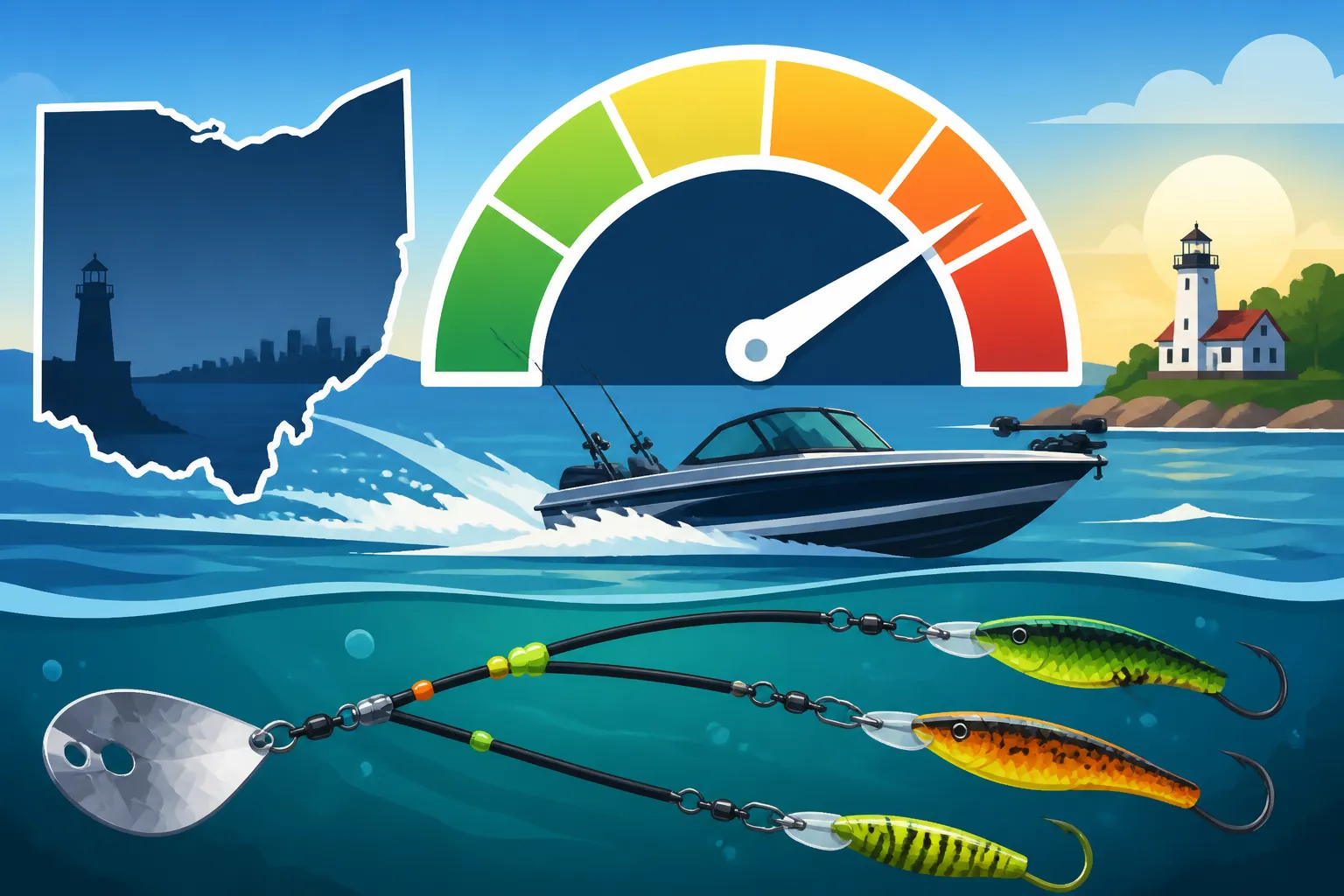
When pulling nightcrawler rigs across the open waters of Lake Erie, speed control is the single most critical variable governing your success. Unlike pulling hard-bodied crankbaits, which often require speeds upwards of 2.0 to 2.5 mph to achieve proper action, crawler harnesses require a lighter touch. For most of the season, your sweet spot will live in a narrow window between 0.9 mph and 1.6 mph.
Finding the right pace isn’t just about putting the boat in gear and letting it roll. It requires a deep understanding of how water resistance affects live bait, how spinner blades thump under pressure, and how walleye feeding behavior shifts from spring through late summer. When you master Trolling for Lake Erie Walleye, you quickly realize that a change of just 0.2 mph can turn an unproductive screen on your depth finder into a cooler full of eater-sized walleyes.
The Magic 1.0 to 1.5 MPH Baseline
If you ask ten veteran charter captains along the Western Basin docks for their go-to speed, nine of them will tell you to start right around 1.2 mph. This baseline offers the perfect compromise between bait presentation and water coverage. At 1.2 mph, almost every common spinner blade style will turn freely without causing excessive torque or line twist.
At this middle-of-the-road pace, a live nightcrawler trails naturally behind the harness hooks, undulating enticingly through the water column. Go down to 0.8 or 0.9 mph, and you risk losing blade rotation entirely, especially if you are pulling heavier cupped blades. On the flip side, pushing past 1.6 mph often causes nightcrawlers to rip off the hooks or stretch out tightly, losing the natural movement that attracts passive fish.
A reliable speed baseline lets you systematically search expansive mud flats off Port Clinton or the reefs around the Bass Islands. If you are setting up your boat with line counter reels, rods, and clip-on weights, picking up a few specialized rigging supplies on Amazon can help you keep your tackle organized so you spend less time untangling lines and more time monitoring your GPS speed over ground.
Water Temperature and Seasonal Adjustments
As water temperatures shift across Lake Erie throughout the fishing season, a walleye’s metabolism fluctuates radically. Matching your trolling speed to the current water temperature is essential to keeping your baits in the strike zone longer.
- Early Spring (45°F to 55°F): Cold water means slow fish. During the early season near river mouths or shorelines, walleyes are sluggish post-spawn. Target speeds of 0.8 to 1.1 mph are ideal. You want a blade that starts spinning at ultra-low speeds, giving cold-water fish plenty of time to track and engulf the presentation.
- Late Spring to Early Summer (56°F to 68°F): As the water warms, walleyes actively feed on emerging baitfish. This is prime time for How to Fish a Crawler Harness for Walleye. Shift your target speed up to 1.1 to 1.3 mph to cover more ground while maintaining a natural live-bait action.
- Mid to Late Summer (69°F and warmer): In peak summer, walleyes migrate deep into Ohio’s Central Basin of Lake Erie seeking cooler water and migrating bait schools. Their metabolism is firing on all cylinders. Increasing your trolling speed to 1.3 to 1.6 mph triggers reaction strikes from aggressive fish suspended in deep water.
Paying close attention to the Best Water Temperature for Ohio Walleye allows you to predict whether you should lean toward the slower or faster end of the harness speed spectrum before you even leave the harbor.
How Blade Types and Sizes Impact Target Speed
Not all spinner blades behave the same way under drag. The shape, cup depth, and overall size of the metal or plastic blade determine how fast you must troll to produce proper rotation and vibration.
Colorado blades are the absolute gold standard for Lake Erie crawler harnesses. They feature a wide, deep cup that catches water easily, allowing them to spin at extremely slow speeds (as low as 0.8 mph). Because they rotate at a wide 60-degree angle from the wire or monofilament leader, they generate immense thump and hydraulic lift. This makes them perfect for slow trolling in dirty or cold water.
Indiana blades sit at a moderate 45-degree angle, offering a blend of flash and vibration. They shine bright at speeds between 1.1 and 1.4 mph. Willow leaf blades are long and slender, rotating close to the leader at a tight 30-degree angle. They produce maximum flash with minimal vibration and low drag resistance, requiring speeds of 1.4 to 1.8 mph to turn properly. If you pull Willow blades too slowly, they simply drag sideways without spinning.
| Blade Style | Optimal Speed | Rotation Angle | Best Seasonal Use |
|---|---|---|---|
| Colorado (#3-#5) | 0.8 – 1.3 mph | 60 Degrees | Early Spring, Cold / Stained Water |
| Indiana (#4-#5) | 1.1 – 1.4 mph | 45 Degrees | Late Spring, Moderate Water Temps |
| Willow (#4-#6) | 1.4 – 1.8 mph | 30 Degrees | Mid to Late Summer, Clear Open Water |
| Plastic / French | 0.6 – 1.2 mph | Variable | Ultra-Slow Cold Water Applications |
Gear and Tactical Adjustments for Speed Control
Trolling effectively at precise speeds below 2.0 mph requires specialized boat control tactics. Open-water winds, wave action, and deep-water currents constantly work against your hull, making simple throttle adjustments on a main outboard motor frustratingly inadequate.
To maintain a steady 1.2 mph glide across Lake Erie’s open water, anglers rely on a combination of trolling motors, secondary kicker engines, and drag-inducing accessories to lock in their speed.
Managing Boat Control with Kickers, Bow-Mounts, and Drift Socks
Relying solely on a large primary outboard to troll slow harness presentations often leads to surging and poor speed control, as large engines are rarely calibrated for sustained sub-2.0 mph operation. Veteran Lake Erie anglers overcome this by using a small gas kicker motor combined with a high-thrust bow-mount electric trolling motor.
The gas kicker provides the main propulsion to push the boat through heavy lake swells, while the bow-mount electric motor acts as an autopilot steering system. By setting the kicker to a steady low throttle and using the bow motor to dial in exact GPS speed adjustments, you gain pinpoint control over your trajectory and pace.
When high winds make even a kicker motor push the boat too fast, deployment of drift socks becomes mandatory. Tying a set of heavy-duty nylon drift socks off the forward or mid-ship cleats creates underwater drag that stabilizes the hull and slows your forward motion down into that crucial 1.0 to 1.3 mph window. If you are rigging your boat for high-wind days, ordering durable drift socks and locking carabiners on Amazon ensures you have the necessary drag equipment on board when sudden Lake Erie squalls build up.
When setting up your trolling spread, using a dedicated Best Rod and Reel Setup for Lake Erie Walleye equipped with smooth drags and clear line counter displays helps ensure that once your speed is locked in, your depth calculations remain 100% accurate across all lines.
Bottom Bouncers vs Inline Weights at Various Speeds
The style of weight you use to sink your crawler harness plays a huge role in how speed impacts your running depth. As trolling speed increases, water resistance against your fishing line creates bow, lifting your bait higher into the water column.
Bottom Bouncing for Lake Erie Walleye is an exceptional technique when fish are pinned close to the lake floor around rocky structures, gravel reefs, or hard mud bottoms. Bottom bouncers feature an L-shaped wire arm with a lead weight cast directly onto the shaft. The long wire feeler ticks along the lake bottom while keeping the harness running roughly 12 to 18 inches higher, clear of zebra mussels and debris.
When fishing bottom bouncers, maintaining a strict 45-degree line angle into the water is crucial. If you troll too fast (over 1.5 mph), the bouncer lifts completely off the bottom, requiring you to let out massive amounts of extra line. If you troll too slowly (under 0.9 mph), the wire drags flat on the bottom, causing snags.
Inline weights—such as keeled sinkers, snap weights, or diving weights—are preferred when targeting suspended walleyes higher in the water column across Ohio’s Western Basin of Lake Erie. Unlike bottom bouncers, inline weights ride cleanly through open water. However, because they rely entirely on speed and weight to dictate depth, increasing your speed from 1.1 mph to 1.4 mph without changing your lead length will cause an inline harness presentation to rise several feet in the water column.
Reading Wave Action and Adjusting SOG vs Speed Through Water
One of the most common mistakes anglers make on Lake Erie is looking strictly at their GPS Speed Over Ground (SOG) reading while ignoring water currents and wave motion. Your GPS tells you how fast your boat is moving relative to a fixed point on Earth, but it does not account for the moving water beneath your boat.
When trolling with the wind and waves (downwind), your hull accelerates over the top of the swells. Your GPS might read 1.2 mph, but as a wave passes beneath your boat, the water current pushes your harness forward faster than the boat is moving, causing the spinner blade to stall out temporarily.
Conversely, trolling into the wind (upwind) forces water against your spinner blades at a higher velocity. Even if your GPS shows 1.2 mph, the effective speed of water passing over your harness might be 1.6 mph or higher. This extra drag lifts inline sinkers high out of the strike zone and can cause nightcrawlers to spin out.
To compensate for wave action:
1. Trolling Downwind: Increase your target GPS speed slightly (e.g., aim for 1.3 to 1.5 mph SOG) to keep tension on the harness wire as waves push the boat forward.
2. Trolling Upwind: Drop your target GPS speed down (e.g., aim for 0.9 to 1.1 mph SOG) to keep from washing out the blades and lifting your baits away from the bottom.
3. Trolling Crosswind: A trolling path perpendicular to wave motion offers the most consistent lure speed, though it requires precise board tracking. Master How to Set Up Planer Boards for Lake Erie Walleye to run wide trolling spreads across side-rolling waves without tangling your outer lines.
Practical Troubleshooting for Lake Erie Trolling
Even when you follow speed recommendations to the letter, real-world fishing conditions on Lake Erie present unexpected challenges. Unlocking the optimal speed on any given morning requires active observation, quick troubleshooting, and an open mind.
Preventing Line Twist, Bait Spinning, and Dragging
If you pull your lines up after a twenty-minute pass and find your leader wound into a tight curly-cue spring or your nightcrawler balling up around the hooks, your speed presentation is out of balance.
Line twist occurs when the torque generated by the rotating blade overcomes the resistance of the leader line, causing the entire harness assembly to spin rather than just the blade on its clevis. To eliminate line twist:
- Upgrade Your Swivels: Always attach your harness leader to your main line using a high-quality ball-bearing swivel rather than a cheap barrel swivel.
- Check Your Clevis: Ensure your spinner blade is mounted on a smooth-operating plastic or brass clevis that spins freely around the leader material without grabbing or binding.
- Inspect Bait Rigging: Thread your nightcrawler cleanly onto the hooks. The nose of the crawler should rest securely on the front hook, and the trailing body should hang perfectly straight down to the back hook. If the worm is bunched up or hooked off-center, it acts like a propeller in the water, spinning continuously even at slow trolling speeds.
If you notice your crawler dragging through mud or coming up covered in algae and zebra mussels, you are either trolling too slowly for the weight size attached, or you have let out too much line. Check your speed gauge, bump your throttle up by 0.2 mph, or reel in 5 to 10 feet of line to lift the bait slightly off the bottom.
Reading Wave Action and Speed Adjustments
Paying attention to how your boat reacts to changing water conditions helps you maintain control over your trolling pattern. When waves build up past two feet, boat speed constantly surges and slows down as the hull climbs and descends wave faces.
During surging conditions, fish often strike right at the precise moment your boat slows down at the crest of a wave or accelerates as it slides down the backside. If you notice that all your bite triggers happen during surging acceleration, it is a clear message from the walleyes: bump your overall trolling baseline speed up across the board.
If bites only occur when the boat stalls out at the crest of a wave, your baseline speed is too fast. Drop your throttle down so your harnesses spend more time coasting in that slow, fluttering strike zone.
Using side-planer boards helps dampen the direct jerk-and-stall motion of the boat hull, providing a smoother drag through the water. If you are wondering Do You Need Planer Boards to Catch Lake Erie Walleye?, the answer becomes obvious on wavy days: planer boards spread your baits away from boat wash noise while smoothing out speed fluctuations across your entire spread.
Step-by-Step Method to Dial In the Daily Speed Pattern
Every day on Lake Erie presents a fresh puzzle. Wind, water clarity, cloud cover, and barometric pressure alter how aggressively walleyes chase down moving live-bait presentations. Rather than guessing at the right pace, follow this systematic approach to lock in the day’s winning speed.
- Start at the Baseline: Begin your first troll pass at a steady 1.2 mph GPS Speed Over Ground, running a mix of blade sizes (such as #4 and #5 Colorado blades) across different depths.
- Stagger Your Spread: Set one side of your boat slightly faster than the other by making wide, sweeping S-turns across the fishing area.
- Observe the S-Turns: As your boat turns in a gradual arc, the lines on the outside of the turn speed up (accelerating to roughly 1.4 to 1.6 mph), while lines on the inside of the turn slow down (dropping to 0.8 to 1.0 mph).
- Note Where Strikes Occur: If the outside boards get crushed every time you make a turn, the walleyes want a faster, reaction-inducing pace. Straighten the boat out and bump your overall throttle speed up to match that outer board pace. If the inside boards take all the hits, drop your speed down immediately.
- Lock in the Speed and Duplicate: Once you get two or three bites at a specific speed, stop experimenting. Adjust your trolling motor, trim your kicker, or deploy drift socks to lock your boat into that exact speed window for the rest of the trip.
By taking a methodical approach to managing your trolling pace, adjusting for water temperature and blade mechanics, and adapting to wave motion on the fly, you can consistently convert slow days on the water into successful trips filled with silver-and-gold Lake Erie walleyes.
Disclaimer
This article is for general informational purposes only and does not constitute professional advice. Laws, prices and regulations vary by location and change over time. Consult a qualified professional for guidance on your specific situation.