Ohio Muskie vs Northern Pike Identification
It's an age-old angler's dilemma here in Ohio: you've landed a long, toothy fish, and in the excitement, your mind races. Is it a magnificent muskie, the "fish of 10,000 casts," or a feisty northern pike? These two apex predators often get mistaken for one another, and understanding the subtle, yet crucial, differences can make all the difference, especially when you consider regulations. This comprehensive guide will equip you with the knowledge to confidently tell an Ohio muskie from an Ohio northern pike every single time.
The Tale of Two Toothies: Why the Confusion Exists
For many anglers, especially those just starting out, the initial glimpse of a long, torpedo-shaped fish with a mouthful of sharp teeth can be exhilarating and, frankly, a bit confusing. Muskie and northern pike share so many superficial similarities that it's easy to see why they're often lumped together. They are both formidable predators, masters of ambush, and key species in many Ohio waterways.
Shared Habitats and Physical Similarities
Both muskie and northern pike belong to the Esocidae family, which is the pike family. This shared lineage means they naturally possess many similar physical characteristics. They both have that distinctive elongated body, a large mouth filled with razor-sharp teeth, and dorsal and anal fins set far back on their bodies, almost perfectly mirrored. These fin placements are adaptations for explosive bursts of speed, allowing them to ambush prey with incredible efficiency. You'll often find them lurking in similar types of cover – weed beds, submerged timber, or along drop-offs – waiting for an unsuspecting meal to swim by. In some Ohio lakes and reservoirs, their territories can even overlap, making identification on the water even trickier. Imagine pulling a fish from a thick weed line that could genuinely be either; the adrenaline certainly doesn't help with critical observation!
Initial Reactions and Misidentifications
The excitement of a catch often leads to quick assumptions. When a large, aggressive fish hits your lure, the primary focus is usually on landing it safely, then perhaps a quick photo, and then deciding whether to keep it or release it. In these moments, it's easy to overlook the subtle clues that differentiate a muskie from a northern pike. Many anglers, myself included in my younger days, have held up what they thought was a giant pike, only to have a more experienced friend gently correct them and point out it was, in fact, a muskie – or vice versa. This isn't just about bragging rights; misidentification can lead to inadvertently violating fishing regulations, which vary significantly between the two species in Ohio. That's why taking a moment to truly observe the fish before making a judgment is so important, even if your hands are shaking with excitement!
Deciphering the Markings: Spotting the Key Differences
The most immediate and often easiest way to differentiate between a muskie and a northern pike in Ohio waters is by looking at their body markings. While both might appear spotted or barred, there are distinct patterns that serve as reliable indicators.
Patterns and Pigmentation
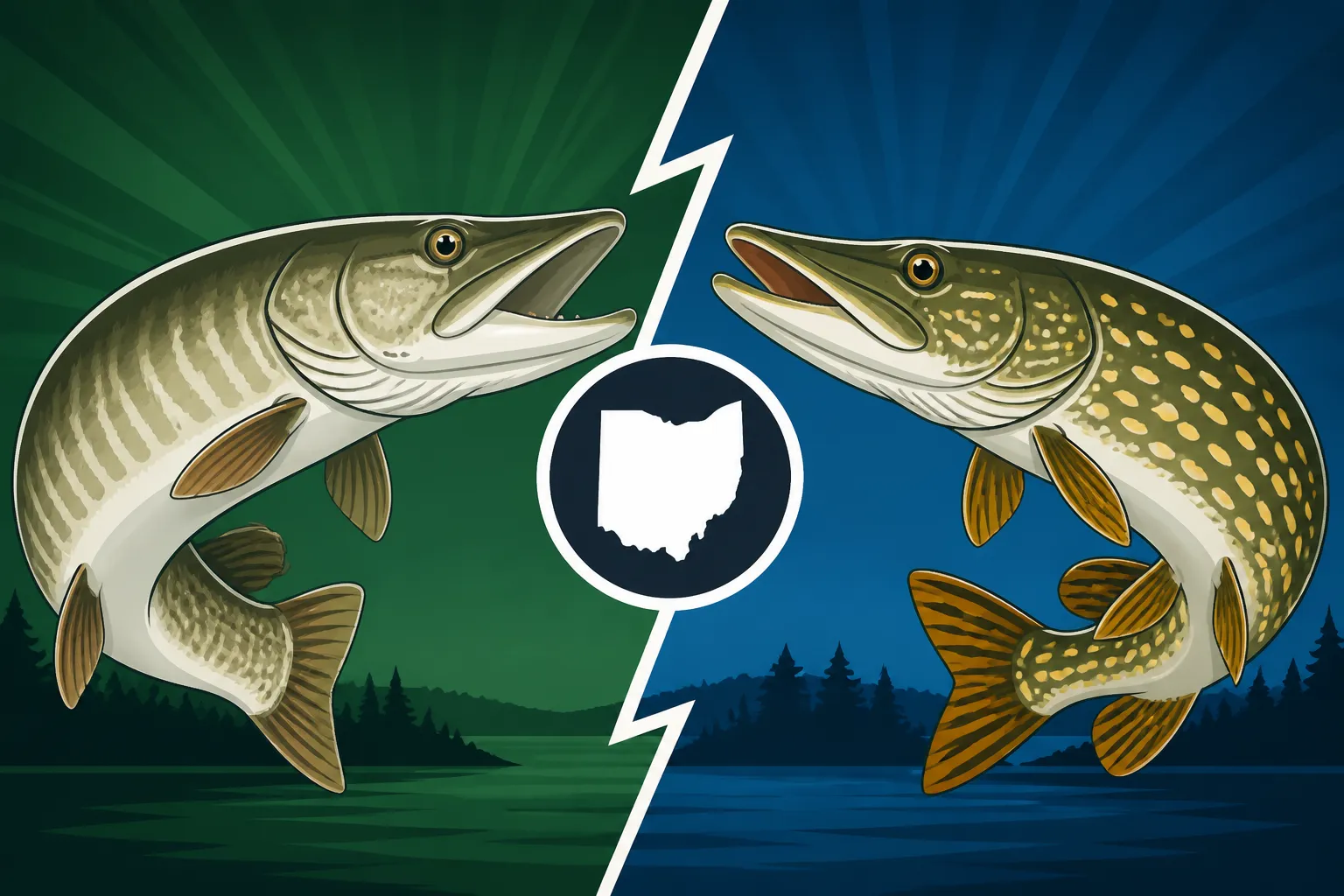
Let's talk about the patterns on their bodies. Northern pike typically have light, bean-shaped or irregular spots on a darker background. Think of it like a dark green or olive canvas with lighter, almost yellowish or cream-colored spots dotted across it. These spots can sometimes merge into horizontal bars, but generally, they retain that distinct light-on-dark appearance. You can often see these markings clearly from a distance, even when the fish is still in the water near your boat or kayak.
Muskie, on the other hand, tend to exhibit the opposite pattern: dark markings on a lighter background. Their bodies usually have a lighter base color, ranging from silver to greenish-gold, adorned with darker, irregular spots, blotches, or vertical bars. Sometimes these markings can be quite subtle, especially on "clear" muskie which appear mostly plain with very faint patterns, but they are always darker than the background color. It's like looking at a pale canvas with dark brushstrokes. This is your first major clue.
Scales on the Cheeks and Gill Covers
This is perhaps the most definitive and foolproof way to tell them apart, requiring a slightly closer look at the fish's head. Both muskie and northern pike have scales on their cheeks and gill covers, but the extent of that scaling is what gives them away.
A northern pike will have scales completely covering its gill covers and at least the upper half of its cheeks. If you run your finger over the gill cover, it will feel rough with scales all the way to the bottom. Similarly, the cheek will be fully scaled, or at least scaled well past the halfway mark towards its jaw.
A muskie, however, tells a different story. They have scales on the upper half of both their cheeks and gill covers, but the lower halves are typically bare or scaleless. This means if you gently feel the bottom half of the gill cover, it will feel smooth. The same goes for the lower half of the cheek. This is a crucial distinction that very rarely fails, making it a go-to identification method for seasoned anglers. You might even carry a compact field guide or refer to a digital one on your phone (if you have service!) to double-check this specific feature, as it's often highlighted as the primary identifier. Amazon offers a variety of waterproof fish identification charts that can be invaluable in these moments.
The Lateral Line: A Subtle Clue
While less pronounced than the scale patterns or gill cover differences, the lateral line can offer another subtle clue. The lateral line is a sensory organ that runs along the side of the fish, detecting vibrations in the water.
On a northern pike, the lateral line is usually quite prominent and often stands out against the lighter spots on its darker body. It tends to be a fairly straight, unbroken line.
With a muskie, the lateral line can sometimes be less distinct or even appear broken or fragmented, especially when compared to the darker markings on its lighter body. It might blend more seamlessly into the overall pattern. While not a standalone identifier, it's another piece of the puzzle that can support your conclusion once you've examined the more critical features.
Fin Details and Body Shape: Beyond the Spots
Beyond the obvious markings and gill cover scales, the fins and overall body shape of these fish offer additional characteristics that can help you distinguish between them. These details might require a keen eye, but they are consistently different once you know what to look for.
Dorsal and Anal Fin Positioning
Both muskie and northern pike are known for having their dorsal and anal fins positioned far back on their bodies, close to the tail. This anatomical feature is common to many ambush predators, allowing for powerful propulsion during a strike. However, there's a slight difference in the number of rays in these fins that can be helpful, although counting fin rays on a live, thrashing fish isn't always practical!
Generally, a muskie will have more rays in both its dorsal and anal fins than a northern pike. Specifically, muskie usually have 12-17 rays in their dorsal fin and 11-15 in their anal fin. Northern pike, in contrast, typically have fewer rays: 7-9 in the dorsal and 8-10 in the anal fin. While you might not be counting rays on the water, you can often visually perceive that the muskie's fins appear slightly larger or more substantial in comparison.
Tail Shape and Caudal Fin Differences
The caudal fin, or tail, of these fish also holds a valuable identification secret. While both have forked tails, the degree of the fork is noticeably different.
Northern pike typically have a more rounded, less pronounced fork in their tail. It’s still a “fork,” but the two lobes tend to be somewhat blunt and less deeply separated. Imagine a gentle curve between the two lobes.
Muskie, on the other hand, boast a much deeper, sharper, and more pointed fork in their caudal fin. The lobes are often more elongated and come to a finer point, creating a more dramatic V-shape. This deeply forked tail contributes to their incredible bursts of speed. When you see a fish with a notably pointed and deeply split tail, your "muskie alert" should definitely go off. This is one of those characteristics that becomes almost instinctive to recognize with practice.
Body Proportions and Build
While individual fish can vary, there are general trends in body proportion and build that can offer clues. Muskie tend to be more slender and elongated in their overall body profile, often appearing more "snake-like." They can reach truly impressive lengths, making them feel like a living torpedo when you're fighting one. If you're looking for a trophy fish, the muskie is often the target, and knowing how to identify them is key. For more on pursuing these giants, check out our Ohio Muskie Fishing Guide.
Northern pike, while still long and streamlined, often appear slightly stockier or more robust for their length. They might have a bit more girth compared to a muskie of similar length, especially around the midsection. They are also powerful fighters, but their maximum size in Ohio generally falls short of a muskie. Of course, this is a generalization, and a very large pike can still be a substantial catch! When considering how big these fish can get, you might want to review How Big Muskie Get in Ohio Lakes versus the general size of pike.
The Mouth and Head: Closer Inspection
Once you've looked at the body and fins, the head and mouth area provide even more specific, telling details that will cement your identification. These are the "up close and personal" features that require careful observation but leave little room for doubt.
Jawline and Snout Shape
The shape of the jaw and snout are very reliable indicators. Northern pike typically have a somewhat duck-bill-shaped snout. Their upper jaw often extends slightly further forward than their lower jaw, creating a flatter, broader appearance. The overall shape of their head can seem a bit more compressed from top to bottom.
Muskie, by contrast, tend to have a more pointed or elongated snout. Their lower jaw usually protrudes beyond the upper jaw, giving them an aggressive, underbite appearance. This gives their mouth a more prominent, almost "meaner" look when viewed from the side. This aggressive jawline is perfect for engulfing prey. It's a subtle but consistent difference that, once you've seen it a few times, becomes easy to spot.
Eye Color and Placement
While not a primary identifier, the eyes can also offer supporting evidence. Northern pike often have eyes that are more golden or yellowish in color, sometimes with black specks. Their eyes tend to be set a bit further forward on their head.
Muskie eyes can vary, but they often appear darker, sometimes with a more reddish or brownish tint. Their eyes can also seem a little more "bug-eyed" or prominent from the side profile, contributing to their intense, predatory gaze. Again, this is a subtle difference, but when combined with the other features, it can help solidify your identification. Always remember to handle these fish with extreme care, especially around their mouths, as those teeth are incredibly sharp! Using specialized long-nose pliers or jaw spreaders (available from retailers like Amazon) is always a good idea for safe hook removal.
Geographic Distribution in Ohio: Where You'll Find Them
Knowing where you're fishing in Ohio can also give you a strong hint about whether you're likely to encounter a muskie or a northern pike. While there can be overlap, certain bodies of water are definitely known for one species more than the other.
Ohio Muskie Strongholds
Ohio is renowned for its fantastic muskie fishing, with several lakes having established, healthy populations. These are often larger reservoirs with ample forage and suitable habitat. Some of the top destinations for anglers targeting muskie include places like Piedmont Lake, Leesville Lake, Salt Fork Lake, and Alum Creek Lake. These lakes are actively managed for muskie, often with stocking programs to maintain the population. You can dive deeper into specific locations in our guide to the Best Ohio Lakes for Muskie Fishing Overall. If you're fishing in one of these known muskie hotspots, your chances of hooking into a true "Esox masquinongy" are significantly higher. Anglers specifically targeting muskie will meticulously research these locations, understanding the nuanced habitats within them to increase their chances of a hook-up.
Ohio Northern Pike Haunts
Northern pike are less widely distributed across Ohio than muskie, but they do have their strongholds. They tend to prefer cooler, weedier waters, often found in smaller lakes, wetlands, and some of the northern Ohio rivers that drain into Lake Erie. While Lake Erie itself has some pike, you might be more likely to encounter them in backwater areas, larger ponds connected to river systems, or certain shallow, marshy lakes. Historically, some areas of northeastern Ohio have been known for their pike populations. Learning about Ohio Northern Pike Range and Habitat can give you a better understanding of where to focus your efforts if pike are your target, or what to expect if you're fishing in their known territory. While not as heavily stocked as muskie, healthy self-sustaining populations of pike exist in the right conditions.
Why Proper Identification Matters for Ohio Anglers
Beyond simply satisfying your curiosity, correctly identifying your catch is critical for several practical reasons for any responsible Ohio angler. It impacts everything from what you can legally do with the fish to how you contribute to conservation efforts.
Understanding Regulations and Limits
This is perhaps the most important reason for accurate identification. Ohio has very specific and often different regulations for muskie and northern pike. For example, muskie typically have a much larger minimum length limit and a smaller daily bag limit compared to northern pike. Imagine the heartbreak and potential legal trouble of keeping what you thought was a legal northern pike, only to find out later it was an undersized muskie! Checking the Ohio Fishing Regulations Every Angler Should Know is paramount before heading out.
Regulations are put in place to protect fish populations and ensure sustainable fishing for future generations. Misidentifying a fish could lead to unintentional poaching, resulting in fines or other penalties. Always consult the official Ohio Department of Natural Resources (ODNR) fishing regulations booklet or website to stay updated on the current rules for both Ohio Muskie Minimum Length Limit on Inland Lakes and Ohio Muskie Daily Bag Limit. It's your responsibility as an angler to know what you've caught and whether it meets the legal requirements.
Conservation and Respect for the Resource
Proper identification also plays a vital role in conservation. Muskie, particularly, are managed as a trophy species in Ohio, and their populations rely heavily on careful management and catch-and-release practices for larger fish. Releasing a muskie unharmed, especially if it's undersized or a trophy, contributes directly to the health of the fishery. Knowing that you're handling a muskie might encourage a quicker release or more cautious handling than if you thought it was a more commonly encountered pike.
Furthermore, accurate reporting by anglers, even if anecdotal, can help fisheries biologists understand populations better. If everyone is misidentifying fish, the data collected can be skewed, potentially leading to less effective management strategies. By taking the time to correctly identify your catch, you're not just being a good angler; you're contributing to the long-term health of Ohio's aquatic ecosystems. Every effort to ensure the vitality of these species helps preserve the thrill of the chase for generations to come.
Muskie vs. Northern Pike: Quick Identification Guide
Here's a handy table summarizing the key differences to help you quickly identify your catch:
| Feature | Muskie (Muskellunge) | Northern Pike (Pike) |
|---|---|---|
| Body Markings | Dark spots/bars on a lighter background | Light spots on a darker background (often bean-shaped) |
| Cheeks | Scaled only on the upper half (lower half bare) | Fully scaled or scaled on more than the upper half |
| Gill Covers | Scaled only on the upper half (lower half bare) | Fully scaled |
| Snout/Jaw | More pointed snout, lower jaw protrudes (underbite) | More duck-bill shaped, upper jaw extends slightly |
| Tail (Caudal Fin) | Deeply forked, pointed lobes | Less deeply forked, more rounded lobes |
| Body Shape | Generally more slender, elongated | Can be slightly stockier for similar length |
| Dorsal/Anal Fin Rays | More rays (Dorsal: 12-17, Anal: 11-15) | Fewer rays (Dorsal: 7-9, Anal: 8-10) |
| Max Size in Ohio | Larger (commonly 30-50+ inches, often over 20 lbs) | Smaller (commonly 20-30 inches, rarely over 15 lbs) |
This table should be a quick reference, but remember, the scaling on the cheeks and gill covers is usually the most reliable differentiator.
Disclaimer
This article is for general informational purposes only and does not constitute professional advice. Laws, prices and regulations vary by location and change over time. Consult a qualified professional for guidance on your specific situation.